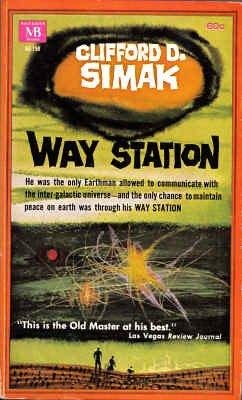
Way Station is about as gentle as a Hugo winner gets, and it’s one of the strangest too, because almost nothing happens in it for a long time and then everything happens in a single evening. Clifford D. Simak ran it in Galaxy in two parts in June and August 1963 under the title Here Gather the Stars, Doubleday put it out as a book later that year, and it took Best Novel at Pacificon II in Oakland in September 1964. Look at what it beat on the 1964 Hugo ballot, though. Heinlein’s Glory Road, Andre Norton’s Witch World, Vonnegut’s Cat’s Cradle, and Dune World, which was the first serial of what became Dune. A farmhouse in Wisconsin won out over Arrakis.
The premise of Way Station is a man who doesn’t age, a house nobody can get into, and a stream of aliens passing through the back room on their way between the stars. That could be a thriller, but Simak writes it like a long walk in the woods, stopping to look at a squirrel or a patch of moss, and the slowness is most of the charm.
The recap below follows the Galaxy serial text, so a few small details may sit slightly differently in the hardcover. Spoilers all the way to the last page.

The man who should be dead
It opens on Gettysburg, the smoke drifting over the dead, with one line about a private named Enoch Wallace still standing there holding a broken musket. Then it jumps a hundred years.
Claude Lewis, a CIA man, is in the office of Dr. Erwin Hardwicke at the National Academy trying to explain something he can’t. Enoch Wallace was born April 22, 1840, near Millville in southwestern Wisconsin, fought with the Iron Brigade at Gettysburg and went down through Virginia under Grant to Appomattox. He’s 124 years old, and he looks about thirty.
Lewis has spent two years on him, posing as a ginseng hunter and drinking moonshine with the Fishers, a coon-hunting, catfishing family down in the river bottoms below the Wallace place. They told him the old story. In 1866 Enoch’s father was thrown in front of the sickle bar of a new mower when the team bolted, and Enoch carried him home, shot both horses where they stood, left them hitched to the mower to rot, and built the coffin in the barn by lantern light. He’s lived alone on the farm ever since and never farmed it again.
Every few years he ships a fistful of diamonds, rubies and emeralds to a New York firm that’s been robbing him blind. He takes four daily papers and a stack of scientific journals, buys bound record books by the dozen and ink by the pint, and never leaves his land.
Enoch lives in a little shed built against the side of the house, with no door through into the house at all. The house itself is wrong. Every surface is slick as glass, so slick a thumbnail just slides off, and the windows are black holes that swallow light and give back no reflection. Out in the orchard there’s a family plot with three headstones. Two are Amanda and Jedediah Wallace. The third is carved in a script nobody on Earth can read, with a figure eight on its side underneath. Lewis dug that grave up. Then he slides the photographs across the desk, and Hardwicke goes white looking at the top one.
Station 18327
Now we get Enoch’s side. A message machine whistles, a traveler from Thuban VI is coming in and needs a No. 3 liquid tank, and Enoch rolls it into place under the materializer like a man who’s done it ten thousand times.
Here’s how it started. Not long after his father’s funeral he was sitting on his porch steps watching a thunderhead build over the Iowa hills, when a gangly, dusty stranger came up the path asking for water. The stranger had walked a long way and wasn’t sweating. They sat on the steps, Enoch admitted he’d sometimes wondered if the stars had people on them, and the stranger’s face split and peeled away just as the storm broke, showing something underneath with a bald head, flat pointed ears and coloring like war paint on a clown. It had no name, so Enoch gave it one. He remembered General Grant sitting on a fence rail whittling while the cannonballs went over, and called the alien Ulysses.
Over ham and eggs and coffee (Ulysses is the only alien in the galaxy who likes coffee) the deal got laid out. Galactic Central needs a stopover on Earth for travelers moving star to star. Ulysses compared it to the railroad coming to Millville, a station on a new line, except nobody on Earth gets to buy a ticket. The alien crew gutted the house down to one big room with the machinery reaching up into where the second floor used to be, kept the old fireplace because Enoch insisted, and sealed the outside so nothing human can scratch it. Travelers are sent as a pattern and rebuilt at the next station, which leaves a dead body behind in the tank every time.
The catch is time. Enoch doesn’t age at all inside the station. He only ages when he steps outside, about an hour a day for his walk down to the mailbox, a few minutes more for the garden or a sunset on the porch. That’s why the neighbors have watched him stay thirty for a century.

A walk, a mailman and a chart that says war
Enoch takes the same walk every day with a rifle under his arm, out to the rock above the Wisconsin River and back up to the spring. This morning he finds Lucy Fisher, the deaf-mute daughter of Hank Fisher, holding a butterfly with a crumpled wing on one fingertip. He watches the wing straighten out and the dust come back onto it, and then it flies off. They’ve been friends since she was a wild little thing of ten, two loners who never try to explain their private worlds to each other.
At the mailbox old Winslowe Grant pulls up in his jalopy. He’s the only person Enoch really talks to. He mentions that the ginseng man is back and he doesn’t believe the man is hunting ginseng, and then he hands over a present, a foot-tall carving of Enoch walking into a hard wind, whittled from one of the strange woods Enoch keeps giving him. Winslowe has never asked where the wood comes from. Which, to Enoch, is pretty much what friendship means. There’s a letter too, from an editor at Nature in London, politely wondering how the same man has been their subscriber for more than eighty years. Somebody else is noticing.
Back inside, the Thuban turns out to be a blob that flattens and balls up in its tank, and it’s brought him a block of black wood, because word has got around the galaxy that this keeper collects wood.
For ten years he’s been working a chart using the Mizar system of statistics, feeding in Earth’s birth rate, death rate, currencies, church attendance, the auction price of art, the incidence of insanity, everything. He’d hoped it would show a way to keep the peace. Every time he runs it, it says war. The Times on his desk has a story about yet another peace conference nobody expects to work.
Then come the shadow people. Mary appears on his sofa in 1860s hoop skirts, and David Ransome leans on the mantel in Union blue with a sabre and a big black mustache, the officer Enoch always wished he’d been. He conjured them himself around fifty years earlier with techniques from the thaumaturgists of Alphard XXII, and they look solid until you try to touch them. Mary is pieced together from Sally Brown down the road and a proud Southern woman he once glimpsed on a plantation portico as his column marched past. Tonight David snaps. They’re illusions made to keep Enoch company, he says, and Enoch made them too human to stand it. He leaves. Then Mary tells Enoch she’s in love with him, and he tells her he’s loved her since the first day, and they both know that’s the end of it, because he can never touch her. She disappears and won’t come back.
The Hazers and the empty grave
The next arrival is a Vegan from Vega XXI. Enoch calls them Hazers, because they walk around inside a sparkling golden haze. The first five came through on July 12, 1915, on their way to an art festival, spread a picnic on his table, and left him twelve bottles that look carved from diamond and an ivory music box holding 206 compositions of sound, color, scent and feeling.
Years later an old Hazer philosopher died mid-story on Enoch’s floor, and the golden haze flickered out and left a bag of bones and scaly parchment behind. Galactic Central told him Vegan law says a Vegan stays where he falls and gets buried by local custom. The Vegans already knew he was dead. So Enoch got the oak boards down from the haymow, built a coffin by lantern light in the same barn where he’d built his father’s, dug a grave beside his parents, read from John 14 (in my Father’s house are many mansions) as the sky went pink, and carved a headstone in the Vegan language saying the dead Vegan wasn’t a stranger to this soil, because in death he belonged to the universe. That’s the grave Lewis dug up.
Before Ulysses arrives, Lucy comes running up the field with her back shredded and bleeding, and on instinct Enoch carries her into the station, the first human but him ever to cross the threshold. Hank and his son Roy show up with a bullwhip. Roy had been training his coon-hound pup, Butcher, on a raccoon staked to a tree, Lucy tried to stop it, and she locked both the dog and her brother up rigid without touching them. Hank whipped her for being a witch until she struck him blind and ran. Now he goes at the door with Enoch’s own axe, which bounces off and nearly takes his leg, then at the window, which shatters the axe.
Inside, Lucy has picked up a gift Enoch never figured out, a little pyramid of colored spheres, and set every sphere spinning and glowing. She did in one try what he never managed in years.
Ulysses arrives with bad news. The Vegan’s body is gone from the grave, the Vegans know, and they kept quiet for Earth’s sake until a faction in the galaxy got hold of the story. That faction wants Galactic Central’s expansion to head for the globular clusters instead of out into this spiral arm, and a planet so barbaric it robs the graves of honored dead is just the argument they need. The Earth station will probably close. Enoch can stay on Earth and age normally, or take another station somewhere else. A Vegan diplomat delivers the formal protest, gently, and notices that Enoch’s Vegan inscription has two spelling mistakes and one awkward phrase. He tells Enoch that what matters is that he wrote it thinking like a Vegan.
Enoch walks Lucy home down the hill. Lewis is sitting at the Fishers’ supper table. Enoch warns Hank that if he raises his hand to Lucy again he’ll see exactly how much devil is in Enoch Wallace, then takes Lewis outside. The body is in Washington. Lewis agrees to fly it back within about a day.
The Talisman and the choice
Ulysses has two more bombs. The Talisman, built by a mystic ten thousand years ago and the only way the galaxy’s peoples can touch the universal spiritual force, has gone missing. It only works in the hands of a sensitive, perhaps one in many billions, and without it the galaxy is coming apart at the seams the way Earth is. And there’s a way to stop Earth’s war, if Enoch applies for it as Earth’s representative. It leaves a whole people unable to understand or run their own technology for several generations, back to the wheel and lever until it wears off. Ulysses calls it stupidity, and says it’s only offered to races worth saving.
Enoch goes down to the basement rifle range the aliens built him, where a projection drops him on an alien hillside against skull-faced wolves, one-eyed toads and a black balloon striding over the trees on stilts. He kills everything, but the score tape says he missed his very first shot. In the Hazer’s trunk he finds letters saying the Talisman had been badly served by a weak custodian for ages before it ever vanished. The rot started long before the theft, and Ulysses never mentioned that part.
Without quite deciding it, Enoch starts packing. Journals, diamond bottles, the music box. He crumples his war chart into the wastebasket.
Then the official materializer, the one only Galactic Central uses, chuckles into life, and out steps a sleek dark rat-like creature that walks upright, draws a weapon, and aims it at the station’s control complex. Enoch throws the nearest thing he has, a slowly growing gift-rock he calls the Pet, and knocks the creature into the wall. They grapple, and the creature hits him with a stench so foul it doubles him over retching, says the word that opens the door and runs for the woods. Enoch grabs his rifle and follows as the sun goes down.
The creature holes up in the boulders at the top of a slope and fires a laser that slices a birch clump in half. Lucy appears in the woods, ignores Enoch’s frantic waving, and circles up the hill. Ulysses arrives out of nowhere, pins Enoch flat, and whispers that the creature has the Talisman. Then they see two figures wrestling on top of the rocks against the sky. Lucy has jumped it with a dead branch. Ulysses tells Enoch to shoot. Enoch is thinking about the shot he missed on the range. He fires anyway, and takes off half the creature’s head.
A soft light starts moving down the rocks. It’s Lucy, carrying the Talisman, and it’s glowing brighter than Ulysses has ever seen it. She’s the custodian they’ve been searching the galaxy for.
Back at the station Winslowe comes running to say Hank has whipped up a mob in town and two carloads are coming, and that he’s slowed them down by dumping two pounds of roofing nails in the lane. Lewis is waiting in the yard with the Vegan’s body in a panel truck, and Ulysses asks for the honor of carrying it to the grave himself. The mob comes padding up the road in the dark, Lucy pulls the Talisman out of its bag and holds it up, and a total peace rolls out over the yard. The men melt back into the night, except Hank, who bolts down the hill howling with terror. Winslowe says Hank is mostly scared of himself.
They rebury the Vegan by moonlight. Then Enoch asks Ulysses if they can borrow Lucy for a day or two before she leaves for Galactic Central, and asks Lewis whether the Secretary of State might put a deaf-mute girl from the river bottoms on the American delegation to that peace conference. Lewis thinks he can manage it. Ulysses says he’ll sit in on the meeting, and that Earth had better start putting together a world committee, since the galaxy can’t take its custodian from a planet that isn’t a member.
Enoch walks down to the cliff over the river, looks at the dead alien among the rocks, and throws his rifle into the Wisconsin. Back at the station there’s one more scene. Mary comes back, and this time she touches his arm and it’s real, because the spinning pyramid Lucy switched on turns out to be a gift from the Alphard system that makes illusions solid. And it still doesn’t work. A doll that comes to life is still a doll, she tells him. She smashes the pyramid against the fireplace and is gone for good. Enoch says goodbye, sits down, opens his journal and gets back to work.
The people in it
Enoch is a nineteenth-century farm boy who’s spent a hundred years learning galactic sign language and alien math, and he’s still a man of Earth who needs his walk and his sun and his river. Throwing the rifle away is his whole arc in one gesture, from a boy given his first rifle at twelve, through four years of war and a century of target practice, to the man who finally doesn’t need it.
Ulysses is one of the best aliens of the era. He looks like a cruel clown, drinks coffee by the pot, and calls Enoch “my brother” for the first time on that dark hillside. Lucy hardly gets a line because she can’t speak, and she’s still the most powerful person in the book. Winslowe and his roofing nails are pure Simak, a kind old man in a small place doing the decent thing without asking why. And Mary is the saddest character on the whole early Hugo list.
Why it won, and why it holds up
The SF Encyclopedia’s Simak entry makes the point that Simak was born in Millville, Wisconsin, in 1904, worked at the Minneapolis Star for decades, and kept bringing aliens home to rural Wisconsin. Way Station is that habit at full strength, and plenty of readers call it the high point of pastoral science fiction. Most early Hugo winners are clever. The Demolished Man is a puzzle box and Glory Road is a swashbuckler. This one is kind, and in 1963, with fallout shelters going into back yards, a book saying the galaxy might save us if we could just stop being afraid of ourselves clearly hit a nerve.
Ulysses’s “stupidity” cure is the part that stays with you. Two years before, A Canticle for Leibowitz took the Hugo with a world that knocked itself back to the dark ages after the bombs fell. Simak offers the same reset as a medicine you could ask for ahead of time, and his hero won’t take it. The quiet first contact runs straight through to Close Encounters of the Third Kind, aliens as people you sit down and talk to, not invaders.
It’s not perfect. The Talisman ending is a deus ex machina, no way around it. One lucky shot, one girl who happens to be the right one in billions, and every problem from the grave robbery to nuclear war gets solved in a night. You can see how hard Simak worked to set it up, though. The butterfly, the paralyzed dog, the pyramid she switches on at the first touch.
It has never been filmed. Revelstone optioned it back in 2004, and in 2019 Netflix announced it was developing a version through Matt Reeves’s company, 6th & Idaho. Meanwhile the original two-part serial is still sitting in the June 1963 issue of Galaxy on the Internet Archive, Wood illustrations and all. Up on that cliff, with the rifle gone into the river, Enoch decides the secret of the universe is “a thing that went on caring,” and the book was carrying that idea long before he says it.
