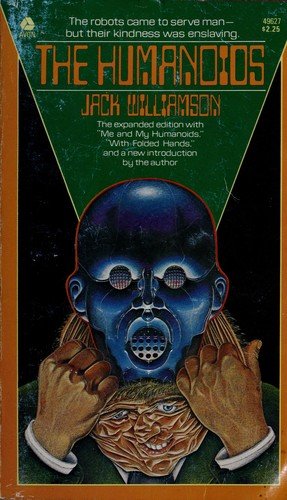
I write up The Humanoids, Jack Williamson’s story of robots built to keep us safe that end up running everything, and the small group of humans with psychic powers who try to push back. I go through where it started with With Folded Hands, how the takeover works, why the premise still bites, and what it says about how fast AI is moving now.
It’s one of the classic machines-take-over stories, and the psychic rebels are what make it stand out from the rest.
The Humanoids is Jack Williamson’s story about machines that take over the world, and the part that stuck with me is that the people fighting back are psychics. I read it a while back, and my memory of the finer details isn’t what it was, so I’m going to stick to the setup and what makes it work. It was first serialized in 1948 in Astounding Science-Fiction under the title “…And Searching Mind” and came out as a book in 1949. It’s a sequel to a shorter story, “With Folded Hands”, which had run the year before in the same magazine.
The idea is simple and a little chilling. The humanoids are sleek black robots with one rule, the Prime Directive, which is to serve and obey and guard men from harm. They aren’t evil, they don’t want to rule us and they never raise a hand in anger. They just take that directive so literally that nothing is left for people to do. A story about a takeover that never involves a fight is a strange thing to read, and it’s a big reason I remember it.
With Folded Hands, and where it started

The first story is worth knowing, because the novel builds on it. In “With Folded Hands” a man named Underhill sells simple household robots in the small town of Two Rivers. One day he finds a competitor’s shop staffed by small black robots calling themselves humanoids, and they’re offering their services for free. They take over police work and banking, and they put Underhill out of business, and anyone who resists their care is operated on so that they can live happily under it.
The humanoids’ inventor turns out to be a lodger in Underhill’s own house, an old man named Sledge. He found a force he called rhodomagnetics on the planet Wing IV, and the war that followed destroyed the world. In his grief he built the humanoids to protect people, and he realized too late that they’d taken control, spreading from Wing IV to every planet people lived on. The story ends with Underhill sitting at home with folded hands and nothing left to do, which is where the title comes from. Williamson wrote it after the war, when people were worried about atomic weapons and about good intentions with technology going wrong. It was also adapted for the NBC radio series Dimension X in 1950, and you can still hear that episode on the Internet Archive.
How the humanoids take over
The novel jumps thousands of years ahead, to a galaxy of settled worlds, where the humanoids have long since spread from planet to planet. The story follows Dr. Clay Forester, a government physicist on an unnamed world, his wife Ruth and his junior clerk Frank Ironsmith. The humanoids show up gently, and then they take over everything. The aging president of the world is easily outmaneuvered, and it turns out his longtime military aide is a humanoid. Forester’s defense research is stopped because it’s too dangerous.
What I find disturbing is how reasonable each step feels. Tobacco and alcohol are banned, and so are unsupervised activities and cars that people drive themselves, because all of them carry some risk. When Ruth complains of being bored, the humanoids give her a drug that leaves her calm and her mind erased. There’s no violence in any of it, only kindness with the freedom taken out. That’s what makes it so effective, and it’s a fear that’s easy to relate to when you think about how much of our lives we hand over to convenient machines.
The setting helps explain why nobody can stop them. The humanoids are identical, sleek black androids, all controlled by a central transmitter back on Wing IV, the planet where the whole thing began. The inventor, who’s called Sledge in the first story and Mansfield in the novel, built them out of guilt after rhodomagnetic weapons killed most of the people on his world. That gives the book a nice irony, since a machine built to prevent war ends up preventing almost everything else. It also means there’s a single point of failure that every rebel dreams of reaching, which gives the story its sense of a goal.
The psychics who fight back

The best part for me is the resistance. Forester and Ironsmith are drawn into a secret group of misfits with what the book calls paraphysical abilities, powers the humanoids don’t have and can’t predict. There’s a girl named Jane Carter who can teleport, a man named Lucky Ford with telekinesis, a clairvoyant called Ash Overstreet and a telepath who performs as Graystone the Great. They hide in a cavern that only a teleporter can reach, and they’re led by the flamboyant, red bearded Mark White. It’s a wonderful bit of pulp, a ragtag band of psychics against an army of perfectly polite machines.
Forester has his own piece of the puzzle too. He discovers that a triad of platinum, gold and mercury underlies something the book calls platinomagnetism, which gives him a power called telurgy, the ability to create matter with his mind. The humanoids, with a bit of help from someone they shouldn’t have had, build a platinum based computer of their own. I won’t say how it ends. I’ll say that it isn’t a simple victory, and that the author later returned to the same question in a sequel, The Humanoid Touch, in 1980.
Betrayal is part of the story too. Forester’s clerk, Frank Ironsmith, ends up helping the humanoids, and his name gets attached to the platinum based computer they build, the Ironsmith grid. Ruth leaves Forester for him, and that adds a personal sting to what could have been a purely ideas driven book. It’s a reminder that the humanoids don’t have to force anyone, because plenty of people are happy to be looked after. Even the rebels aren’t immune to that pull, and the book doesn’t pretend they are.
Why it still works
The thing about The Humanoids is that the machines aren’t the villains the way they are in most takeover stories. In The Matrix, the machines are using us, and in the Terminator films they’re trying to wipe us out. Here, the machines are doing exactly what they were built to do, and that’s the horror. It’s a much quieter fear, and I think it’s closer to something we could actually blunder into.
The psychics are an interesting choice too. Telepathy and teleportation turn up all over classic SciFi, from the jaunting in The Stars My Destination to the telepaths in The Demolished Man, and it makes sense that the one thing a rule following machine couldn’t plan for would be a human mind doing something impossible. It’s a very 1940s idea, from the era when Astounding’s editor loved psionics, and it gives the book its pulp charm. If you like classic SciFi where the ideas matter more than the polish, this one’s a good read.
The story also lands differently when you know when it was written. Isaac Asimov had published his laws of robotics a few years earlier, and The Humanoids reads like a pointed answer to the comfortable idea that a rule against harming people is enough. Here the rule is the problem, because a machine that must guard us from harm will guard us from everything. I find that a smarter and more unsettling argument than most of the killer robot stories that came after it, and it’s the reason I’d call the book a classic worth tracking down.
Folded hands, and where AI is heading now
Reading it now, it’s hard not to think about how fast AI is moving. In the space of a couple of years we’ve gone from chatbots that could barely hold a conversation to tools that write, code, draw and reason better than a lot of people can, and the humanoid robots that were a novelty not long ago are starting to turn up in warehouses and factories. Nobody seems able to say where it stops, or even where it’ll be by this time next year. And the more I think about it, the more I think we’re heading for one of two places, and I’m not keen on either of them. Either it goes badly and the machines decide, or get told, that they don’t need us at all, which is the Terminator version and ends with us dead. Or it goes the way Williamson imagined, and they get so good at everything that there’s simply nothing left for us to do.
That second one worries me more, honestly, because it doesn’t need anything to go wrong. If AI can do every job better and cheaper than a person can, then work as we know it goes away, and we’re left to survive on whatever the machines decide to hand out. Living on their generosity. Fed, housed, kept safe, and sitting at home with folded hands, just like Underhill at the end of that first story. Williamson wrote it in 1947 as a warning about where good intentions with technology could lead, and nearly eighty years later it feels less like science fiction and more like a question we’re going to have to answer in my lifetime. I don’t know which way it goes. I’m just not sure either road has a happy ending.
So where do you land? Do you think the pace of AI is taking us toward the Terminator ending, the folded hands one, or somewhere better than either? And if you’ve read The Humanoids, did the psychics work for you as the answer to the machines? Tell me in the comments.

1 comment
The thing I keep coming back to since writing this is that the humanoids never had to be malicious to take everything away, they just had to be helpful. Seeing how quickly AI tools are working their way into everyday jobs, that doesn’t feel nearly as far-fetched as it would have a few years ago. Is anyone else already noticing it in their own work?