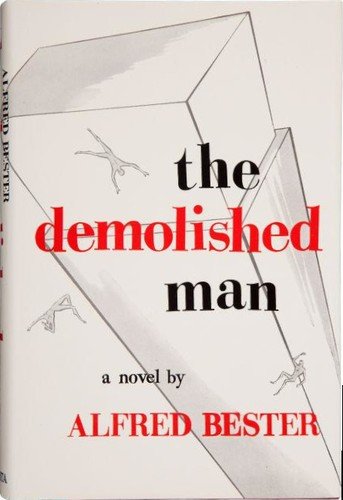
The Demolished Man by Alfred Bester won the first Hugo Award for Best Novel ever handed out, in 1953, and that’s a heck of a way to start a list. It’s a murder mystery with the whodunit surgically removed. You watch Ben Reich plan a killing, commit it, and spend the rest of the book being chased by the one cop who can’t be fooled, and the tension comes from how, not who.
The setup is the clever part. It’s the year 2301 and about one in ten people are Espers, telepaths ranked by strength, who can read a mind and hear the crime forming before it happens. Murder has basically stopped. Nobody’s been “demolished” in generations, which is the society’s word for the punishment, the total dismantling and rebuilding of a personality, and in this world that is the death penalty. So Reich, who runs a giant trading house called Monarch and is being crushed by his rival Craye D’Courtney, sets out to do the impossible: kill D’Courtney and keep it out of the heads of every telepath on the planet.
How you hide a murder from mind readers
Reich’s first move is to get an Esper on his payroll, and his second is to buy a jingle. Duffy Wyg&, who writes the catchiest ear-worm songs in the solar system, gives him “Tenser, said the Tensor”, a rhyme so sticky that it floods his thoughts and works as noise a telepath can’t see through. It’s a great idea, one of those inventions you want to steal, and it’s also just funny, a murder shielded by a commercial jingle.

Then there’s Lincoln Powell, the Esper prefect of police, and honestly he’s the more interesting of the two. Powell is warm, a little smug, and he can read anybody, yet he still has to build a case a court will accept, because a telepath’s word isn’t evidence. That gap is where the book lives. He knows, and he can’t prove it, and Reich knows he knows. And Reich is haunted, too, by a recurring dream of a faceless man, which Bester uses to make a rich, cold murderer into someone you almost feel for, even while he’s being awful to everyone around him.
The book looks different on the page
Bester was a magazine guy, he’d written for Astounding and for comics and radio, and it shows in how he thinks about a page. When Espers talk to each other the text gets weird. Lines run in columns, words stack and overlap, a whole conversation arrives in scattered typography that’s meant to look like minds bleeding into one another. It’s 1952 and he’s already doing what the New Wave would get credit for a decade and a half later. The novel first ran in three parts in Galaxy magazine in early 1952, before the book came out in 1953, and you can feel that Galaxy energy, fast, cynical, a bit showy, aimed at grown-ups.
For the record, the Hugo wasn’t a fluke. Bester’s own entry in the Science Fiction Encyclopedia calls this book and his next one genuine classics of the genre, and the 1953 Hugo record shows it took the very first Best Novel trophy. The 1950s were full of gee-whiz rocket stories, and this was a crime novel about guilt that happened to use SF as machinery.
What it did for the genre
Telepathy was already a well-worn idea by then, so it’s fair to ask what’s new, and the answer is that Bester treats it as a legal and social problem instead of a superpower. If crime can be read out of your head, what happens to privacy, to trial by evidence, to punishment? The Encyclopedia’s entry on telepathy shows how many SF writers wrestled with that, and Bester got there early and got there with style. You can draw a line from here to precrime stories like Minority Report, and it’s hard to miss that Babylon 5 named its ruthless psi-cop character Bester, which is a very deliberate hat tip.
If you want the other side of the coin, read what Bester did next in The Stars My Destination, a revenge story with the same crackling prose but a wilder vision. And if you’re working your way up through the early Hugos, the 1961 winner, A Canticle for Leibowitz, is about as far from Bester’s neon city as SF gets, and both are fantastic. It also makes an interesting pairing with Heinlein’s Starship Troopers, which took the Hugo in 1960, because the two show how wide the field already was.
The ending, and whether it holds up
Spoilers from here. Powell corners Reich, and Reich is demolished, the personality torn down and rebuilt, and Bester makes the argument that this is mercy instead of death, that the man gets to come back and be something better. It reads as either lovely or chilling depending on your mood, and I’d say that’s the point. The faceless man from Reich’s dreams pays off too, and it lands harder than the plot mechanics deserve.
Does it hold up? The prose does, the jingle trick does, the ideas about mind-reading and law do. Some of the gender and class stuff is very 1950s, and the pace is breakneck to the point where a couple of scenes feel skipped. But as a first Hugo winner it set a high bar, and it’s still a fast, weird, stylish read that a lot of later science fiction quietly borrowed from.
