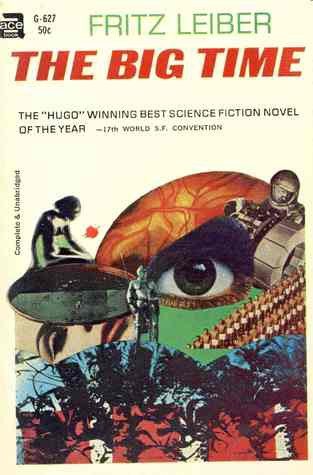
The Big Time is a time-travel war novel where you never see a single battle. Fritz Leiber took the biggest idea going, two secret powers rewriting history across billions of years, and shoved it all into one room with a handful of people, a piano, and a bomb. It ran in Galaxy in March and April of 1958, got its first book printing from Ace in 1961, and took the 1958 Hugo for Best Novel at Solacon in South Gate, California. I haven’t read this one, so this is a walk through the story and not a review, and I’m going to give you the whole thing, ending included, because the way it plays out is the point.
The war is called the Change War. Two sides, the Spiders and the Snakes, send agents back and forward through time to alter history in their favour, and every change blows “Change Winds” up and down the timeline, rewriting lives and killing people who just happen to be standing in the way. Nobody in the story knows who the Spiders and Snakes actually are. Everybody they recruit has been pulled out of their own life just before they’d have died, patched up as a “Demon,” and put to work.

The Place
Our narrator is Greta Forzane, a Chicago girl of Scandinavian parents who describes herself as twenty-nine and a party girl. She was recruited ten minutes before dying on North Clark Street, and her great love, Dave, died fighting Franco in Spain years before that. She now works as an Entertainer at a recuperation station called the Place, which floats outside space, time and the universe, in a gray nothing the book calls the Void. The Place is a cross between a big nightclub and a small zeppelin hangar. Soldiers come through its Door after operations in the past and future, and the Entertainers’ job is to nurse them back to sanity and send them out again. Sleeping there means two nightmares every time you lie down.
It’s kept alive by two gadgets, the Major Maintainer and the Minor Maintainer, which look like portable radios with extra dials. The Minor one handles air, gravity and the little stuff. The Major one keeps the walls from buckling and the Place tied to the cosmos, and it has an Introversion switch that nobody touches, because Introverting a Place cuts it off from everything and the Spider high command can never rescue it.
Greta works with five other Entertainers, all from wildly different eras. Sid Lessingham runs the Place, a fat bearded Elizabethan from King’s Lynn who talks in thees and thous and swears he knew Shakespeare. Beau (Beauregard Lassiter) is a gambler from a Mississippi that never had Grant’s gunboats, and he plays the piano. Doc is a Russian physician and a hopeless drunk who spent his last months in a Nazi salt mine and says “nichevo” when nothing matters. Maud Davies is a Ganymede-born woman of the 23rd century, fifty-odd years old and still looking about nineteen. And Lili Foster is the new girl, an English woman who’s been through the Twenties. There’s a tradition that the new girl always gets called Lili, and in her case it happens to be her real name.
Three hussars and a left-handed glove
The book opens as three Soldiers come through the Door dressed as black hussars with white skulls on their shakos. Erich von Hohenwald is a Wehrmacht lieutenant who fell at Narvik, and he’s Greta’s lover, a cocky, scarred, openly Nazi commandant that she loves and loathes in equal parts. Mark is a Roman legate, Marcus Vipsaius Niger, who died fighting the Parthians at the Battle of Alexandria in 10 A.D. And the new boy is Bruce Marchant, an English poet and lieutenant pulled out of the mud at Passchendaele in 1917.
They’ve just bolted from Saint Petersburg in 1883, where they tried to kidnap the infant Einstein back from the Snakes and ran into a trap. Bruce is furious at Erich for pulling them out of it, they trade insults, and next thing there are sabres out and Bruce has a cut on his cheek until Sid switches off gravity and leaves them both floating.
Then comes the glove. Bruce rages about the Spider Issue gauntlets he’s been given, which are both left hands, and the whole room laughs at him. That’s the joke that’s about to turn into the clue the whole book hangs on. Lili, who has read his poetry “I don’t know how many times” and thinks he’s the greatest voice of his generation, steps up and puts a perfectly fitted right-hand glove on him. Nobody asks where she got it.
Bruce uses the next ten minutes to explain what’s wrong with the war. The Spiders have built Crete up at the expense of Greece, collapsed Rome, kept America out of the Second World War and handed Germany the New World. He wants to know what all the changes are doing to everybody. Beau answers with the Conservation of Reality, the rule that the past resists change and the future only shifts enough to fit the new facts, so nothing gets wiped out by a grain of dust. Bruce isn’t buying it.
An SOS from nowhere
The party’s going well, with Beau at the piano and Erich getting ready to sing, when the Major Maintainer starts blinking an emergency distress call. It isn’t a scheduled pick-up, and Sid is cautious. He opens the Door and in come three more, hauling a heavy bronze chest. Kabysia Labrys, Kaby, is a Cretan officer with a double-headed axe who serves the Triple Goddess, is Sid’s “sweet Keftian friend,” and slides into verse whenever something’s important. Ilhilihis, Illy, is a Lunan, a silvery tentacled being from a billion years in the past, who talks through a squeak box and calls Greta “Greta girl.” And Sevensee is a Venusian satyr from a billion years in the future, all hoof and shaggy haunch, whose English was taught to him by a Demon who used to be a longshoreman.
Kaby’s story is that the Snakes ambushed them in Crete around 1300 B.C. while the Dorians were wiping out the Cretan fleet, and they escaped into an Express Room, a small Spider hideout under the sea. There the Maintainer started melting and the Void closed in around them, so the Snakes seem to have found a way to attack Places from outside the cosmos. A dying agent called Benson-Carter gave her his orders, and they’re why the three came to Sid. In the chest is a tiny tactical atomic bomb, with seven death’s-head buttons on the lid. Press them in the order one, three, five, six, two, four, seven and you have half an hour. The plan was to use the three black hussars, Parthian disguises, and the bomb to blow up a Parthian army in Egypt at the Battle of Alexandria and save Rome.
So now the Place has an atomic bomb sitting by the bar, nobody on hand is an atomics technician, and no Door can open for another five hours. Maud tries to throw the chest out. Beau wants to Introvert the Place. Doc stands up and announces that he knows exactly what to do, mumbles “Introversh, inversh, glovsh” and falls over.
The speech, and the Place goes dark
This is the moment Bruce takes over. He jumps up on the bar, asks if anyone’s triggered the bomb, and talks everyone down. Then he turns the whole room on itself. Why are the sides called Spiders and Snakes? What has the war done to all of them? Reality is wearing thin from too much changing. The Zombies, meaning the dead whose lives get rewritten, are going to wake up one day and march. The Spiders’ promise of a real “now” waiting after victory is a lie, because the future’s been used up. He proposes a peace message: use the Places to contact the Snakes’ Demons and heal the cosmos.
Erich jumps up on the bomb chest to answer him and calls it mutiny. Mark says Bruce is possessed. Kaby wants him whipped. Bruce asks each of them in turn whether they’re in. Illy says include him out. Maud says “Do you think I’m a fool?” Beau, bored of the Place, says it’s a long shot and he’s with him. Sevensee, sick of Spiders, deals himself in. Doc smashes a bottle and screams “Kill the Spiders, and the Germans!” in Russian. Sid hesitates. And then Bruce says “Miss Forzane?”, and Greta has to answer.
She doesn’t get to. She turns her back on the room to think and when she turns round the two Ghostgirls the Entertainers had summoned, Phryne and the Countess, are gone, and so is the Major Maintainer. The Place has been Introverted. The Change Winds have died completely. They’re cut off from everything, and nobody knows where the Maintainer went.
A locked room
From here the book becomes a locked-room mystery, and Leiber says outright in the text that the Maintainer is somewhere inside the Place, because there’s nowhere else it can be. The group spends three hours turning the Place inside out. Every one of Sid’s more than a thousand Ghostgirl envelopes is empty, proving that a Ghost dies when its link to its lifeline is cut. They fluoroscope everyone, and Illy writhes through it. Kaby splits a Venusian carving with her axe. Mark drills through the floor and breaks four drill bits. Their Callers, which should point at the Maintainer, just spin.
Greta works through who might have wanted to hide it. Doc has motive but was face down. Sid loves reality too much. Erich would do it to settle his feud with Bruce. Bruce needs no accomplice, since Lili would do anything for him, and the group quietly agreed not to count their searches. And the one thing Greta keeps coming back to is that Bruce was looking right at the Maintainer from the bar the whole time, so whatever happened to it, he saw.
Lili makes her pitch next. She tells the story of her Resurrection, from the Red Cross hut in France to the stranger in a rose robe who asked “Voulez-vous vivre, mademoiselle?” She reveals she’s the girl who died of Bright’s disease in New York in 1929 and in Nazi-occupied London in 1955, and that meeting Bruce was the first thing in her three lives that felt real. Then she makes a case for staying Introverted. The Place is a balanced aquarium that can feed them forever. The Change Winds have stopped, and they can stop being Demons. They can plant a seed for a new cosmos, and she looks to the four women to see if the Change World’s sterility has lifted. Maud’s face goes blank, and then she crosses the room to stand beside her. Everybody starts to dream. And Erich, who’s been quietly coming apart through the whole thing, goes off, shouting that this is Kinder, Kirche, Küche, and accuses Lili of hiding the Maintainer so she could have her nest. Bruce hits him and says “Loki!”
Erich staggers to the bomb chest and presses the seven buttons in the right order. Thirty minutes.
Thirty minutes
The mutiny comes apart quickly. Erich orders Lili questioned. Bruce claims to be an atomics technician and says he worked on this bomb, which nobody believes. Beau jumps Erich, Illy ties Beau up, Sid reaches for the Minor Maintainer and Kaby takes it from him with a knee to the gut, then cranks the gravity to about eight times normal, pinning Bruce, Beau, Sevensee, and Sid to the floor. She tosses Maud in too. Then she starts on Lili, slapping her, choking her with her own bandeau, and threatening her with the Invertor in Surgery, the machine that turns a person inside out. Greta had a bad time with it once as a nurse, and she can’t stand the thought.
While Kaby’s working Lili over, Greta pieces it together lying on the floor. Her eye falls on the sculpture Doc kept pushing at people, which Erich smashed down earlier without breaking it, and which left a trail of diamond dust on the floor. Doc had been trying to tell them “Invert the box.” And that right-hand glove of Bruce’s had never come out of Stores. It was his spare left-hand glove, run through the Invertor in Surgery to flip it into its mirror image. Lili had done the same thing to the Major Maintainer. She’d turned it inside out and set it in the Art Gallery as an abstract sculpture of perfect gray spheres, which is also why the Callers spun.
So Greta slips off her shoes, walks into Surgery, puts the sculpture on the Invertor, turns the switch, and the Maintainer comes out blue-flashing and normal. Erich picks it up, flips off Introversion, and the Change Winds come back through everyone like a stiff drink.
Then Sid pulls a bluff. Standing in the Surgery screen with his back to the room, he starts begging pardon of an unseen Lord Spider in a voice shaking with terror, and from somewhere behind him comes a long awful wailing. The Soldiers snap to attention, even Illy, and Sid snaps his fingers without looking and Kaby puts the Minor Maintainer in his hand out of pure reflex. They march out through the screen to meet their masters and find nothing but Sid, grinning, with his thumb on the gravity. (The wailing was Doc doing his Siberian wolf howl, Greta works out later.) Beau takes the Major Maintainer to a taboret and gets headquarters on the line, and Bruce, with about nine minutes left, calls out to Sid that they both came down to London from Peterhouse, trips up Sevensee and Maud, and sprints for the bomb. Sid could pin him flat and doesn’t. Bruce kneels at the chest, gives the first ankh a quarter turn right, the second a quarter turn left, the fourth a quarter turn left, and leaves the third alone. Headquarters tells Beau the same thing. The bomb is safe, and Greta, who thought her arteries were bursting, is fine too. Bruce wasn’t bluffing about the atomics, either. He’d spent some of his first weeks in the Change World as a secretary to a group of atomic scientists.
What’s left
A comedown follows. Sid sweeps everything under the rug, since everybody has something to hide: Erich triggered the bomb, Bruce incited a mutiny, Doc’s drinking, Sid’s own mess of a performance. Lili gets drunk and dances the black bottom on top of the piano, and Greta reads it clearly. Lili wanted the nest and now she’ll go to hell her own way, while Bruce wanted the Change World and its adventures more than he wanted Lili. Greta, the one who actually solved the mystery, ends up with a black eye (she clawed Erich’s face and he knocked her down) and nobody in a hurry to give her credit. Mark, helping her up, offers a Latin tag she can use: all things change, but nothing is really lost. Kaby gets into the old-woman disguise meant for Benson-Carter, Mark pulls on his Parthian trousers, and the operation to Alexandria is going ahead after all.
The last scene is Illy talking to Greta through feather-talk, the way Lunans communicate, tapping patterns on her palm until she finds she’s reading English. He tells her the war isn’t really a war. There are four orders of life: Plants bind energy, Animals bind space, Men bind time through memory, and Demons bind possibility. Resurrection is a caterpillar turning into a butterfly. The Snakes are the thesis and the Spiders the antithesis, and the Change War is a kind of evolution aimed at a final synthesis. Greta isn’t sure she buys it, but she taps back “That’s the picture, all right, Spider boy,” and the book ends with Erich and Bruce singing a song about three blind mice on the wrong time-track.
Why it won, and what came after
Leiber wrote The Big Time in about a hundred days after a four-year break from writing, according to the Library of America’s notes on his work, and he gave Greta an “intensified first person” voice, all puns and half-swallowed oaths, borrowed in spirit from Joyce Cary. It reads like a play. One room, a dozen people, one long night, and the war only arrives as news and orders. Nobody ever sees a Spider.
The Conservation of Reality is the cleverest piece of rules-lawyering in it. The past resists change, so a single alteration barely ripples and it takes a lot of them to move anything, which is how Leiber keeps a time war from erasing its own soldiers every ten minutes. If you’ve ever watched Doctor Who wrestle with a Time War, like the one in The Day of the Doctor, you’ve met the same nagging question of how anyone fights a war across time and keeps their own memories straight. For time paradoxes done as physics instead, there’s my look back at Interstellar. Leiber came back to the setting in other Change War stories, among them “Try and Change the Past” and the 1963 novelette “No Great Magic,” which turns the Entertainers into a theatrical troupe.
Whether it deserved the Hugo is a fair argument, and not everybody thinks it did. HiLoBrow’s Golden Age SF rundown files it under the team-of-specialists adventure and calls the win contentious. It also makes a good contrast with The Demolished Man, the other Galaxy serial on this list, which won the very first Best Novel Hugo five years earlier and turns telepathy into a murder puzzle instead of a stage play.
The full text of the Galaxy serial is free to read at Project Gutenberg, and you can see the full 1958 Worldcon results on the Hugo Awards’ own history page.
