I’m going to be honest about this one: I spent most of “Once, Upon Time” not understanding what was happening, and not in the enjoyable way. Chapter three of Flux drops the Doctor, Yaz, Dan and Vinder into their own personal timestreams, cuts between four subjective histories with no signposting at all, and layers a Division flashback on top of the lot. There are good ideas in here. I couldn’t reach most of them through the fog, and somewhere around the forty-minute mark I stopped trying.
That’s a shame, because the ambition is real and I’d rather the show swung and missed than never swung. A Doctor Who episode built like a fever dream, where scene-to-scene continuity is deliberately broken, is a genuinely interesting thing to try on a Sunday teatime. Deliberate disorientation only works if you hand people one solid thing to hold onto, though. This hour keeps taking the handrail away every time I reach for it.
The bits that do work
Bel is the best new character Flux has produced. Thaddea Graham plays her as tough and funny and completely undramatic about picking her way across a collapsing universe looking for the man she loves, and her scenes are the only ones in the hour with a clear shape. She talks to a recorded message. She shoots a Cyberman. She keeps going, and it lands precisely because it isn’t tangled up in anybody’s timestream.
Vinder gets his backstory here too, and Jacob Anderson makes something decent of it. He’s a soldier who reported a corrupt superior, got exiled to an outpost at the edge of nowhere for his trouble, and never stopped being decent about any of it. That gives his lonely observation post back in chapter one a point it didn’t have at the time, and Anderson underplays it, which is the right call in an hour where everything else is shouting. The reveal that Bel and Vinder have been looking for each other across the whole series is the one long-game trick in Flux that’s paid off with any grace. I worked it out about ten minutes before the show confirmed it and still enjoyed being right, which is a decent sign the setup was fair.
What’s telling is that both characters who work here have the simplest material. Bel is looking for Vinder. Vinder did the right thing and got punished for it. There are no timestreams in either story, no fractured chronology, no Division. Give this episode two people with a clear want and it comes alive immediately, which rather suggests the ideas aren’t too clever and the presentation is just fighting them. Every time the hour returns to Bel walking through rubble, you can feel it relax.

Division, and a face I recognised
The Doctor’s timestream is where the arc lives, and it’s the part I most wanted to work. We see her as a Division operative on a mission, with Swarm and Azure as her team, wearing a face that isn’t the one she has now. Jo Martin turns up as the Fugitive Doctor and every second she’s on screen is electric, with more presence in four minutes than most of this hour manages in fifty. That casting remains the best decision Chibnall’s era made, and Fugitive of the Judoon is still the high point of the whole Whittaker run for exactly that reason. Seeing her again reminds you what this arc could be if the show would only commit to it.
We’re three episodes into six, though, and Division is still a name, a logo and a mood. The Doctor doesn’t learn anything she can act on: she glimpses, she’s yanked out, she’s told it isn’t time yet. After The Timeless Children built this mystery up as the thing that reframes her entire life, watching it get withheld for another week is wearing rather than tantalising. Every time a story holds back an answer it has to hand over something else in its place, whether that’s a smaller answer, a sharper question or a change in what somebody wants. Holding back on its own isn’t tension, it’s just delay. By the third time the Doctor is pulled out of a memory mid-sentence, I’d stopped anticipating the answer and started resenting the interruption.
Why the shape of it defeats the episode
The problem isn’t complexity, and I want to be clear about that. Doctor Who has done non-linear storytelling before and done it beautifully, and I’ll take a difficult episode over a lazy one every time. The trouble is that this hour has no baseline to depart from. Every scene is already unmoored, so nothing lands as a departure from anything, and the whole thing flattens into noise instead of building into unease.
Compare it to the way Flesh and Stone handles disorientation. That episode works because the corridor, the crack and the forest are all solid and consistent, and it’s the Doctor’s behaviour that quietly goes wrong. You can feel the ground shifting because there was ground to begin with. Here the Doctor, the setting, the timeline and the supporting cast are all sliding at once, and there’s nothing left to measure the strangeness against. You could argue that the incoherence is doing deliberate work, and I can follow that and don’t think it’s wrong about the intent. I just don’t think meaning to be impenetrable is much of a defence when I had to read up on the hour afterwards to be sure what I’d watched.
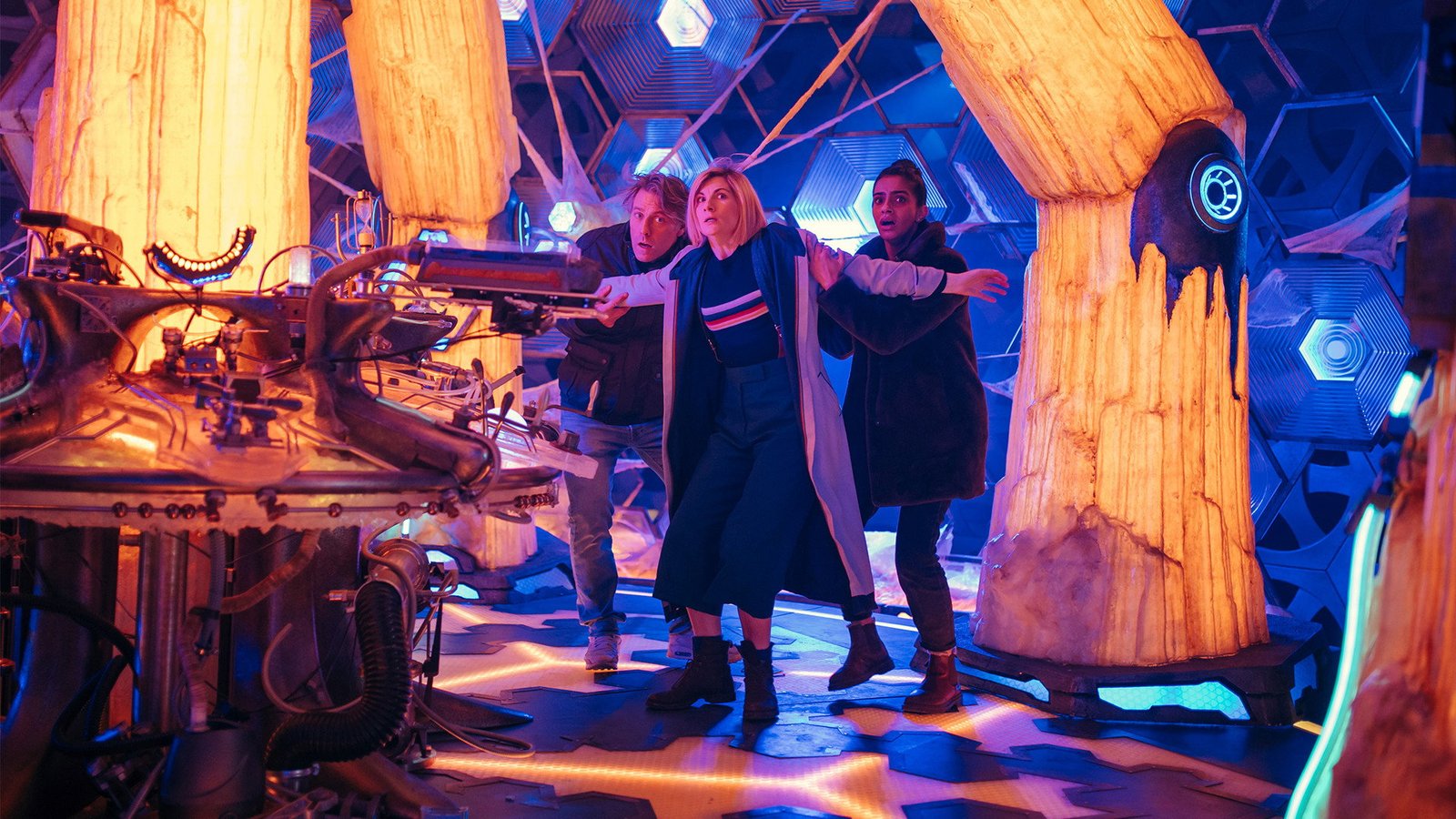
It finishes with the Doctor stopping the Flux at Atropos, Swarm and Azure escaping again, and the Weeping Angel that took Claire turning up inside the TARDIS to hijack it. That last shot is a proper jolt and easily the best cliffhanger of the run so far, because it’s the one moment where the hour stops being abstract and puts a concrete monster in a concrete room. The Angel has been in the TARDIS the whole time, riding along inside Claire’s head and then inside the ship, which makes the previous two episodes slightly more unnerving in hindsight. Doctor Who has always been good at the idea that the safest place is the one you should be checking, and a statue in the console room is about as direct a version of that as the show can manage.
Rating: 2.5/5. Not my favourite. Two genuinely strong new characters and one electrifying cameo, wrapped in an hour that mistakes confusion for depth and withholds its central mystery for the third week running. The Angel in the TARDIS is the only thing that had me sitting forward.
