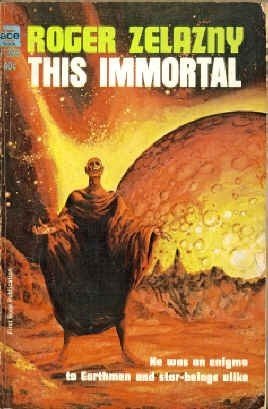
This Immortal is the Hugo winner that didn’t win alone, because at the 1966 awards it tied for Best Novel with Frank Herbert’s Dune, and I can’t think of two books that look less alike on a shelf. One is a whole desert planet with its own religion and ecology, and the other is about fifty thousand words of wisecracking narrator, ruined Greek temples and monsters. Roger Zelazny first ran it in The Magazine of Fantasy and Science Fiction in October and November of 1965 under the title “…And Call Me Conrad”, and Ace Books restored most of the cuts and renamed it This Immortal for the 1966 paperback.
It starts with a wife calling her husband a kallikanzaros, which is a goblin out of Greek folklore, and the husband in question is Conrad Nomikos. He’s tall, hairy, one leg shorter than the other, mismatched eyes, a scarred face, and he plays the pipes. He’s also a good deal older than he looks, and he doesn’t talk about that, because he’s spent a long time arranging not to be asked.
The Earth Conrad is stuck guarding
The Three Days, a nuclear war, came and went, and Earth is left with only about four million people. Most of the survivors huddle on islands that missed the worst of it, and everybody else left, because the Vegans turned up. They’re blue-skinned aliens with a lot of money, and they bought a good chunk of the planet and treat what’s left as a tourist destination. They’ve developed a taste for Coca-Cola and for human women, among other things. Human government now sits on a Vegan-owned planet called Taler, and the mainland is a mess of radioactive Hot Places and mutants that look like they walked out of a Greek myth: fauns, vampiric flowers, mermaids who can see the future, and a Black Beast that raids Thessaly.
Conrad is the Commissioner of the Earthoffice Department of Arts, Monuments, and Archives, which means he’s responsible for keeping what’s left of human culture standing. He lives on one of the islands with his wife Cassandra, who has the gift her namesake had, of seeing what’s coming and not being believed. He also used to be a very different man. Fifty years before the story begins he led a revolt against Vega under another name, Konstantin Karaghios, and when it failed he staged a boating accident to kill the identity off. The only way it works is if nobody looks closely at a man who somehow looks the same after half a century.
Cort Myshtigo wants a guide
Then a Vegan named Cort Myshtigo arrives, an aristocrat from one of the big wealthy families, and announces he’s writing a travel book about Earth. He wants to see the ancient sites, and he wants Conrad to take him. Conrad does not want to, but Lorel Sands, the Earthdirector and a friend of his, leans on him until he gives in.
The trouble is that a radical underground on Earth, Radpol, thinks the tour is a front. They figure it’s the first step in a Vegan takeover of the planet, and they decide Myshtigo has to die. Conrad ends up protecting a man he finds contemptuous, partly because he owes Sands and partly because some instinct tells him this tour matters more than it looks. Myshtigo, for his part, is cynical and enigmatic, and he doesn’t explain himself.
The party that forms around the two of them is a mixed bag, which I think is the book’s best idea. Don dos Santos is the nominal head of the faction that wants Earth back by force, and his companion Diane, called Red Wig, is the one actually running things. Hasan, who is Don’s bodyguard, is a yellow-eyed assassin with a code he won’t break, and he knew Conrad under one of his other names. Phil is Earth’s poet laureate, an old friend of Conrad’s and a bitter one. And two scientists, George and Ellen Emmets, are along too, Ellen being a former lover of Conrad’s.

Egypt, Greece and a lot of things that want to eat them
The tour runs through Egypt and Greece, and nearly every stop has something that tries to kill someone. There’s a robot warrior, a cannibal tribe, a mutant boar as big as an elephant, and a crocodile-and-snake horror the book calls a boadile, so it plays as a string of Greek-myth monster fights with a tourist in tow. Some of these are just what Earth is like now. Some are Radpol, or Hasan, or someone else trying to get Myshtigo, and for a good part of the trip Conrad can’t tell which is which. Conrad does most of the fighting, because he’s far stronger than a man ought to be.
Dos Santos and Diane know something they won’t share: they’ve got intelligence that says Myshtigo has to die, and they’ve hired Hasan to do it. They never say why, which suits Conrad badly, because he has no idea what he’s protecting. At one point Conrad gets a telepathic glimpse of how the Vegans see, a world with ultraviolet in it and no red, and it’s left unclear whether that’s a mutant gift or just something a creature like him knows.
The nastiest running joke is what Conrad is doing to the pyramids. Myshtigo, appalled, learns that Conrad has the pyramids being taken apart for building material. Conrad tells him it’s all being filmed and will be run in reverse to show how the pyramids were built. Myshtigo can’t tell whether he’s serious.
The bad news and the last fight
Then the trip turns on Conrad. He gets word that the island where he and Cassandra live has been wrecked by an earthquake, and that everybody on it is dead. Not long after, Phil dies too, and he leaves Conrad a note that says Myshtigo must stay alive, again without any reason. That’s what settles it for Conrad. He’s lost the one person he really cared about, and the last friend he’s got is telling him to keep going, so he goes on protecting a Vegan he doesn’t like for reasons nobody will tell him.
In the final fight to keep Myshtigo alive, Cassandra turns up. She survived the sea disaster on Conrad’s yacht, and she lands the blow that decides it. Myshtigo says he’s seen enough, cuts the tour short and goes home to Vega. That’s the turn some reviewers have a problem with, since one calls the final twists overly simple and a bit of a cop-out.
What the tour was for
Myshtigo’s mission was never a travel book. The Vegans have decided they don’t want Earth. The plan is to buy it from the Taler government, give Vegan citizenship to the humans living off Earth, and then hand the planet over to one person who has the strength and the character to guide it into whatever comes next. Their computers picked Conrad, and the entire tour was Myshtigo watching him to see if the computers had it right. Another reader found that ending unexpected but foreshadowed, and I can see the argument both ways.
That’s why the pyramid business matters, because it tells the Vegans something real: people on Earth would sooner tear down their own heritage than let anyone else own it. Dos Santos and Diane come around to the idea that Conrad has been defending the planet all along, just in his own way. The Vegans decide that a man this old, this powerful and this stubborn is the right caretaker. So Conrad ends up as the owner of Earth, and he leads what the book treats as its renaissance.
Why it won, and how it holds up
Reviewers do split on it, and I can see why. The 9 out of 10 crowd calls it a page-turner with sharp dialogue and a bittersweet finish, and the lower scores say the plot never gains much weight and the Vegans act like humans in unusual suits. The common ground is that it moves, it’s funny, and Conrad is a hard man to look away from. He’s a limping, hairy wisecracker with a pile of old names, and he carries the book on his voice.
What it did that hadn’t been done yet is hard to pin to one thing. Post-apocalypse SF in the mid-sixties mostly meant quiet and mournful, like A Canticle for Leibowitz, and this one is brisk and mythological and treats the ruined Earth as somewhere to go on holiday. That’s an odd thing to say about a planet after a nuclear war, and an odd thing to give a Hugo, and it’s the same year the award also went to a desert planet with sandworms.
Conrad, with his limp, his wisecracks and his many names, looks a lot like the sort of narrator you get in Nine Princes in Amber, and one reviewer compares him to Corwin in so many words. Which is where I’d send anyone who finishes this and wants more of him.
So here’s my question for anyone who’s read it: did you buy the Cassandra rescue in the final fight, or did it feel like the book backing out of the corner it had written itself into? Tell me in the comments.

1 comment
The Cassandra rescue at the end is the bit that still splits people, and I can see both sides of it. If you’ve fallen for Conrad by then it feels earned, and if you haven’t it can come across as a bit too neat.