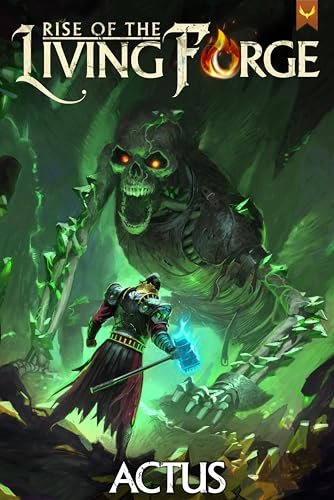
Rise of the Living Forge has a great hook and an ok book wrapped around it. The Hero of the realm, a guy who’s been fighting a war since he was dragged in from Earth at ten years old, finally lands the killing blow on the demon queen, notices a black gem hidden in his own armour, and wakes up a month later in a crummy border town back at Apprentice level with everybody thinking he’s dead. His combat class is gone. What he gets instead is a crafting class, The Living Forge, and a title that means he has to literally eat magic items to stay alive. That’s a fun setup, and the first stretch of the book is genuinely good, but for me it ran out of steam a long way before it ran out of pages.
Swords into hammers is a good idea
The thing I liked most about Rise of the Living Forge is the basic idea. Arwin’s spent fifteen years destroying things for the Adventurers’ Guild, and the book gives him the chance to spend a second life making things instead, and he decides pretty quickly that’s the better deal. There’s something nice about a LitRPG where the big ambition is a working smithy and a quiet street rather than the next level cap. He finds a broken-down, abandoned forge, scrapes together some barely functional item just so he’s got something to eat, and slowly starts learning a craft he knows nothing about. His [Soul Flame] lets him shape hot metal with his bare hands, which is a cool visual, and early on his items come out with random, mostly bad traits, brittle, explosive, “hungry”, which got a couple of laughs out of me. Eating his own failures to survive is a properly odd little survival mechanic, too, and it gives the early crafting some stakes, because a bad batch isn’t just a waste of metal, it’s a missed meal.
It’s got a bit of the same cosy, build-something-quiet feel as Beware of Chicken, a strong guy deliberately walking away from the fighting life, except here the past keeps knocking on the door. And I’ll give it credit for making the crafting actually feel like crafting for a good chunk of the book, with Arwin having to grind basic drills like forging perfectly round steel balls rather than just getting handed a legendary hammer. Those early chapters, a former Hero being humbled by a grumpy old smith and a pile of bad metal, are the best stretch of the book for me. You can see the story it wants to be. A guy who was only ever valued for how well he could kill, finding out he’s actually quite good at something gentler, and liking himself a bit more for it. I’d have happily read a much shorter book that was just that.
The innkeeper is the best twist in it
The other bit that really worked is the innkeeper on his street. I won’t dance around it since it’s right there early on, she’s Lillia, the demon queen he supposedly killed, also knocked back down to nothing and given a cooking class of all things. That’s a brilliant twist, and their uneasy truce turning into a partnership is the most interesting relationship in the book. When the two of them start comparing notes and realise each side was only ever told about the other side’s atrocities, never their own, the book hints at a much bigger story about who actually profited from fifteen years of war, and I was keen to see where that went. Two people who were raised from childhood to destroy each other, both thrown away by the sides they fought for, now running a smithy and an inn across the street from each other. That’s a premise I’d have liked to spend a lot more time inside, and when the book leans into it the banter between them is easily the best dialogue in it.
There’s a found-family thing going on too. Reya, the street thief he rescues at the start, who’s managed to annoy every gang in town, and the misfits who slowly gather round the smithy and the tavern, give the place a lived-in feel. When the local gangs and adventurers come leaning on them, you do want Arwin and Lillia to win, and there’s a decent bit of satisfaction in watching small-time thugs who think they’re picking on a nobody blacksmith find out otherwise. It’s all quite warm, the tavern with Lillia cooking whatever they’ve just killed in a dungeon, the street’s haunted reputation covering for the odd things going on in it, Reya finally having somewhere she isn’t being chased out of. I just wish the book trusted those bits more, because whenever it sat still with these people it was fine, and whenever it went into another long stretch of smithing detail or back-and-forth dialogue that didn’t move anything along, I started skimming. It’s a long book, over 700 pages, and you feel every one of them.
Simple prose and a story that drags
I’m going to be straight about it. The writing is simplistic in places. It’s not the greatest prose by any means, and a lot of the conversations go round in circles saying the same thing two or three different ways. It still manages to tell a story, and I never felt lost or confused about what was going on, but there were long sections in the middle where nothing really happened and the book could easily have lost a couple of hundred pages without missing anything. It really needed a tighter edit. Some chapters felt like they’d been written to stand on their own, recapping what had just happened before moving on, and in one long book that adds up.
The other thing that got me is the overpowered hero. Arwin’s supposed to be starting over, but he’s still the guy who nearly killed the demon queen, he knows how to fight better than anyone in town, and he’s quietly hiding a combat power because smiths aren’t supposed to be dangerous. So whenever a threat turns up you know he can handle it, and after the third or fourth time that took a lot of the tension out for me. I’m still not really used to the overpowered main hero trope, it’s not something I’ve got much patience for yet, and I got a bit bored waiting for something to actually push him. A reset story should feel like a climb back up. This one felt more like a guy pretending to be weak while everyone around him catches up. Watching Sung Jinwoo get stronger in Solo Leveling worked because he started from nothing. Arwin started from the top and the book never really makes him feel like he’s lost much.
Not sure I’ll be back for book 2
Which leaves me in a funny spot. There’s clearly a bigger story here, the Guild conspiracy, the war that maybe wasn’t what anybody thought, Arwin and Lillia working out where they stand with each other, and in theory that’s exactly the kind of hook that drags me into a second book. In practice I’m not sure I’ll pick it up, and that’s the clearest sign of where I landed, because normally I can’t leave a series alone once a mystery’s been dangled in front of me. It just wasn’t engaging enough to make me want another 700 pages of the same pace, and the bits I liked were spread too thin across the bits I didn’t. If book 2 came in at half the length with the conspiracy front and centre I’d probably give it a go, but that’s not usually how these series go, they tend to get longer rather than shorter.
The ratings on it are a lot higher than mine, and I get it, there’s an audience for a long, slow, comfy crafting book and this is aimed squarely at them. I might even come back to it one day if I’m in the mood for that sort of thing and have a lot of time to kill. For me it was the kind of book I finished, didn’t regret, and also didn’t think about much afterwards, which is about the most lukewarm thing I can say about something I spent that many hours on.
3 out of 5. It was ok, and I’ll leave the hammer swinging to someone else for now.
