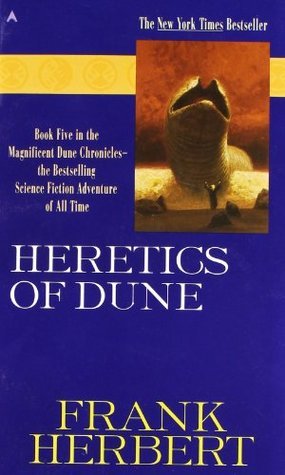
Heretics of Dune picks the series up fifteen hundred years after Leto II died, in a galaxy that has very nearly forgotten him. New cast, new factions, new problem, and a Bene Gesserit order promoted from background manipulators to the people the story is actually about. It is a soft reboot in everything but name, and it ties in to God Emperor far better than a fifteen century gap has any right to.
The Scattering sends something back
Leto’s death released humanity outward and most of what went out has not been heard from since. Now some of it is returning, and it is not friendly. The Honored Matres grew out of Bene Gesserit and Fish Speaker stock somewhere past every map, traded patient influence for sexual imprinting and open force, and burn worlds that do not fall in line quickly enough. What they are walking back into is an old empire held together by habit, with Rakis carrying worms and a priesthood, and the spice trade running partly through a Tleilaxu monopoly nobody is happy about.
The most effective thing Herbert does with them is refuse to explain them. They are obviously running from something. Nobody in the old empire can find out what, and the Sisterhood’s inability to answer that question is more frightening than the violence is.
The pacing helps enormously too. After a book that was largely one character thinking, this one has chases, ambushes, a siege and a genuine sense of things happening on more than one world at a time. Herbert had clearly decided to write a novel with a plot again, and whatever you make of the direction, the change of gear is immediately noticeable and mostly welcome.
Rakis is the other thing that has changed, and the state Herbert finds it in is quietly brutal. The planet that was Arrakis has worms again and a priesthood built on them, and both are essentially a tourist operation running on the memory of events fifteen centuries gone. The desert is back and the people who understood it are not. For a series that spent three books on the relationship between a landscape and the culture it produced, showing you the landscape restored and the culture replaced by administrators is a bleaker note than anything the Honored Matres do.
This is the Clans coming back to the Inner Sphere
The whole time I was reading it I kept thinking about BattleTech, and specifically about the Clans returning to the Inner Sphere. The two are not the same, and I would not push the comparison further than it goes. The Honored Matres are running from a threat, where the Clans came back to claim something they considered theirs by right. But the shape underneath is the same, and it is the part that interests me: a society that stayed home has atrophied and decayed, and the group that got pushed out has spent the intervening centuries getting harder, and when the two meet again the ones who stayed are simply outclassed.
You get the same uncomfortable question in both settings, which is whether the ones who left are the same people any more or something else entirely. Way of the Clans and Bloodname put you inside that culture looking out, and Herbert does something similar here by showing you Honored Matre thinking from the inside rather than treating them as a wall of hostility.

The other thing both settings get right is that the returning side is not simply stronger, it is organised around a completely different idea of what a person is for. That is what makes the meeting so destabilising rather than just a lopsided fight. An institution that has spent centuries assuming it is the cleverest thing in the room suddenly has to deal with people who were built, deliberately and over generations, for exactly this moment. The Bene Gesserit spend most of this novel a step behind and knowing they are a step behind, and Herbert is good on the specific humiliation of that, which is not fear so much as professional embarrassment.
It is also a smarter piece of world-building than it first appears. A civilisation that scatters does not simply spread out, it diverges, and the versions that come back are shaped by whatever they met out there. Herbert never shows you the Scattering directly and never needs to, because the Honored Matres are the evidence. Everything about how they behave tells you something about what was chasing them, and the book trusts you to assemble that yourself rather than explaining it.
The other reason the parallel holds is that both settings make the returning force honestly admirable in places, which is much harder than making them merely scary. The Honored Matres are disciplined, capable and unified in a way the old empire manifestly is not, and Herbert lets you feel the appeal of that even while showing you what it is built on. A threat you can partly respect is considerably more unsettling than one you can simply condemn.
Where the two part company
The difference, and the thing that gives the book a different weight, is method. The Clans breed and train for war and settle everything by ritual combat. The Honored Matres use sexual imprinting to bind people to them, which is a far uglier instrument and deliberately so. Set that against the Bene Gesserit, who train for influence and patience and play centuries-long games, and you get the real argument of the novel: two orders descended from the same root, one that learned to persuade and one that learned to own.
That contrast is what makes the Honored Matres work as antagonists rather than just being loud. The Sisterhood is looking at a distorted version of itself and hates what it sees, partly because the distortion is effective. It is the same gravitas problem the Inner Sphere has when it realises the Clans are not barbarians who got lucky.
There is a limit to how far the comparison runs, and it is worth naming. BattleTech’s Clans are a military problem with a cultural explanation attached, and the fiction is mostly interested in the fighting. Herbert is doing the reverse. The Honored Matres barely fight anyone on the page, and what the book actually wants to examine is what happens to an institution’s sense of itself when a distorted copy turns up and starts winning. The battles are the least interesting thing in it, which is not something you could say about the BattleTech novels at all.
Method is also where the book gets its title. Heresy, in Bene Gesserit terms, is not believing the wrong thing. It is an institution discovering that its own doctrine has produced something it does not recognise and cannot disown, and Herbert applies that to the Sisterhood, the Tleilaxu and the Honored Matres in turn. All three are running on inherited orthodoxy that has drifted a long way from whatever it originally meant.
The Tleilaxu finally get opened up
The surprise of the book is the Tleilaxu. Five novels in, they have been a supplier of gholas and Face Dancers and not much else, a convenient source of plot devices with no interior life. Herbert finally opens them up here, and they turn out to be a deeply religious people running their own long plan, with their own reading of what the Prophet meant and their own view of everyone else as soulless. Waff is the Master carrying it, and he has been waiting a very long time for a chance like this one.
What their axlotl tanks actually are gets disclosed here too, in a single unpleasant sentence that recontextualises every ghola in the series including all the Duncans. It is the kind of reveal that makes you put the book down for a second, and it is characteristic of how these later novels work. Herbert keeps taking something I had accepted as background furniture for four books and showing me what it actually costs.
Alongside that, the Bene Gesserit end of the plot runs through Lucilla, an Imprinter sent to bind the Duncan ghola, and Burzmali, Teg’s former student. The long chase across Gammu that takes up the middle of the novel is the closest the late books come to straightforward adventure writing, and it is a relief after God Emperor. What makes the axlotl disclosure work is that Herbert has spent five books letting you accept the gholas as a convenience, a way of bringing back a character everybody likes. The reveal does not change any plot mechanics at all. It simply changes what you have been comfortable with, retroactively, which is a far more unpleasant and far more effective move than any twist about who is secretly working for whom.
Gammu is worth a note as well. It is Giedi Prime under a new name, scrubbed and replanted after the Harkonnens fell, and Herbert uses it to make a point about how thoroughly a place can be laundered and how little that changes what is still buried under it. The no-globe hidden beneath the surface, a sphere invisible to prescience that the Harkonnens built and everyone forgot, is where a good deal of the middle of the book happens, and it is a neat way of tying the new cast back to the first novel.
Teg, Odrade and Sheeana
Miles Teg is the character everyone finishes this book talking about, an old Bashar brought out of retirement, written with more competence and restraint than the series had previously bothered with, and consistently underrated by people who should know better. Something happens to him partway through that changes what he physically is, and it is the strongest sequence in the back half of the series.
Darwi Odrade is the other half of it, an Atreides descendant arguing with the Bene Gesserit from inside, and she carries this novel and the one after it. Sheeana can walk up to a sandworm and tell it what to do, which neither the priesthood nor the Sisterhood can account for and both immediately try to own. And Duncan Idaho is back again as a ghola supplied by Tleilaxu with their own agenda. The ending does not tidy up. Rakis burns, the worms go with it, and what survives is one smuggled worm and a ship the enemy cannot see.
Fifteen hundred years is an absurd gap to be asked to cross, and the remarkable thing is how little it costs. The concerns are the same ones the series has always had, about who gets to steer a species and what they are willing to spend doing it, and the new cast carries them without leaning on anybody’s memory of Paul Atreides. I enjoyed this one a great deal more than I expected to.
For a book that resets almost everything, it is also unusually generous if you have come the whole way. The Tleilaxu payoff only works because you have watched gholas for four books. Gammu only lands if you remember Giedi Prime. Sheeana only means anything against everything the series has established about worms. Herbert rebuilt the cast completely and kept the accumulated weight, which is a trick most long series never manage.
Rating: 4/5.
