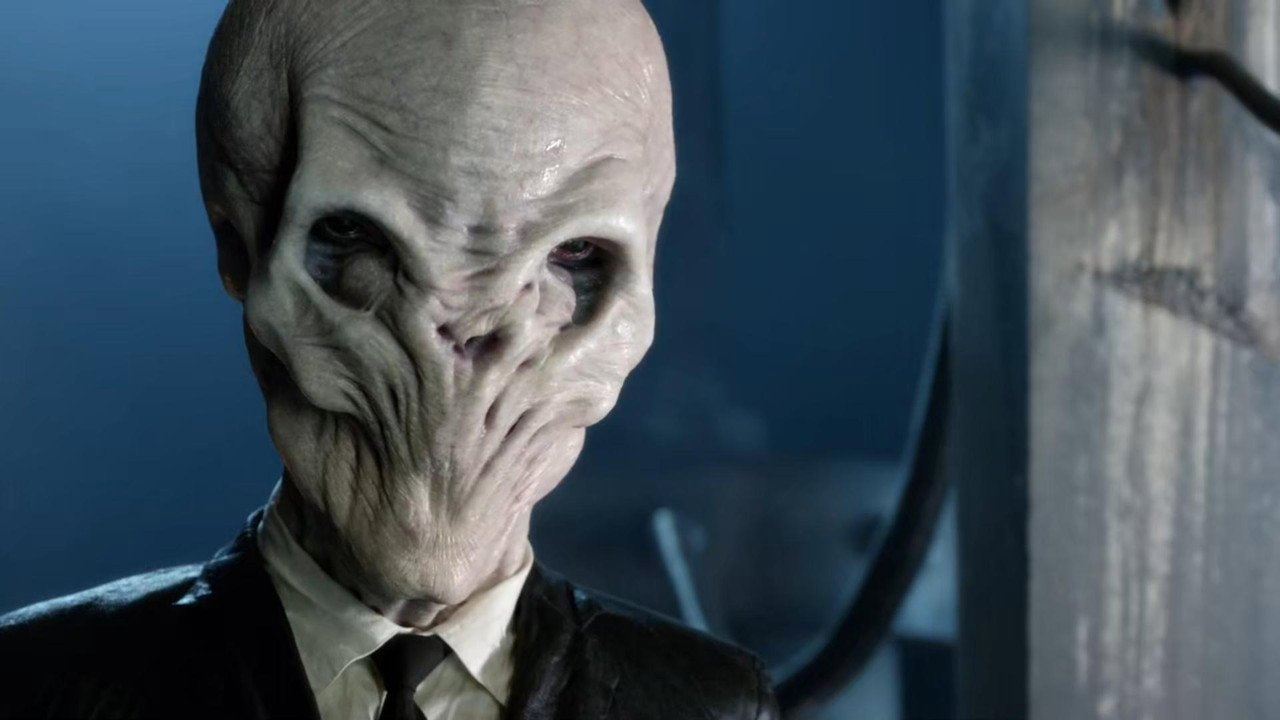
I look at Day of the Moon, the second half of the Doctor Who series six opener, where the team spend three months on the run in 1969 America with tally marks up their arms, and Amy ends up alone in an orphanage full of the Silence.
I thought the way it beats a monster nobody can remember was brilliant, the orphanage is the scariest stretch the show has done in years and River’s kiss genuinely hurt. It’s dense and sometimes wilfully confusing, but I gave it 4.5/5.
The problem with a monster you forget the instant you look away is that it’s very hard to write a way of beating it, and Day of the Moon solves that so elegantly I was grinning at the telly. Then it spends a big chunk of its runtime on the most frightening half-hour Doctor Who has given us in years, and somewhere near the end there’s a two-minute scene that quietly guts you. I came out of last week’s episode with no idea how they’d get out of it. I still can’t quite believe how much they packed into the answer.
We open three months on. Amy gets shot in the Utah desert, Rory gets cornered at a dam, River throws herself off a skyscraper in New York, and Canton Everett Delaware III is hunting all of them across America, and none of it is what it looks like. It’s a ruse, staged so the Silence stop paying attention, and finding out the team have been running an operation the whole time is a lovely bit of misdirection after how lost everyone was at the end of The Impossible Astronaut. The tally marks are the thing I won’t forget. Amy’s arms are covered, Rory’s are worse, and they’ve been counting encounters they can’t remember having, so the sheer number of marks tells you how many of these things are out there without anyone saying it. And the Doctor’s locked up in Area 51 in a cell made of dwarf star alloy, which turns out to be the point, because they’ve built the one room on Earth the Silence can’t get into and then shut themselves inside it.
Canton is the quiet pleasure of the whole thing. Mark Sheppard plays him as a man doing a completely absurd job with total professionalism, sunglasses on, never once raising his voice, and the episode slips him a small, sharp bit of character on the side. He was pushed out of the FBI because he wanted to get married, and near the end he tells Nixon the person he wanted to marry was a black man. Nixon’s baffled non-answer does more for the 1969 setting than any speech could have.

The orphanage
And then Amy goes to Graystark Hall with Canton, and the episode turns into something I could barely watch. It’s the best sustained horror this show has tried in years, proper creepy gothic horror, a crumbling building, a caretaker whose memory has been worn down so far he can’t hold a conversation, and words scratched into every wall by someone desperate. GET OUT. GET OUT. The Silence are nesting up on the ceilings, in the dark, dozens of them. Amy has a torch and a phone camera and no way of holding on to what she sees, and the scene plays it with a flash going off, a room full of them hanging above her, darkness, and she’s forgotten again by the time the next flash comes. That’s a really nasty use of the rule from last week, the one where they vanish from your head the second you look away, and Karen Gillan carries the entire stretch on her own.
What I liked is that nothing in there jumps out at her in the usual way. The fear is all in the gaps, the bits she’s lost between one flash and the next, and in the marks on her own arm going up while she isn’t looking. A ceiling has never been so frightening. I found myself checking the corners of the room afterwards, which is a bit embarrassing for a grown man, but there it is. It’s also the bit where the plain old horror of a creepy empty house and the cleverer memory idea finally sit on top of each other properly, and the two together are far worse than either would be alone. The episode has a cross-country chase in it and a laser fight in a spaceship and a president in the Oval Office, and still the thing I’ll remember is a torch beam going across a ceiling.
The hatch, the photo and the comms link
The detail that finishes the job is the woman with the eyepatch, glimpsed through a hatch that opens in a wall where no hatch should be. She looks straight at Amy, says “no, I think she’s just dreaming,” and closes it again. No explanation, no follow-up, and it’s the most disturbing thirty seconds of the series so far. Then there’s a photograph of Amy holding a baby, in a room she has no memory of ever being in, and I’ve been chewing on it since. Put that next to the pregnancy she mentioned last week and has since told the Doctor was a false alarm, and something has clearly been done to her, though I couldn’t tell you what.
There’s a second, quieter cruelty running underneath the orphanage too, and I nearly missed it the first time. Amy has a live comms link open the whole time she’s missing. At one point, convinced she’s about to die and thinking the Doctor’s the one listening, she says a lot about how she feels, about Rory, and about which of the two of them she was really waiting for all those years. The Doctor isn’t on the other end. Rory is. Arthur Darvill plays a man hearing something he was never meant to hear and deciding, completely silently, that he’s never going to bring it up, and it’s some of the best acting he’s done on the show. Rory’s been stuck as the comedy sidekick for long stretches, so it was good to see him get a moment like that, even if it’s a sad one, and it makes him the most grown-up person in the TARDIS by a distance.
Weaponising the moon landing
The way they win is superb, and it’s built out of the monster’s own trick. If the Silence plant suggestions that people obey without ever knowing why, then the answer is to give everyone a suggestion of their own. So the Doctor gets footage of one of them saying “you should kill us all on sight” and splices it into the Apollo 11 broadcast, the single most watched bit of film there’s ever been. Everybody on Earth sees it and nobody remembers seeing it, and from that moment the whole species is carrying an order to destroy them on sight that it’ll act on without ever knowing where it came from. It’s ruthless, it’s clever, and it’s pretty dark in a way the episode doesn’t dwell on, because the Doctor has just signed humanity up to wipe out another species without asking anybody. Nobody raises it. It just sits there.
What I like most is how neatly it fits what the Silence are. They never conquered Earth by force, they stood behind us for thousands of years, nudging, and let people build whatever they wanted built, rockets included. The Doctor doesn’t out-fight them, and he doesn’t really out-think them either so much as borrow their own method and point it straight back at them. Beating a parasite by turning its host against it is a really satisfying way to end a two-parter, and the small stuff around it (Nixon fussing in the Oval Office, the Doctor asking Nixon to say hi to David Frost) keeps it from getting too pleased with itself.
The kiss
And then the two minutes that hurt. River kisses the Doctor. She’s been circling it ever since she first turned up in Silence in the Library knowing him far better than he knew her, and she finally does it, and he’s startled and delighted and totally unprepared, because he’s never kissed her before. She works out what that means straight away. Their timelines run in opposite directions, so if this is his first time, then everything ahead of her is a road where he knows her less and less. She’s just had her first kiss with him and, from her side, it was one of the last. Alex Kingston plays the realisation in about four seconds without a word, and it’s devastating. Her death in Forest of the Dead has already happened for him, so the show’s been running this relationship backwards for a while, and this is the first time it really lets you feel the maths. It was the bit I was still thinking about the next morning.
Then there’s a coda the episode barely bothers to explain. The little girl from the spacesuit, out of it and loose in New York six months later, collapses in an alleyway and starts to glow, regenerating on her own with nobody there to see it. She’s a Time Lord, or something a lot like one, and not one character in the story is there for it, so it’s aimed squarely at us. I’ve got no idea what to do with that yet.
Rating: 4.5/5. It’s dense and sometimes wilfully confusing, but I loved it.

4 comments
[…] photographs the woods is the most sustained dread this show has managed since the orphanage in Day of the Moon, and it does it almost entirely with sound and an empty […]
[…] pregnant, and the woman with the eyepatch opens her hatch in the wall again, exactly as she did in Day of the Moon. Whatever is being done to Amy is still being done, whether this particular hour has time for it or […]
[…] what he was travelling with. Every scan flicker, every eyepatch through an impossible hatch since Day of the Moon, lands at once. And then the real Amy wakes on a slab in a white room, hugely pregnant, alone. A […]
[…] pays off. It also explains the little girl I watched regenerate in a New York alley at the end of Day of the Moon, who has obviously done it at least once more since. So when Hitler fires at something else […]