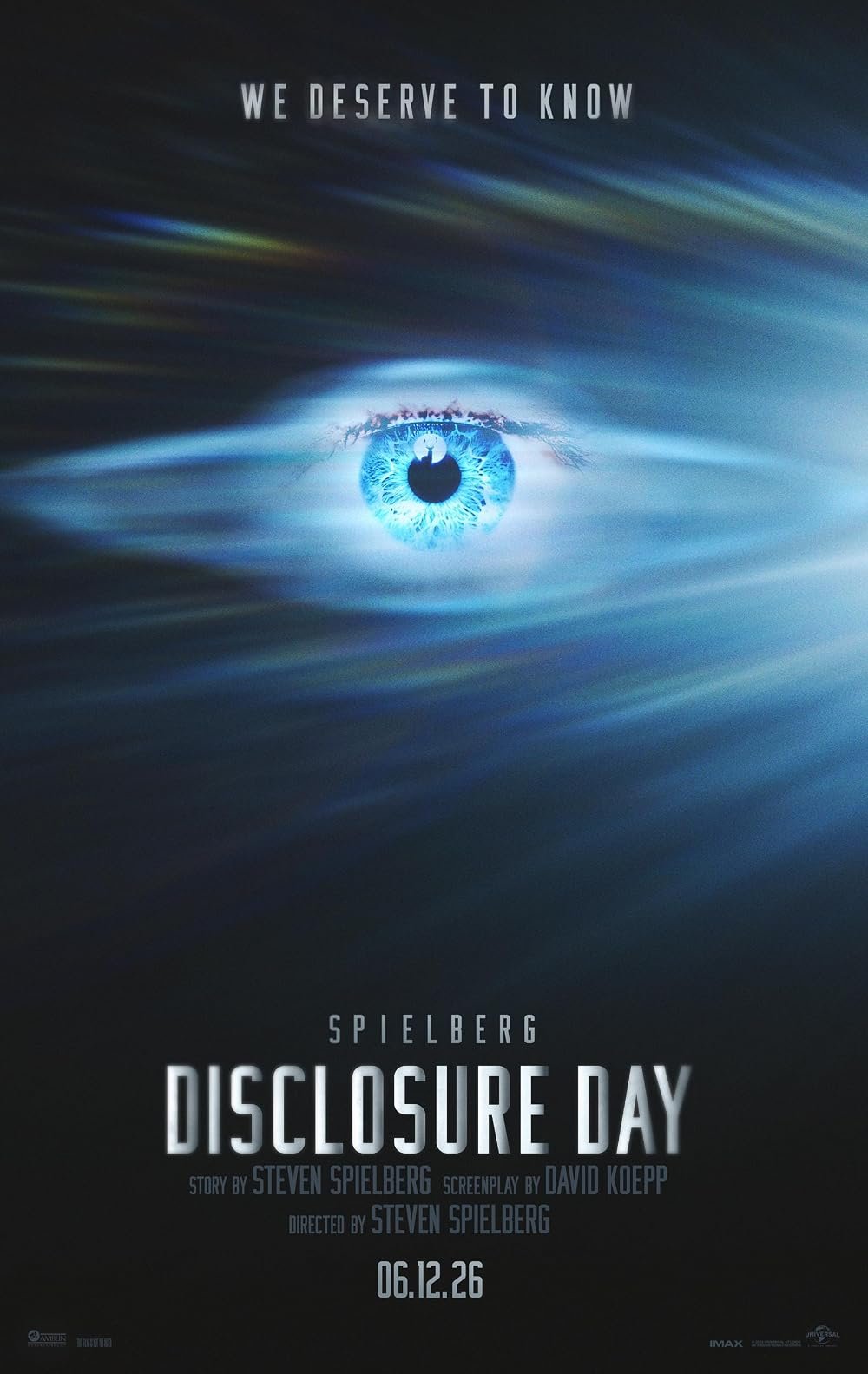
Disclosure Day is a sci-fi thriller that earns favorable comparisons to The X-Files through its slow-burn pacing, institutional paranoia, and government secrecy themes, while delivering an actual first contact resolution the show never provided. Its standout sequence is patient and emotionally restrained, and the film treats its science with enough seriousness to avoid embarrassing itself.
The film’s weaknesses include an underexplored tension between its “benevolent alien” framing and the historical record of abductions, an unexplained crash history that strains credibility, and a rushed third act that doesn’t fully reckon with the aftermath of disclosure. It earns a 7 out of 10.
Rating: 7/10
My daughter has never seen a single episode of The X-Files.
I kept waiting for Cancer Man to step out of the shadows throughout Disclosure Day, cigarette in hand, expression unreadable. She had no idea what I was talking about. That’s the thing about taking someone born after the Mulder-and-Scully era to see this film — you’re watching two completely different movies at once. She saw a reasonably tense sci-fi thriller about first contact. I saw ninety-plus minutes of Chris Carter’s spiritual successor, reimagined for the streaming generation.
Both of us came out thinking it was pretty good. She just didn’t understand why I kept muttering “The truth is out there.”
It Feels Like The X-Files Got a Feature Film Budget
That’s the highest compliment I can give Disclosure Day. The mood, the slow burn, the institutional paranoia — it’s all there. If you grew up watching Mulder pin newspaper clippings to a wall in a dimly lit basement office, this film will hit every note you’re looking for. The visual language, the way it handles government secrecy, the tone of the whole thing — it’s vintage X-Files DNA wrapped in a 2025 production budget.
The difference is that where The X-Files spent nine seasons dancing around the truth, Disclosure Day actually delivers it. The aliens exist. We see them. They make contact. The veil drops, and the film doesn’t pretend it didn’t.
Which is great, until you start asking follow-up questions.
The Benevolence Problem
Here’s what bothered me walking out of the theatre: the film spends a lot of energy establishing that these beings are peaceful. Benevolent, even. They’ve been watching us for a long time, they have no hostile intent, they mean us no harm.
And then you start thinking about all the people who got experimented on.
The abduction cases, the lost time, the medical procedures without consent — Disclosure Day doesn’t really grapple with any of that. It’s all a bit “don’t worry about those other incidents, the beings here are the nice ones.” That’s a dodge. If this civilization is advanced enough to cross interstellar distances and genuinely means no harm, the documented history of interference sits uncomfortably alongside the “we come in peace” messaging.
Either there are multiple factions at play — which the film only hints at — or the definition of benevolent needs some work. You can’t just wave off the abduction file.
The Technology Question Nobody Asks
The crash record is also a problem. If you’re a species sophisticated enough to arrive in our solar system, why have there been so many incidents over the decades? Roswell. Rendlesham. The UAP hearings. The sheer volume of documented sightings and near-misses doesn’t square with a civilization that should, by any reasonable measure, have solved autonomous navigation long ago.
Honestly, if their autonomous systems are anything like early enterprise AI, the crash rate suddenly makes sense — I’ve written about deploying AI ticket triage and the early failure modes were spectacular. But a civilization advanced enough to cross the void between stars should be a few versions past “this sometimes works.” Disclosure Day doesn’t give us any explanation, and it’s the kind of plot thread that nags.
Minor gripe. But a real one.
What Works Brilliantly
None of that should overshadow what the film does right. The first contact sequence is legitimately one of the better ones in recent sci-fi cinema — patient, tense, and surprisingly emotional without tipping into sentimentality. There’s a restraint to the whole production that Close Encounters captured in 1977 and that most modern first-contact films botch by going immediately to spectacle.
This one earns its moment.
The science is treated with enough respect that it doesn’t embarrass itself. At one point the film nods to the Drake Equation — Frank Drake’s 1961 formula for estimating the number of communicating civilizations in our galaxy — which produced a quiet fist pump in my seat. My wife still doesn’t believe alien life exists. I’ve been losing that argument for years. Mathematically, the odds of us being alone in a universe with more stars than grains of sand on every beach on Earth are so small they’re not worth entertaining. Disclosure Day at least has the decency to acknowledge the math was always on our side.
Where It Falls Short
The third act is the film’s weakest point. After the disclosure itself — which lands — the movie isn’t quite sure what to do with the aftermath. There’s a tonal shift that feels slightly rushed, like the writers knew what the revelation should be but hadn’t fully mapped what comes after it.
If you’ve read the Dune series and spent any time thinking about what a truly advanced civilization’s relationship with a younger species might actually look like, the film’s resolution feels too clean. Real first contact stories are messier. The power asymmetry alone should produce a more complicated emotional register than we get here.
It’s not fatal. It’s the kind of thing a sequel could address if this becomes a franchise — and based on how this one lands, there’s no reason it shouldn’t.
The Verdict
Disclosure Day is a solid 7. It’s the best straight-up X-Files successor since the show itself, it earns its first contact moment, and if you grew up believing the truth was out there, it’ll scratch that itch convincingly.
Take someone who’s never seen The X-Files and they’ll have a great time with it on its own terms. Take someone who has, and you’ll spend the whole film scanning the background for a man in a dark suit who never arrives.
My daughter wants to see it again. I told her she needs to watch The X-Files first.
She’s got nine seasons of homework ahead of her. I’m calling that a win.

1 comment
[…] cleared up, and I kind of love that it doesn’t. It’s the same question I had walking out of Disclosure Day, where the visitors are supposed to be the good guys and nobody wants to talk too much about the […]