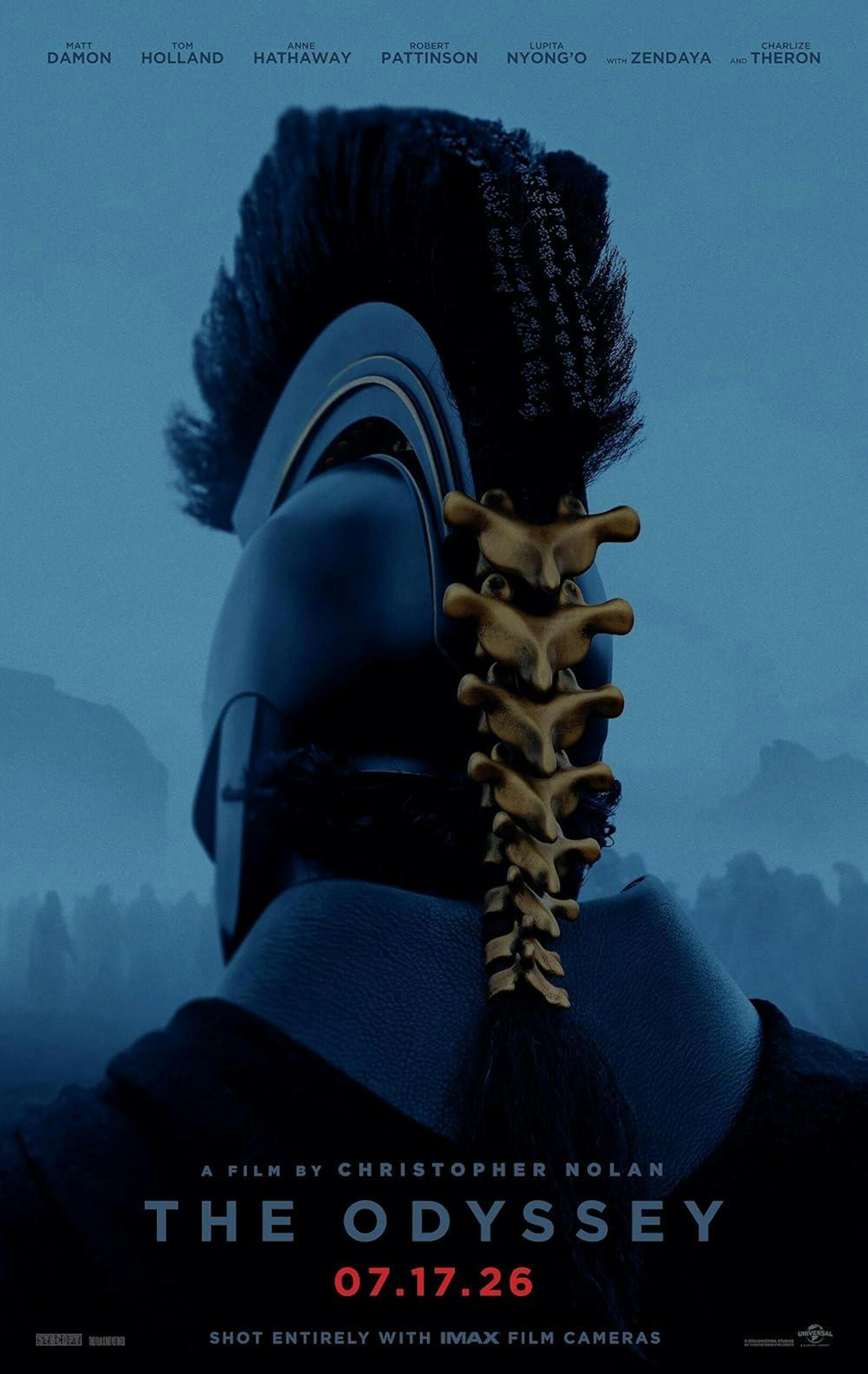
A review of Christopher Nolan’s 2026 film adaptation of The Odyssey, starring Matt Damon in the title role and Anne Hathaway as Penelope. The reviewer, coming to the story without deep knowledge of Homer, found the film’s handling of Greek concepts like xenia and its fractured narrative structure to be effective rather than distracting.
Standout elements include Hathaway’s performance, the Underworld sequence, and an ending that draws on Homer in the same way Tolkien did — filtered through Nolan’s own vision. The film is praised for telling a complete story rather than expanding into a franchise, with Nolan’s non-linear approach seen as purposeful.
First things first: Matt Damon is absolutely jacked in this film. I don’t know what Nolan put him through, but somewhere between Good Will Hunting and Odysseus, the man went full superhero prep. It matters — this is a role that asks you to believe someone survived ten years at sea, outwitted a Cyclops, escaped a sorceress, and still had enough left to fight his way back into his own house. Built the way he is here, you believe it.
More on the physicality of the performance later — first, the cast.
The cast
I went in skeptical about Anne Hathaway as Penelope. Not because she can’t act — she’s a proven dramatic performer — but because Penelope is a specific kind of difficult. She’s the woman who holds an entire kingdom together for two decades while everyone around her assumes she should have moved on, and she does it through wit and patience rather than action. That’s a harder performance than it sounds. Hathaway was extraordinary. By the final act I was more invested in her story than Odysseus’s, which feels exactly right for this material.
Tom Holland as Telemachus worked better than expected too. There’s a quiet throughline about a son growing up in the shape of an absence — having to become a man without a father around to show him how — and Holland handles that with more restraint than his Marvel work might have led me to predict.
Coming in without a roadmap
I’ll be upfront: I wasn’t a classics kid. No Latin, no forced Homer. My knowledge of The Odyssey came in fragments — games, other stories that borrowed from it, cultural osmosis. I knew the Sirens and the wax. I knew Circe turning the crew into pigs. I knew the Cyclops. Pieces, not the complete shape.
What I didn’t have was the moral architecture underneath it all. The concept of xenia — the sacred Greek duty to honor any guest as a potential god in disguise — underpins the entire story, and the film establishes it early. It sets up the central contrast the rest of the film keeps returning to: how things should work versus how people actually behave. The Trojan Horse sequence handles this beautifully. Troy falls not through heroism but through deception, and the film lets the weight of that sit without comment.

What the film gets right
The Underworld sequence. Odysseus descending to the gates of Hades, navigating the dead, meeting the shades of everyone he’s lost — it could have been a visual effects showcase and instead it’s the emotional centre of the film. Nolan shoots it like grief.
Agamemnon’s fate hit me completely out of nowhere. I knew the name from a dozen other places — it surfaces everywhere in military science fiction — but I had no idea how his story actually ended. Discovering it here, inside Odysseus’s own journey home, reframes everything. The parallel the film is drawing is not subtle. It doesn’t need to be.
And the ending. Odysseus walking toward the sea, the way the film closes on a man the world has used up being released into something beyond — it struck me immediately as Tolkien’s boats into the West. Bilbo. Frodo. The Fellowship, diminished and complete, watching the Grey Havens recede. It turns out Tolkien almost certainly borrowed from Homer, not the other way around, but watching the film I felt the echo so clearly it recontextualised both stories at once. (That specific feeling — a new story revealing a seam in something you already love — is exactly why I keep coming back to epic fantasy; I wrote about a version of it in my Wheel of Time and Lord of the Rings comparison.)
The Nolan fingerprint
Is it disjointed in places? Yes. That is, at this point, a feature. The man made Memento backwards and Dunkirk across three simultaneous time scales. A clean chronological Odyssey would be a lesser film. Nolan’s fractured structure creates unease where the original text created it through the supernatural — you’re never quite sure where Odysseus stands in his journey, which is precisely how Odysseus himself spends the whole story feeling.
The bottom line
This is one I want to watch again — not because I missed things (though I did; Nolan films always reward the second viewing) but because I want to see Penelope’s performance knowing how it resolves. I want to track how the small choices accumulate.
Most satisfying thing: Nolan made one complete film. The source material is ancient and sprawling, it could have been a franchise, and it wasn’t. Compare that to The Hobbit — a single book inflated into three films until it collapsed under its own weight. Whatever the commercial calculation was here, the creative one was right. The Odyssey covers everything it needs to cover and then ends. That restraint is increasingly rare and genuinely worth noting.
One last thing: at least twice watching this film, I saw Matt Damon fight his way out of a trap and thought this is just Jason Bourne in a tunic. I mean that entirely as a compliment. He brings the same coiled intelligence, the same physicality of someone smarter than his situation buying himself just enough time for his brain to catch up. Bourne by way of Homer.
Also — and I cannot stress this enough — the man was absolutely jacked.

1 comment
[…] I had missed watching these two specific actors play these two specific people. You’d think after the Odyssey I’d have had enough of them, but you’d be […]