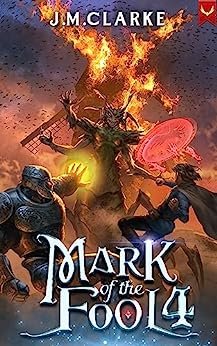
This whole story feels like it has a defined beginning, middle, and end, and that’s rarer in this genre than it should be. It shows in how Mark of the Fool 4 is built. It’s clearly a middle book, and middle books in any genre do tend to drag a bit (if you’ve read Wheel of Time you know what I mean!), but it’s still enjoyable and it does the job of moving the larger story forward rather than just treading water until the next big beat.
Alex travels to Thameland this time to dig into the mystery of the Ravener, alongside his university companions, who’ve all grown in power since the Games of Roal. Generasi is still recovering from a demon knight’s wrath from earlier in the series, and the university mounts an expedition into the hills of Greymoor that puts Alex up against threats no amount of academy training could have fully prepared him for.
The Mark stops being a workaround
The real turn in this book is that Alex hits an actual wall in his magical progression. To master the spells he needs, the Mark itself can’t be worked around anymore. It has to be removed or transformed, full stop. I think Alex gradually worked around the limitations that were placed on him to find a solution that best suited his own unique issues, and that’s the version of a power-up arc I want to see more of in this genre: not a new ability handed to him, but him actually solving a problem that’s specific to who he is rather than a generic obstacle every protagonist in this kind of story eventually clears the same way.
What I liked most is that the book doesn’t let him find a clean third option. Removing the Mark and transforming it both carry real costs, and for a good stretch of the book I genuinely didn’t know which way Alex would go, or whether either choice would actually work the way he hoped.

That’s the spine the rest of the book hangs off, and it works because the series has spent three books establishing exactly what the Mark is and isn’t capable of. When a limitation that specific finally becomes the plot, it lands as a real stakes-raiser instead of an arbitrary wall thrown up to manufacture tension.
The Heroes of Thameland, and a slower stretch
The Greymoor expedition brings in the Heroes of Thameland, other Mark-bearers who’ve been fighting monsters independently across the realm and finally get a reunion here. I liked the idea of expanding the cast this way, though it’s part of why the middle stretch of this book drags a little. Splitting focus across more Mark-bearers means less time with Alex directly, and this series is at its best when I’m watching him specifically work through a problem rather than checking in on a wider cast of side characters.
There’s also a hidden-society thread here, assassins and spies tied to Uldar and something called the First Apostle, that deepens Thameland’s own secrets without fully paying off yet. It’s clearly setup for later books, and on its own terms it’s fine. It’s just another thread competing for space in a book that’s already carrying the Ravener mystery, the Greymoor expedition, and the Mark’s forced turning point all at once.
Claygon, still developing
Claygon keeps growing here too, in the same slow-burn way the series has handled it since Book 1. Nothing about this book pushes Claygon into anything fully sentient. It’s still “developing,” the same word I’d use to describe where the character was a book ago, just with more happening under the surface than before. The series is clearly saving something for later, and I’d rather it take its time than rush the payoff just to give this book a bigger character beat.
Where this lands against the series so far
Coming right off Book 2, the jump in scale here is noticeable. Thameland’s war zone raises the stakes past anything the academy setting alone could manage, and the Mark’s forced turning point gives Alex a genuinely personal problem to solve rather than just a bigger threat to punch through. Looking back at Book 1, it’s a good reminder of how much groundwork this series laid early so a limitation like this one could actually mean something four books later.
It drags in the middle, and the expanded cast costs the book some of the focus that made the earlier entries work as well as they did. But the core of this one, Alex actually solving his own problem instead of leveling past it, is exactly the kind of progression fantasy beat I keep coming back to this series for. It’s enough to keep me firmly on board for wherever the Ravener mystery goes next.
