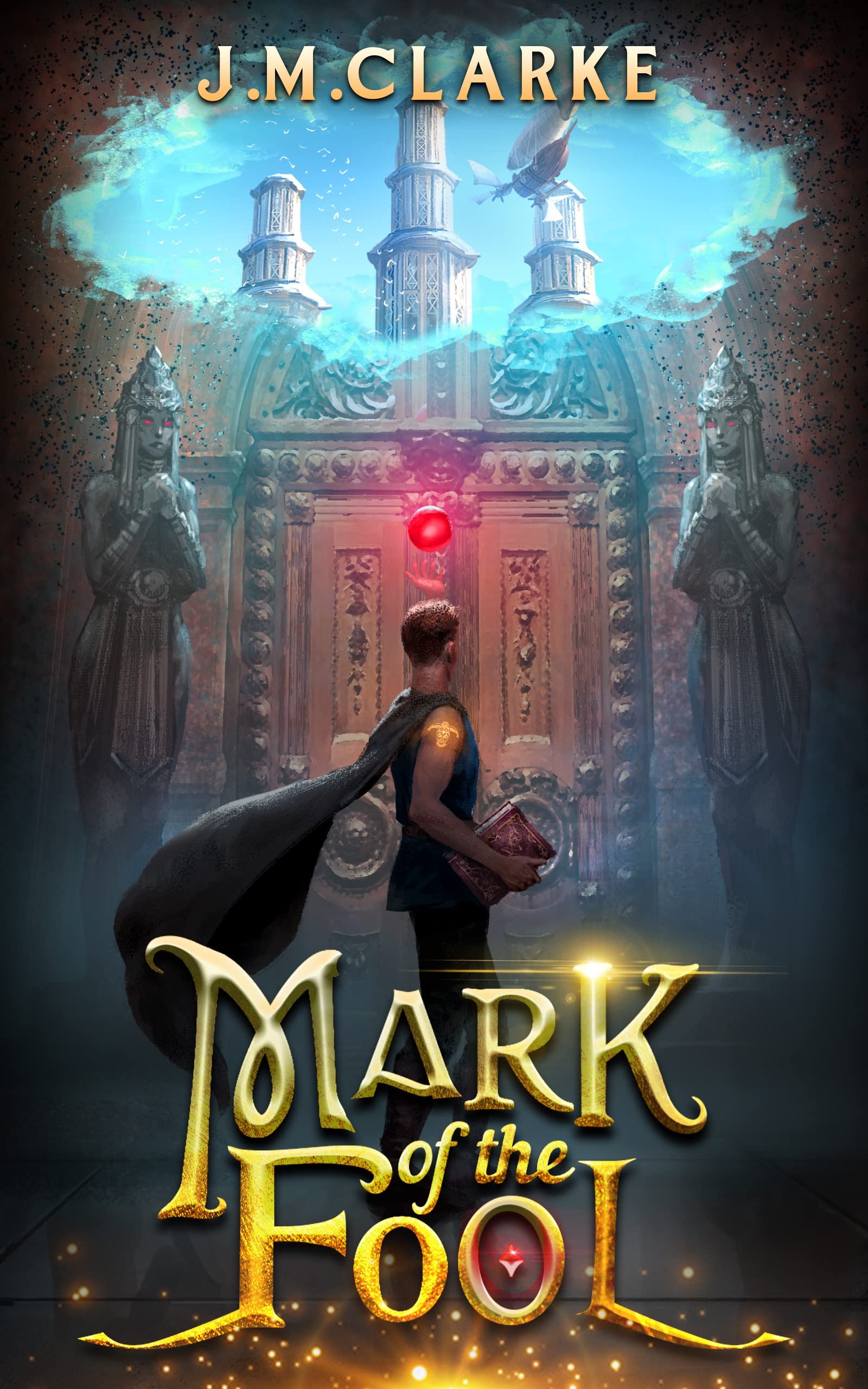
Every so often a progression fantasy comes along with a premise so clean you wonder why nobody did it first. Mark of the Fool is one of those. The gods of Thameland mark five teenagers as Heroes every century to fight back an ancient evil called the Ravener — the Champion, the Chosen, the Saint, the Sage, and the Fool. Four of those are gifts. The fifth is a punchline. And our guy, Alex Roth, draws the punchline.
If you’ve spent any time in the progression fantasy corner of the genre, you know the usual shape: a protagonist with overpowered abilities and a tragic backstory grinding toward inevitable godhood. Mark of the Fool keeps the grind but flips the gift into a curse — and that one inversion is what makes it sing. Here’s how the opening book goes.
Meet the Fool
We open in the small kingdom of Thameland, where Alex has exactly one plan: get to the University of Generasi, the greatest magical academy in the world, and become a wizard. He’s a practical, slightly anxious eighteen-year-old — orphaned young when a fire killed his parents, left responsible for his little sister Selina, and taken in alongside her by the Lu family, whose daughter Theresa is his childhood best friend. He’s spent years grinding: helping the Lus, working for a bully of a baker, studying at the church school, and secretly teaching himself the Forceball spell out of a tattered old book. It’s a grounded, lived-in setup, and Clarke takes his time letting you feel the weight Alex carries before the plot detonates.
Then the Mark lands. On his eighteenth birthday Alex is branded the Fool — the worst of the five marks. The Fool can learn any skill at superhuman speed, but the catch is brutal: the Mark sabotages magic and combat. The way it works is nasty and clever — when Alex tries to cast, the Mark floods his mind with the memory of every time he ever failed that spell, drowning his focus. Past Fools ended up as one of three things: ineffectual mascot, heroic sacrifice, or traitor. Alex looks at that menu and decides he’d rather not order anything. So he runs. He grabs Selina, Theresa, and Theresa’s enormous three-headed cerberus Brutus, and they bolt for Generasi before the priests of Uldar can drag him into a war he’ll probably die in.
That refusal is the whole hook. Alex isn’t chosen-one bait. He’s a guy actively dodging the prophecy, trying to build a future out of a cursed hand.
The escape, and the thing in the cave
The flight out of Thameland doesn’t go cleanly. Hunted, the group ends up taking shelter in the Cave of the Traveller — a strange sanctum of doors tied to Alric’s patron saint — and that’s where we get the book’s first proper monster: a Hive-Queen lurking at its core, with her brood.
This is where Clarke shows his hand. Alex can’t just blast the thing — the Mark won’t let him cast cleanly, and he’s no warrior. So the encounter becomes a problem to be solved rather than a fight to be won: using the Traveller’s strange magic, the layout of the sanctum, and a lot of fast, panicky improvisation, the group has to outmaneuver something they can’t overpower. It’s tense and genuinely clever, and it sets the template for the whole book — survive by being smarter, not stronger. Watch this sequence closely; it’s the first time we see what the Fool is actually going to be good at.
The spear-and-oar dance
The beat that made me realize this book truly understood its own premise is the spear-and-oar dance. Because Alex can’t rely on magic in a straight fight, he has to lean into the one thing the Mark makes him extraordinary at: learning physical skills, fast. The dance — a flowing, practical movement-and-weapon form — becomes his first real answer to the question hanging over the whole book: “okay, if you can’t cast and can’t brawl, what can you do?”
It’s a small thing on the page but a big thing under the hood. It’s the moment the Fool stops being a victim of his Mark and starts treating it like a tool. The whole appeal of the character is right there — take the limitation, examine it hard enough, and it turns into a different kind of advantage.
Generasi, and the start of something
Once they finally reach the University of Generasi, the book downshifts into magical-academia mode, and your enjoyment of Book 1 will hinge entirely on whether you like that stuff. I loved it. Clarke clearly relishes the texture of a magic university — the entrance process, the classes, the politics, the mad-genius faculty, and the very real, very funny problem of how a broke runaway with a thin backstory is going to pay tuition.
Two things stood out to me here.
First, the cabal starts to come together. In the combat course run by the university’s Chancellor, Alex begins falling in with the people who feel like they’re going to matter: Khalik, the easy-going princely earth-mage with his eagle familiar; Thundar, the cheerfully destructive minotaur; Isolde, the proud, lightning-flinging noble who starts out more rival than friend. They’re not a found family yet — they’re classmates circling each other — but you can feel the foundation being poured. By the end of the book they fight beside each other, and that’s where the bond starts.
Second, Baelin. The Chancellor of Generasi is the single most interesting presence in the book — an ancient, unbothered, casually terrifying archwizard who radiates power so far beyond Alex’s that it recalibrates your sense of the ceiling. He’s the kind of mentor figure progression fantasy lives on, and he invites comparison to the great ones. Where Robert Jordan’s Moiraine in the Wheel of Time guides from the shadows — secretive, manipulative, always keeping her own counsel — Baelin is the opposite kind of mentor: open, genial, almost lazily confident, because he has nothing to prove and nothing to fear. He’s closer to the wise-but-overwhelmingly-powerful archmage energy you get from the master wizards in Legend of the Arch Magus, but with a twinkle of mischief that makes him a genuine joy to read. Crucially, he isn’t a Gandalf who vanishes when convenient — he’s a faculty member with office hours, which makes the academy feel real.
In a move some readers will find bold and others will find a stretch, Alex makes the call to trust Baelin with the truth about his Mark, reasoning that an ally that powerful is worth the gamble. Whether that’s clever or reckless is genuinely up for debate — but it’s a real character choice, and it pays immediate dividends for how the rest of the book unfolds. (For the record: it’s Baelin he trusts. His classmates don’t know what he is, and Alex is very deliberately keeping it that way.)
And then there’s the third thing, which might be my favorite: Claygon. Because the Mark won’t let Alex fight, he arrives at the obvious-but-brilliant solution — if you can’t defend yourself, build something that can. Using the Fool’s Mark to pick up golemcraft at superhuman speed, and with Selina lending her real artistic talent to sculpt the body, Alex constructs a clay golem bodyguard as a family project. It’s a wonderful encapsulation of the entire premise: the Fool turns a crippling limitation into a manufacturing problem and just engineers his way around it. At this stage Claygon is a tool — a silent, towering construct Alex pours enormous effort into — but the care lavished on his creation tells you the book thinks he matters. (The chapter where Alex brings him to life is even cheekily titled after Prometheus, which should tell you Clarke has plans.)
On Alex and Theresa
A quick note, because the book leaves it deliberately quiet: Alex and Theresa are childhood friends, and that’s how Book 1 plays it. There’s the faintest hum of something underneath — the way they rely on each other, the ease between them — but Alex barely registers it himself, and Clarke wisely doesn’t force it. It’s a friendship doing the work of a friendship. Whatever it might become, that’s not this book’s concern.
What works
The premise pays off on page one and never stops paying. The “learn anything, but no magic or combat” constraint forces creative problem-solving constantly, and watching Alex turn a curse into a toolkit is the whole pleasure. It’s a smarter, more disciplined kind of progression than the straightforward power-grinding of something like Hell Mode, and it shares DNA with the best slice-of-life-leaning LitRPG — the warmth and found-family focus you get in Beware of Chicken, or the collective, community-minded growth at the heart of Chrysalis. The magic has rules you can feel — spells described almost like circuitry — and the worldbuilding is dense without being homework. The sibling relationship between Alex and Selina gives the book its heart, and the academy’s faculty are vivid and weird in the best way.
What drags
It’s a slow burn, and I won’t pretend otherwise. Once we hit campus, the looming Ravener threat largely recedes and the book becomes about classes, exams, and getting established. If you need your fantasy charging at the big bad, the academy pace will test your patience. Alex also spends a fair amount of time in his own head — worrying about Selina, about money, about the Mark — which is entirely in character but occasionally circles the same anxieties a few too many times.
Character watch
This is the starting line, so I’m only marking where everyone begins. Alex ends the book having taken his first real ownership of the Mark — from victim to user. Theresa is quietly the most capable fighter in the group, a hunter’s upbringing made physical, though the book keeps her a touch underdrawn compared to the siblings. Selina is the vulnerable little sister and Alex’s whole reason for running — sweet, a little haunted, more going on than first appears. Claygon, Alex’s hand-built clay golem, ends the book as a silent guardian — but one you sense the story isn’t finished with. And the cabal — Khalik, Thundar, Isolde — go from strangers to the first real friends Alex has made on his own terms.
Verdict
9/10. As an opener it’s about as good as the genre gets — a brilliant premise executed with warmth, cleverness, and a cast you immediately want to spend more time with. The slow pace is the only real knock, and honestly it’s part of the charm. If you’ve ever wanted a magic-school fantasy where the hero wins with his brain instead of a bigger fireball, this is the one. I finished it and immediately wanted the next.
On to Book 2 → “Something Followed”
More progression fantasy, reviews, and recaps in the LitRPG section — and if epic fantasy with a great mentor is your thing, my Wheel of Time coverage runs deep.

7 comments
[…] stuff” in the abstract — is one of the more interesting takes on the genre I’ve come across. Mark of the Fool proves how much a strong magic-system foundation can carry a LitRPG even when the protagonist […]
[…] has to level up or die” setup without five books of accumulated baggage, I’d point you at Mark of the Fool instead — it’s tighter and the power system actually stays a power system. For anyone […]
[…] you’ve read Mark of the Fool, the comparison that comes to mind is the academy scaffolding: both books hang a […]
[…] your time, and if you want another series that balances a hard game-system with real heart, my Mark of the Fool coverage is a good place to […]
[…] baked into it, something the academy-year format doesn’t always have on its own. Going back to Book 1, the tournament format is a good reminder of how far Alex has come. He’d have had no business […]
[…] Mark of the Fool has one of those premises so clean you wonder why nobody did it before. Every century the gods of Thameland mark five teenagers as Heroes to fight an ancient evil called the Ravener, the Champion, the Chosen, the Saint, the Sage and the Fool. Four of those are gifts. The fifth is a punchline. Alex Roth gets the punchline on his eighteenth birthday, a mark that lets him learn any skill at superhuman speed but floods his head with every failure he’s ever had whenever he tries to cast a spell. Past Fools ended up as mascots, sacrifices or traitors, and Alex looks at that menu and decides he’d rather not order anything. So he runs, with his little sister Selina, his best friend Theresa and her enormous three-headed dog Brutus, for the University of Generasi, the greatest magic school in the world. […]
[…] carrying Mark of the Fool over from 2024, because it was my top pick that year and it still belongs next to this lot. I gave […]