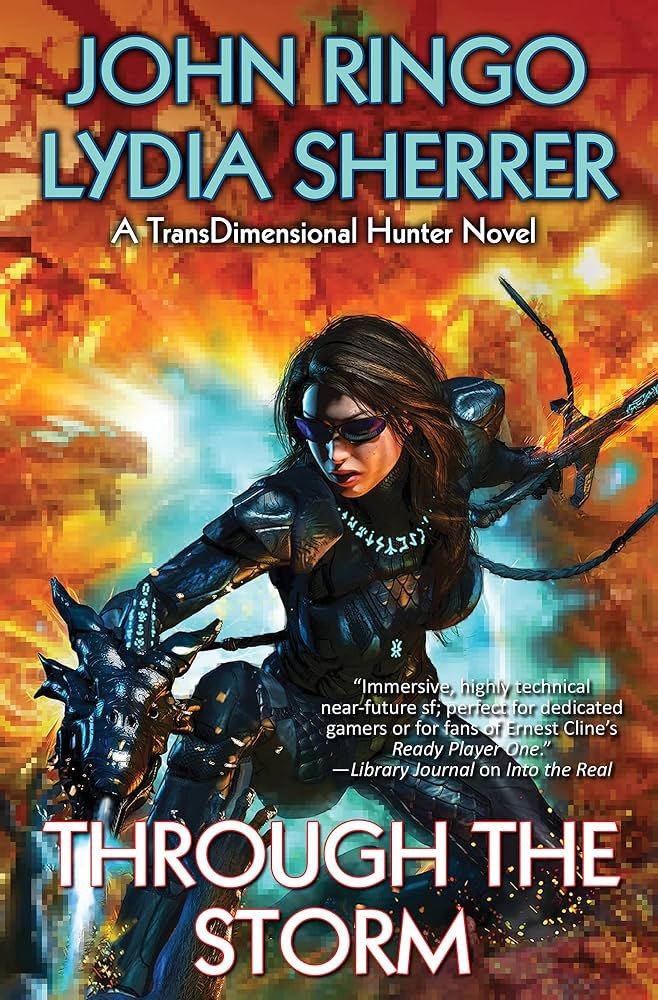
Through the Storm is not the strongest book in this series by a distance, and I say that as someone who has read all three more than once and enjoyed them.
The underlying story does advance. There are still threads moving under the surface, and the thing the first book planted about what TransDimensional Hunter actually is keeps developing. But the bulk of this book is about how Lynn Raven copes with becoming famous, and that’s a much narrower subject than what came before it.
The reversal is genuinely smart
Credit where it’s due, the structural move is the best idea in the book.
The first book was about being forced out of the house. This one is about what happens once everybody can see you. Lynn’s cover as Larry Coughlin is gone, she’s competing publicly as herself, as a teenage girl, and she’s winning. The winning is the problem. Drone paparazzi follow her around, she acquires a public profile she has no tools to manage, and every bit of it lands on someone whose entire functioning strategy was anonymity.
That’s a proper reversal rather than a repeat, and on paper it’s exactly the right second-book move. Take the thing that made the character work and remove it.
So why doesn’t it land?
Because the execution keeps reaching for the same handful of conflicts.
There’s more of the girl-on-girl bullying that I already flagged as the weakest part of the first book, and now there’s doxing on top of it. There’s a basic romantic subplot that doesn’t do much. The jealous-teammates thread has some merit, since success genuinely does breed resentment inside a competitive roster, but it’s handled at about the level of a school drama rather than a professional one.
Individually none of these are unreasonable. Fame, harassment and jealousy are real things that would happen to a teenage girl who suddenly became a public competitor. The problem is that they crowd out the material I actually came for. The alien thread barely moves. The question of what the game is really doing, which is the strongest idea in the whole series, sits nearly still for four hundred pages.
The middle-book problem
I’ve been here before, and recently. Citadel is the Troy Rising book I have to push through on every reread, and this is the same shape of problem, a middle volume where the author is moving pieces into position and the reader can feel it happening.
There’s a difference worth naming, though. Citadel drags because it’s doing logistics. Through the Storm drags because it swaps genres. It stops being a science fiction novel with a social layer and becomes a social novel with a science fiction subplot, and if you came for the second thing, that’s a long wait.
The comparison that flatters it more is Ender’s Game, which also spends most of its length on training and social hierarchy with the real story hidden underneath. Card gets away with it because the social material is the training, and every bit of the bullying is the system deliberately shaping him. Here, the bullying is mostly just bullying. It happens to Lynn rather than being done to her for a reason, and that’s the gap.
Lynn carries it
What saves the book is the character work, which is genuinely strong. Lynn’s insecurities are written convincingly, she makes real mistakes, and the balancing act between being competent in-game and functional out of it is the most honest thing in the series.
If the first book was premise-forward, this one is character-forward, and Lydia Sherrer is clearly doing the heavy lifting there. That’s not a criticism of the collaboration, it’s the reason these books read differently from Ringo’s solo work. The interiority is not something his military SF is known for.
The ending does what it needs to. Lynn leads her team through a multi-team boss battle and wins, which sets up the run at the national championship in book three. It’s a clean handoff.
Does it hold up on a reread?
This is the real test for a middle book, and my answer is a qualified yes.
I don’t skip it, which is more than I can say for a lot of second volumes. But I don’t reach for it either. It reads better knowing what book three does with the threads it leaves hanging, and worse if you’re coming to it fresh expecting the pace of the first one.
The audiobook helps. Sarah Mollo-Christensen narrates the whole series and she’s good enough that the slower stretches go down easier than they do in print. If you’re deciding how to take this one on, that’s my recommendation.

The fame material is better than the bullying material
Worth separating these, because I have been lumping them together and they are not equally weak.
The fame thread has real substance in it. Lynn genuinely cannot handle being perceived, and the book is good on the specific texture of that: the way a public profile arrives whether you consent to it or not, the way winning generates obligations she never agreed to, the way there is no version of success available that does not cost her the thing that made her functional. That is a proper subject and the book takes it seriously.
The bullying and doxing material is where it thins. It is incident rather than exploration, a series of things that happen to Lynn rather than a pressure that changes her. The difference matters. The fame thread asks what happens to a person built for anonymity when anonymity ends. The bullying thread mostly just asks you to feel bad for her.
If the book had cut the second entirely and doubled the first, it would be considerably stronger and about the same length.
Ringo and Sherrer, and who is doing what
I said in my book one review that this does not read like a Ringo novel, and book two makes the division of labour even clearer.
The interiority here, the anxiety, the social calculation, the specific texture of being a teenage girl who is suddenly visible, is not something Ringo’s solo work has ever shown much interest in. His military SF is excellent at systems, hardware and consequence, and largely uninterested in what anybody feels about any of it. This book is almost entirely about what somebody feels.
That makes book two the strongest evidence yet that Sherrer is carrying the character writing, and it is also why this volume divides readers. If you came to the series through Ringo’s name, this is the book furthest from what that name usually delivers. If you came for Lynn, it is the most concentrated dose of her in the series.
Neither reading is wrong. It just means the book has a much narrower audience than the one either side of it.
What it does for the series
Setting aside how it reads in isolation, this book does necessary work.
Lynn has to stop being the girl hiding behind Larry before she can be anything else, and that transition needs a whole volume. You cannot skip from anonymous prodigy to national competitor without showing the cost, and the cost is what this book is about. Read as a bridge, it is doing its job properly.
The team material matters for the same reason. Book three’s championship run only means anything if the roster is a real thing with real friction, and this is where that friction gets established. It is tedious in places, and it is load-bearing.
Where I land
Not the best of the three at this point, and the one I’d warn people about. It’s a bridge, and it’s a well-written bridge with excellent character work, but it’s asking you to spend a long time on high school problems in a series whose best idea is about something else entirely.
Read it, because book three needs it and because Lynn is worth the time. Just go in knowing what kind of book it is, and don’t expect the alien plot to move much. I’ve got book four sitting on my Audible queue and I’ll be going back through the whole series again before I start it, including this one, which is probably the fairest thing I can say about it.

1 comment
[…] said in my review of Through the Storm that the alien plot barely moved across four hundred pages, and that the fame-and-bullying material […]