
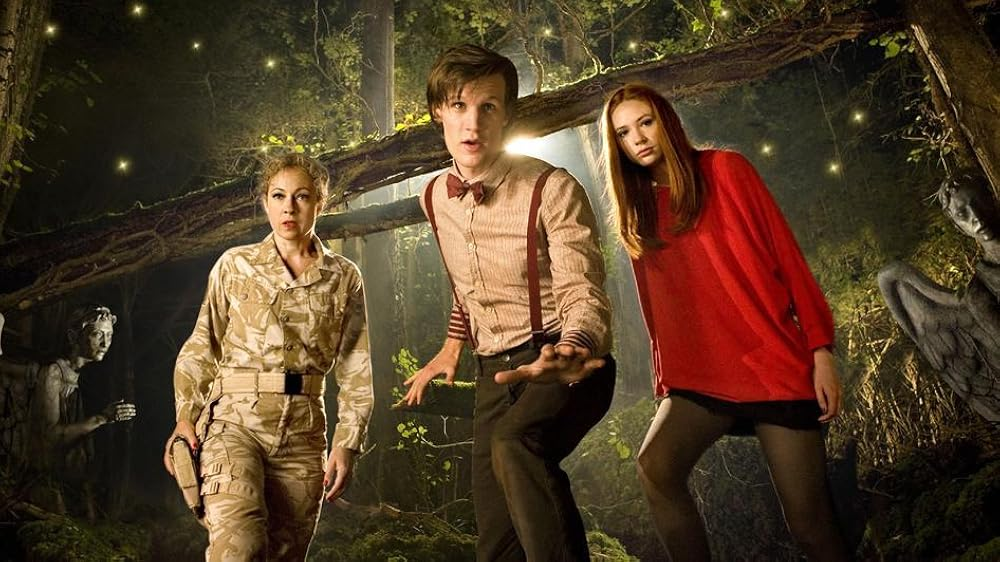
The second half of the Weeping Angels story does something I didn’t expect: it barely bothers with the Angels. “Flesh and Stone” resolves them almost casually and spends its real energy on something far more frightening, a crack in the wall of the universe that doesn’t kill you so much as delete the fact that you ever existed. It’s the episode where Series 5 stops being a fun new era and starts showing its teeth.
Out of the crash
We pick up from The Time of Angels with everyone about to be torn apart, and Moffat resolves it with the sort of trick he’s very good at: the Doctor shoots a gravity globe and the whole party falls up into the crashed hull of the Byzantium. It’s clever, it’s fast, and it buys the episode a much better setting, an oxygen forest growing inside a starship, all trees and dappled light and sprinklers, with an army of stone angels closing in through it. The forest is a lovely piece of design work, a vast internal biosphere gone dark, tree borgs humming quietly to themselves, shafts of emergency lighting falling through the canopy, and it gives the Angels somewhere genuinely unnerving to stand. Statues among trees work very differently from statues in a corridor: every trunk might be one, the shapes keep resolving wrongly at the edge of frame, and the camera keeps letting you check and then declining to let you check again.
Father Octavian’s clerics are the best guest ensemble the new era has had. They’re soldiers doing an impossible job with good humour, and the episode kills them methodically. Octavian himself gets one of the finest exchanges of the season, because dying, held in a statue’s grip, he tells the Doctor he wishes he’d known him better, and gets the reply that he did know him at his best. It’s a lovely, sad little beat in the middle of a monster chase. It’s a strong showcase for Matt Smith too. His Doctor is at his best here, a young face carrying a very old temper, snapping orders at armed soldiers twice his size and being obeyed without argument. There’s a moment where he tells Amy to trust him and she simply does, instantly, because of who he was to her when she was seven years old, and the weight of that lands without anybody having to stop and explain it.
The angels, and the thing behind them
The Angels here are meaner than the ones in Blink, and the story keeps adding rules to them. They snap necks now rather than politely displacing people in time. They talk, through a dead man’s cortex, which is genuinely horrible. And the nastiest new rule of all is that whatever holds the image of an Angel becomes an Angel, so Amy, who looked one of them in the eye, now has one growing inside her head with a countdown to prove it. That gives the episode its standout sequence. Amy has to walk through a forest packed with Angels with her eyes shut, alone, pretending she can still see them, because the moment they realise she’s blind they’ll take her. Karen Gillan is superb doing it, the shaking hands and the counting and the forced calm, and it’s the most nerve-shredding four minutes of the season so far. If there’s a criticism, it’s that the Angels are ultimately dispatched rather offhandedly. They fall into the crack and are unmade, and the episode moves on. Den of Geek put it well, that everything resolves very suddenly around the thirty-five minute mark. For a monster this good it’s a perfunctory exit.

Because the crack is what the story actually cares about. It’s the same crack that was in Amy’s bedroom wall when she was a little girl, back in The Eleventh Hour, a split in the universe itself, glowing white, and it is here too, on a different world in a different century. What it does is far worse than killing. Anything that falls into it is erased from having ever existed. A cleric walks into the light and vanishes, and thirty seconds later nobody in the room can remember him, not his name, not his face, not the fact that he was standing there. Only the Doctor remembers, because he’s a time traveller and the rules bend around him. Amy doesn’t. She’s talking to a man one moment and has never met him the next, and she doesn’t notice a thing.
The show is unusually disciplined about it. There’s no scene where somebody explains the mechanism, no helpful diagram, no moment of the Doctor working it out aloud for the audience’s benefit. People simply stop having been there, and the episode trusts you to spot the gaps on your own. By the final act the surviving party is a fraction of the size it started at, and nobody in the room besides the Doctor, and you, has the faintest idea that anything has gone missing. That’s an exceptional horror idea and the episode plays it patiently. The group gets smaller and the survivors don’t grieve, because there’s nobody to grieve for. It’s also doing quiet arc work: Amy can’t remember the Daleks, she can’t remember the year the stars went out, and the Doctor’s face when he realises how much has been eaten out of her memory is not reassuring.
River, and a date that matters
River Song remains the most tantalising thing in the show. She’s here as a prisoner on day release, escorted by armed clerics, working off a sentence, and when the Doctor asks what she did, Octavian tells him she killed a man. A good man. A hero to many. Possibly the best man she ever knew. She still knows the Doctor’s future. He still doesn’t know her. Since Forest of the Dead, which from her perspective hasn’t happened yet and from his has, the imbalance has flipped in a way that makes my head hurt pleasantly. She promises him he’ll see her again, at the Pandorica. He has no idea what that means. Neither do I. The AV Club makes the point that the two-parter is really about advancing her and the crack rather than the statues, and that’s exactly what it’s doing.
Then the episode does something genuinely awkward, on purpose. Amy, wired on survival adrenaline, throws herself at the Doctor, and he is completely, comically out of his depth, all flailing limbs and horrified politeness. It’s played for laughs, but there’s a serious point underneath. The Doctor asks about her wedding, and the date, and the date is the twenty-sixth of June, 2010, and something about it clearly matters enormously. He drags her back to the TARDIS not because he’s offended but because he’s worked something out and won’t say what.
What it leaves behind is a crack that unmakes people, erasure rather than death with nobody left to notice, which is the most frightening idea the new era has produced. It leaves Amy’s blind walk, four minutes of pure nerve and the moment Gillan proves she can carry a sequence alone. It leaves Angels with new rules, talking and neck-snapping and infectious through the eye, meaner than Blink if less elegantly used. It leaves holes in Amy’s memory, things she was present for and has lost, with the Doctor visibly alarmed about it, because something has been eating this universe for a while. And it leaves a wedding date that matters, the twenty-sixth of June 2010, which he wouldn’t explain and I’d very much like to understand.
Rating: 4.5/5. A superb, tense hour that trades a bit of monster satisfaction for a much bigger idea, anchored by a terrific Amy and the best guest cast of the run. The Angels deserved a better exit; everything else is close to flawless. A forest growing inside a crashed spaceship, a girl walking blind past a hundred statues, and a crack in everything that quietly eats you out of history. Also, River Song killed a hero, a good man, the best she ever knew, and she still won’t say who.
