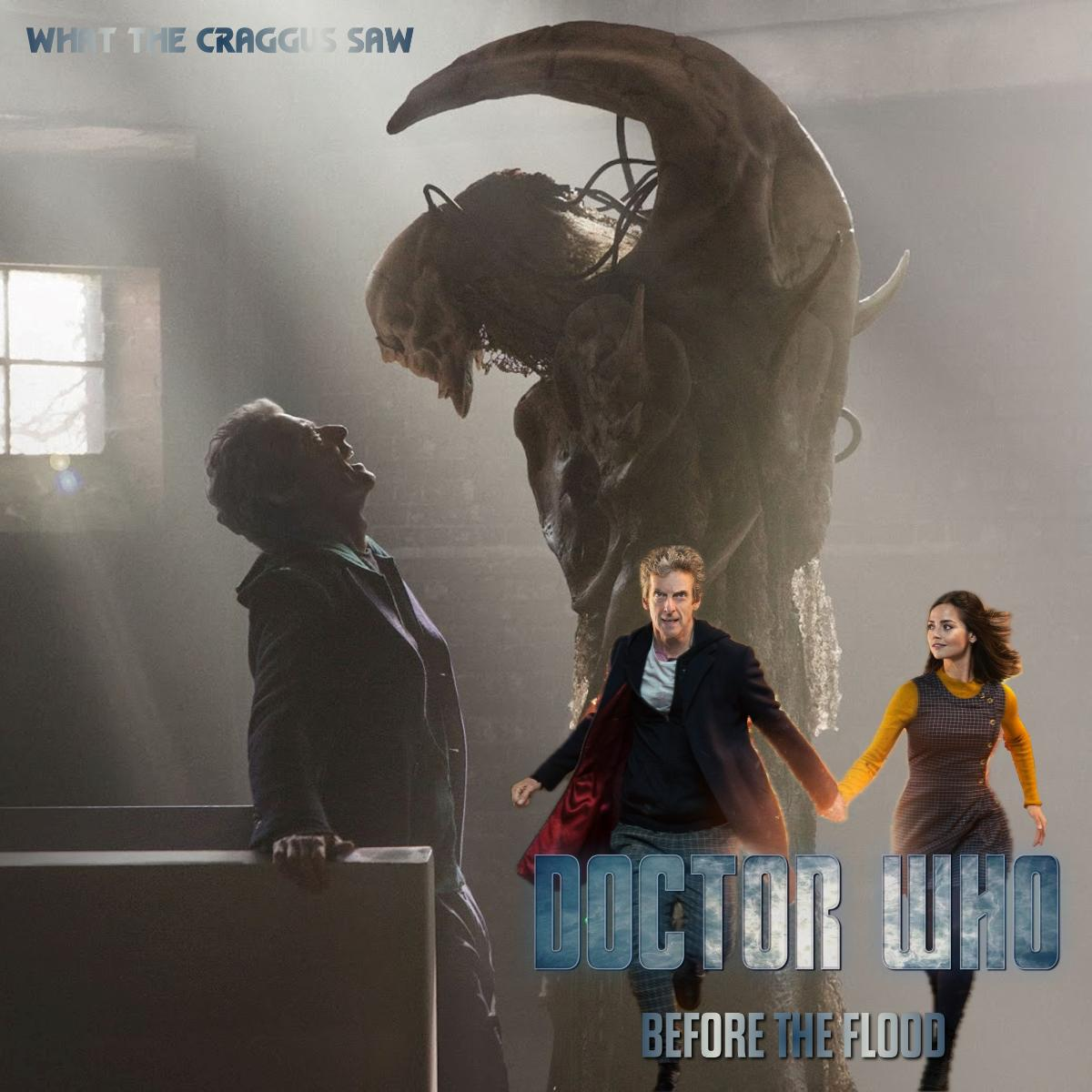
“Before the Flood” concludes the Series 9 two-parter that began with “Under the Lake”, sending the Twelfth Doctor back to 1980 to discover where the ghosts at the Drum came from while Clara holds out in the future. The review covers the Doctor’s bootstrap paradox opening, the arrival of the Fisher King and how the episode handles its own time loop.
It praises the Fisher King as one of the best villains of the era and enjoys the Doctor finally addressing his own influence on history, but finds the ghosts’ timeline inconsistent. It rates the episode 4.5 out of 5.
This series is all about the two-parters, and “Before the Flood” picks up straight from Under the Lake, which I’ll be honest wasn’t one of my favourites. The good news is that this one is a big step up. It opens with the Doctor looking straight down the camera, strumming an electric guitar and explaining something called the bootstrap paradox, and that alone had me grinning. Then it introduces the Fisher King, an awesome new villain they clearly spent the budget on, which is more than I can say for last week’s spaceship. By the end I’d forgiven the first half almost everything.
The bootstrap paradox
The opening is my favourite cold open of the series. The Doctor tells the story of a time traveller who goes back to meet Beethoven, finds that nobody has ever heard of him, and saves history by copying out all the symphonies from the sheet music he brought with him and publishing them himself. So who actually wrote Beethoven’s Fifth? Capaldi then plays the opening notes on his electric guitar, and the theme tune kicks in with a rock riff, which is about as cool as this Doctor gets. He also mentions in passing that he’s met Beethoven, nice chap, very intense, loved an arm wrestle, and that made me laugh out loud.
What I really liked is that the Doctor finally deals with his own influence on history head-on. He’s been meddling with it for years, sometimes in small, subtle ways like Vincent and the Doctor and sometimes in much bigger ones like The Shakespeare Code. The show keeps talking about fixed points in time that he supposedly can’t touch, but half the time that’s been more of a talking point than a rule. Having him stand up and admit the paradox at the heart of what he does is genuinely refreshing. It also sets up the whole episode, because the story that follows turns out to be exactly that kind of loop.
The Fisher King
The story proper sends the Doctor, O’Donnell and Bennett back to 1980, to the town that will one day sit at the bottom of the lake. It turns out to be a fake Soviet village built for army training, which is a nice detail. The ship is there, but the writing that’s been causing all the trouble isn’t in it yet, so someone still has to put it there. O’Donnell gets a lovely little moment when she reels off a list of things that are coming, Harold Saxon, the Minister of War, the moon exploding and a big bat coming out of it, and the Doctor cuts her off before she can tell him any more. I have no idea who the Minister of War is, and neither does he.
Then there’s the Fisher King, and I can’t speak highly enough of him. He’s huge, he’s properly malevolent, and unlike the spaceship he looks like somebody actually cared about making him. The Undertaker, a Tivolian who has brought the Fisher King to Earth to be buried, turns out to be the first ghost we saw last week, and the Tivolians are a funny idea, a race that’s been conquered so many times they now take pride in it. The Fisher King isn’t dead, though, and he’s been using the writing in the ship to turn the dead into ghosts that broadcast a signal to his people. He knows exactly what he’s capable of, and he knows exactly who the Doctor is.
Best of all, he hates the Time Lords. He calls them cowardly, vain curators who suddenly remembered they had teeth and became the most warlike race in the galaxy, and the contempt in his voice is palpable. It’s fascinating to hear what the wider universe thinks of the Doctor’s people after the Time War, because the effects of that war clearly reached a lot further than Gallifrey and the Daleks. His confrontation with the Doctor isn’t quite at the level of the conversations with Davros in The Magician’s Apprentice, but it’s excellent all the same. He’s only on screen for a few minutes, and I wanted a lot more of him. You can’t really ask for more in an enemy.

Where the loop gets tangled
Meanwhile in the future, Clara, Lunn and Cass are just trying to survive, and it gets worse when O’Donnell’s ghost turns up and lets the others out of the Faraday cage. This is where the time travel stopped working for me. O’Donnell’s ghost only appears in 2119 once we’ve watched her die in 1980, as if the future were politely waiting for the past to catch up. But the Undertaker’s ghost was there right from the start, and you can’t have one part of the story running in a straight line and another part not. I think they should have been braver and let the timelines properly scramble, the way Interstellar did. As it stands, it’s the one thing in the episode that pulled me out of it.
The best scare of the whole two-parter comes in this half, too. Cass is left alone in a corridor while one of the ghosts comes up behind her dragging an axe, and the episode drops all the sound so that we hear it the way she does, which is not at all. She only knows it’s there because she can feel the axe scraping along the floor through her feet. It’s a brilliant idea, beautifully done, and it had me holding my breath.
The resolution is clever, though. The Doctor’s ghost turns out to be a hologram he’s programmed to look and act like him, which traps the remaining ghosts in the cage again, and he only knew to build it because he’d already seen it work. That’s the bootstrap paradox from the opening, played out for real, and it’s a satisfying way to close the loop. He also opens the dam and floods the valley to finish off the Fisher King, which is where the title finally pays off. The ship is carted off by UNIT, and Bennett, having lost O’Donnell before he could tell her how he felt, pushes Lunn to tell Cass while he still can. It’s tidy in the best way.
Rating: 4.5/5. A cracking second half that fixes most of what dragged in the first, with a cold open I loved, a monster I’d happily see again and a Doctor finally owning up to his own paradoxes. The ghosts’ timeline doesn’t quite hang together, and that’s the only thing keeping it from full marks. This is the kind of Doctor Who I watch the show for.
