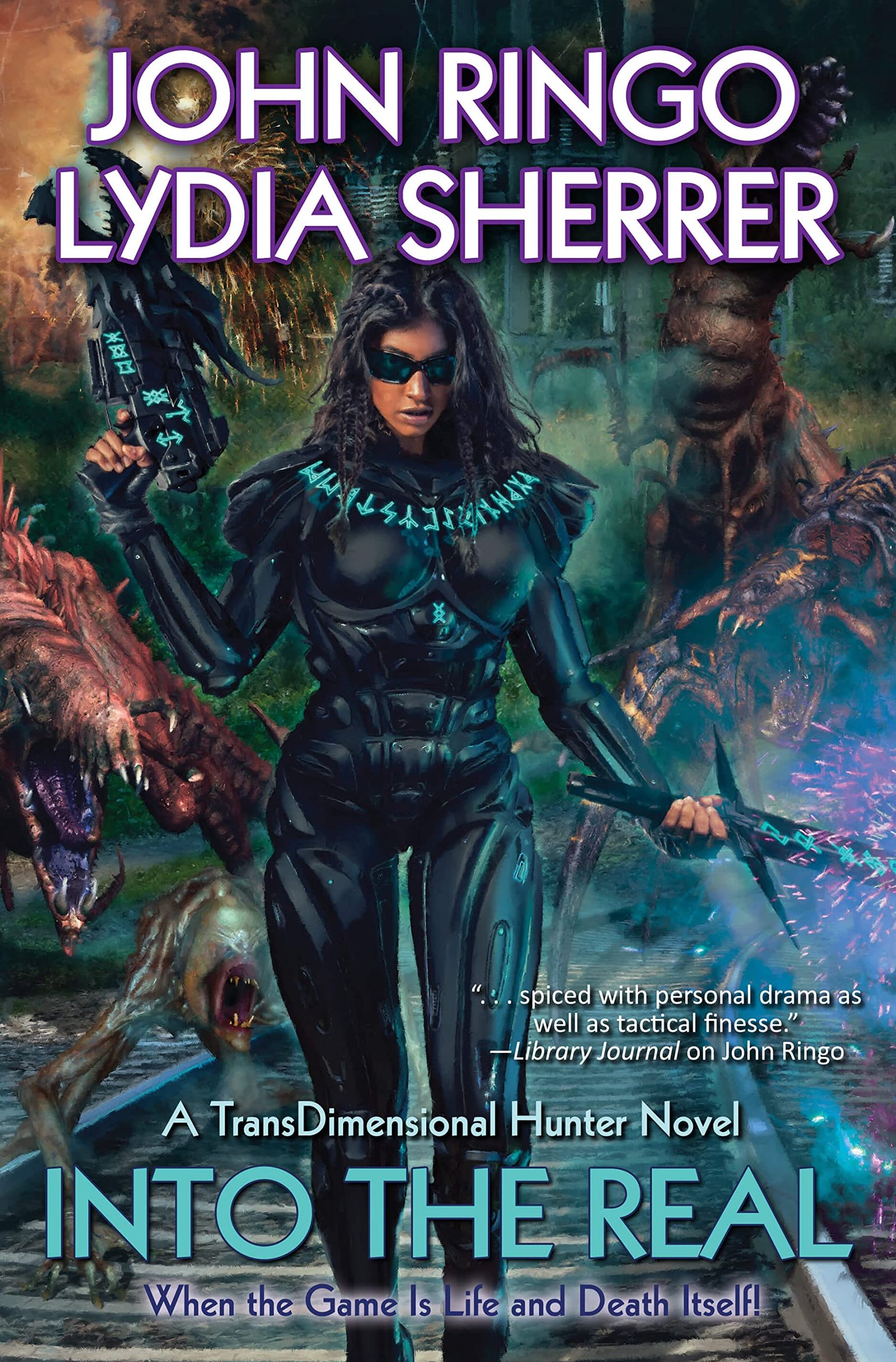
I’ve reread Into the Real three times now, which tells you more than any plot summary could. John Ringo and Lydia Sherrer’s TransDimensional Hunter opener isn’t the book people expect from Ringo’s name on the cover, and that’s exactly why it works.
Lynn Raven is seventeen, agoraphobic to a real degree, and the best player in the online shooter WarMonger 2050, as long as nobody knows she’s Lynn. Behind the screen she’s Larry Coughlin, “Larry the Snake,” a grizzled merc voice nobody questions. Then the CEO of Tsunami Entertainment personally recruits her to beta-test TransDimensional Hunter, an augmented-reality game that requires her to go outside, in daylight, around other actual people. That’s the whole engine of the book: an indoor prodigy forced into embodied, public competition where the anonymity that makes her good at anything stops protecting her.
The Ingress comparison nobody else is making
Every review reaches for “Ender’s Game meets Mean Girls meets Pokémon Go,” and it’s not wrong, but it missed the game I actually thought of reading it: Ingress. If you remember Ingress, you remember capturing nodes, running missions, building faction loyalty around a game layered onto real streets with less spectacle than Pokémon Go ever had. TransDimensional Hunter reads like Ingress got a monster-hunting skin and a training-simulator subplot nobody’s supposed to notice until the ending pulls back the curtain. That’s the book’s best structural idea, and it’s more original than the marketing lets on.

The Larry Coughlin conceit is the part that actually earns the book. A teenage girl building a convincing hard-bitten-veteran persona online, then having to defend that persona in person once the game forces her outside, is a sharper hook than “girl plays AR game.” I liked that Lynn stays a normal, human character throughout rather than turning into a chosen-one archetype the moment the plot needs her to win. The RPG-style progression, the leveling, the gear: all of it lands, because it’s attached to a character worth rooting for instead of bolted on as genre furniture.
Where the book drags
Here’s my actual complaint, and it’s a real one on a reread: the schoolgirl romance and mean-girl bullying subplot with Elena and Ronnie’s crew feels formulaic. It’s the kind of conflict that exists because YA books are supposed to have it, not because it’s driving the story Lynn is actually in. I know that dynamic happens in real high schools. That doesn’t mean it needed this much page space here, especially against a premise this interesting.
The Larry Coughlin quips only work if Lynn is consistently winning as Larry, and the book spends more time on the social drama than on showing the hand-eye coordination and training grind that would make her dominance in WarMonger 2050 believable. I’d have traded some of the bullying subplot for more of that. It’s a minor gap, but it’s the one place the book leans on assertion over evidence.

There’s a related question the book never quite answers, and it nagged at me on the second read. How much research could a seventeen-year-old actually do into being a hard-bitten army veteran? The persona has to survive scrutiny from people who play military shooters obsessively. Lynn pulls it off, and the book’s answer is essentially that she’s very good and very careful. I wanted a scene showing the work: the forums she trawled, the terminology she drilled, the near-misses where she almost got caught out on something a real vet would know. The deception is the premise. Show me the machinery.
The reveal that makes it worth a series
Underneath the loot-and-level surface, three threads build at once: Lynn assembling a team against Ronnie’s casual dismissal of girl gamers, a rival team that plays dirty, and a set of glitches that look personally targeted rather than random. The ending strongly implies TransDimensional Hunter isn’t entertainment at all. It’s a detection and training system, and there’s something real on the other side of it. That’s a strong book-one turn. It reframes everything that came before without cheating the reader.
I’ve gone through the Kindle edition and then all three audiobooks, narrated by Sarah Mollo-Christensen, more than once. Book four, Beyond the Rift, is already sitting on my Audible queue, and I expect I’ll be back through the whole series again before I start it. That’s not a small thing to say about a book I’d file loosely as YA. The rereads are the review.
Ringo’s co-author books keep proving the same point
Compare this to Live Free or Die, still the best idea Ringo’s had in straight military SF. Into the Real is a different animal entirely, and Sherrer’s fingerprints are all over the parts that work best: Lynn as a person, not a plot device, and a social world that (mostly) reads as real rather than assembled from tropes. Ringo’s solo output has leaned harder into formula lately. His co-author books, this one included, are where the actual craft is showing up.
The structural debt to Ender’s Game is obvious and the book doesn’t hide from it: a kid whose competence in a “game” turns out to be training for something with real stakes. What Into the Real adds is the identity question Card’s book never asked. Ender never had to wonder who he’d be if the other kids at Battle School knew who he actually was outside the sim.
Baen shelved this as military SF, which is a marketing sin. It buried a genuinely good YA science fiction novel under a label that scares off exactly the readers who’d love it. If you bounced off Ringo’s solo work, or you want a gaming novel where the offline life is the more interesting half of the story, this is worth the detour.
