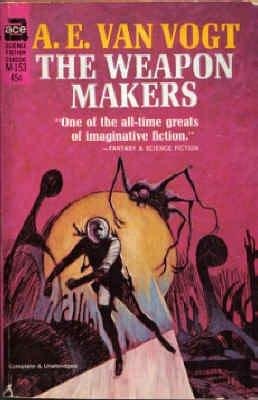
This is my The Weapon Makers review, and it’s a 2 out of 5 from me. It was a hard read, it didn’t deliver what I was expecting, and it really dragged. I struggled with it, and I don’t say that lightly about a book that’s only 186 pages long. It’s old-school science fiction, and I’ve got nothing against that, since I’ve read plenty of the classics on here (like The Demolished Man, The Stars My Destination and Old Man’s War), but this one just wasn’t for me. I was waiting for it to click, and it never did.
The Isher Empire and the Weapon Shops
The setup is big, pulp-sized stuff. Thousands of years from now the solar system is ruled by the Isher dynasty, and a guild called the Weapon Shops keeps the Empress honest by selling ordinary citizens defensive guns. The idea is that nobody can be pushed around when everyone’s armed, and it’s the core of the whole book: a ruler with all the power and a guild whose whole job is to stop her abusing it. It’s a clever idea, and it gives the story a good backbone. The Weapon Shops sit on one side, the Empress on the other, and everything that happens is a push and pull between them.
Robert Hedrock is a senior man in the Weapon Shops, working undercover as a captain at the Empress Innelda’s court. He’s also secretly the only immortal human, made that way thousands of years ago by a freak accident. That’s a good hook for a hero, and it’s the best thing about the book, a man who’s lived long enough to see empires rise and fall. Then scientists build the first interstellar drive, and the Empress wants it buried so her subjects can’t scatter beyond her reach, while the Weapon Shops want it out in the open. Everything else in the book hangs off that argument.
Hedrock at court, and hunted
The first stretch is Hedrock at court, where he watches the Empress condemn him to hang and then makes a very public show of Weapon Shops power at lunch, which gets him thrown out of the palace rather than quietly executed. It’s a good opening, with a hero watching his own death sentence being decided on a spy-ray, and I can see why it’s the part people pick out. On his way out he’s arrested by the Weapon Shops themselves, who question him about his past and order his execution too, so he ends up hunted by both sides. That’s an interesting turn, since the guild he secretly founded is ready to put him to death. The court intrigue is the part that gets the most praise, and I can see why it’s the part that’s set up best.
Meanwhile an engineer called Neelan goes looking for his brother Gil and finds out that a man called Greer marooned Gil and the drive’s inventors on an alien planet and stole the ship. The ship is hidden in plain sight in the middle of the Imperial City, and when the Empire mounts a military assault to seize it, Hedrock uses the drive to escape into deep space. It’s a lot of plot, and a lot of characters, and I found it hard to stay engaged with any of them. That’s where the book started to slow for me.
Neelan’s thread is the one that reads most like a mystery. He’s an engineer who comes back from an asteroid at the far side of the solar system and finds there’s no record of his brother Gil’s death at all. Gil’s landlady says he left a year ago, so Neelan goes looking for the ship, and finds out what’s really been going on. When Greer is cornered, the Empress forces Neelan, under threat of death, to kill him, and the story’s two halves begin to run together. It’s a decent thread, a man digging up a secret, and it gives the book a human angle that’s easy to follow. It’s the sort of storyline that should have pulled me through the middle, and for me it didn’t.

Why it dragged
But for me it really dragged, and that was true long before the spiders turned up. I struggled to stay with it. The starship, the assault, the chase and the escape all felt like a lot of motion without much pulling me through it. It’s a short book, and it felt a lot longer. Some books pull you along. This one I had to push through.
I don’t think it’s a bad idea for a book, and I can see why it has fans. The Weapon Shops and the Empress are an interesting pair of opposites, and there’s a good book in there about power and who gets to hold it. But what I got on the page didn’t live up to what I expected, and I’m not sure I could say exactly what was missing. It just didn’t hold me.
What it’s about underneath
There’s a lot going on under the pulp, and I’d be unfair if I didn’t say so. The Weapon Shops idea, that ordinary people should be able to buy weapons to defend themselves against the state, is the sort of thing you could argue about for hours, and the book clearly wants you to. There’s also the idea of the lone superman, someone who’s lived so long and learned so much that he can quietly steer history without anybody knowing it’s him. Hedrock plays that part straight, as a kind of immortal hero who’s always one step ahead. It’s an idea the Foundation series plays with on a much bigger scale. And then there’s the final idea, that human love and self-sacrifice are what make us special, which is why the spiders step back at the end.
It’s a lot to pack into 186 pages, and some of it works better than the rest. People who like Golden Age science fiction praise it for being fast and inventive, with a striking ending that rates humanity above the aliens instead of below them. The criticisms I’ve seen are about the language getting overblown, especially in the scenes with the aliens, and about the hero being harder to believe than you’d like. It’s pure pulp, with ray guns, a starship, aliens and mental powers, and it plays all of them without a wink. If that’s what you’re after, it’s all there, and if it isn’t, it’s a long road.
Out in space Hedrock meets a race of enormously powerful, spider-like aliens who’ve never known altruism, and he’s under pressure from all sides as his immortality gradually comes out. They look down on other species and don’t understand the idea of helping someone else, and they’re watching what humans do. Then comes the climax, where he makes himself a hundred and fifty feet tall and strides through dozens of cities smashing buildings until the Empress gives up the drive. It’s about as pulp as it gets, and I can see why someone would love it. It didn’t change how I felt about the book.
It ends with Hedrock marrying Innelda, and her dying in childbirth so the child and the Isher line can survive, and the spiders deciding that humans are the greatest of the intelligent species after watching that kind of love. It’s an unexpected way to finish, with the Empress who ordered him hanged becoming his wife, and it all happens quickly. It has a big, strange sweep to it, and I can see what it was going for. For me it was too late, and the book had already lost me by then.
What I made of it
I can see what the book is going for. It’s got big ideas, a hero who can’t be killed, a clever setup around who gets to hold power, and a finish that stakes everything on love and sacrifice. A lot of readers like exactly that kind of thing, and if you do, you may well get more out of it than I did.
For me it was a hard read, it didn’t deliver what I was expecting, and it dragged. I struggled with it, and that’s the plainest way I can put it. It’s a 2 from me, and I’d say that if you’re curious about old-school science fiction, there are better places to start. Rating: 2 out of 5. It was a hard read and I struggled through it.
