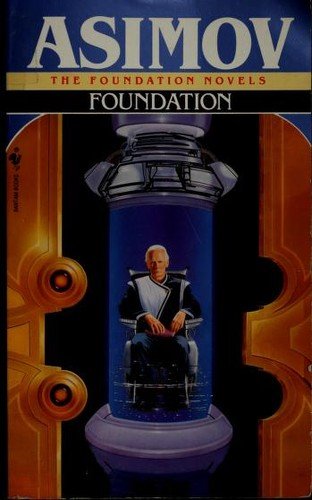
I look at Isaac Asimov’s Foundation series, the books about Hari Seldon, psychohistory and the slow collapse of a Galactic Empire, and how the original trilogy grew into a universe that ties in his Robot and Empire novels across nearly twenty thousand years.
It was one of the first truly epic science fiction series I ever read and I loved it. I walk through the setup, the two Foundations, where the later books take things and the order the books fall into, without giving away where the Second Foundation is hiding.
Probably one of the first “epic” series of science fiction books that I had the pleasure of reading, and it’s stuck with me ever since. The Foundation series was written by Isaac Asimov, a grandmaster of science fiction and, along with Arthur C. Clarke and Robert Heinlein, one of the granddaddies of the genre. It’s a set of novels spanning hundreds of years of future history, all of it about the fall and rebirth of a Galactic Empire, and if you’ve ever wondered where half the ideas in modern space opera came from, a lot of them start here. Asimov wrote something like five hundred books in his life, but this is the one most people know him for.
The initial Foundation series was tied to the first trilogy of books he published, but later on the Robot series and the Empire novels were tied into the same fictional universe through some key and very specific characters, so that in total the time span covered is almost twenty thousand years! That’s a mind-boggling amount of history for one author to keep straight. The original stories ran in Astounding Science Fiction magazine through the 1940s before being collected as Foundation in 1951, Foundation and Empire in 1952 and Second Foundation in 1953, and they come from that same era of big-idea magazine science fiction that also gave us The Stars My Destination. Asimov said he got the idea from Gibbon’s history of the decline and fall of the Roman Empire, just moved out to a galaxy of millions of worlds, and once you know that you can see Rome everywhere in it.
Hari Seldon and the maths of a falling empire
The basic story goes like this. Hari Seldon, a mathematician in the First Empire, works out that the fall of the Empire is not only imminent but inevitable. He bases this on his “new” science of psychohistory, which works on the principle that the behaviour of a mass of people is predictable as long as the mass is very large, and they don’t come much larger than the population of the galaxy, quadrillions of humans spread across millions of star systems. The bigger the number, the more predictable the future gets. Using this new maths Seldon can see what’s coming, but only on a large scale, never for one person, and what he sees is the Galactic Empire collapsing and a dark age that will last thirty thousand years before a second empire rises to replace it. Nobody wants to hear that, least of all the people running the Empire from Trantor, a capital planet that’s been built over into one enormous city.
So Hari sets out to shorten the period of anarchy and barbarism. He can’t stop the fall, the maths says it’s coming whatever anyone does, but he thinks he can cut thirty thousand years of darkness down to a mere one thousand. It’s a very different way of thinking about civilisation collapsing to something like Lucifer’s Hammer, where the end arrives in one terrible day and the survivors scramble to hang on to what they can, because here the collapse is slow and the rescue plan is laid down centuries before anybody needs it. His answer is to set up two separate foundations at “opposite ends of the galaxy”. Each one is given its own skills and its own scope, so that together they’re stronger than either of them would be on its own, and the idea of a plan playing out over a thousand years is what hooked me the first time round.
Two Foundations at opposite ends of the galaxy
The First Foundation is located on the planet Terminus, right on the extreme edge of the galaxy, about as far from Trantor as you can get. The people living there are working on the all-encompassing Encyclopedia Galactica and are unaware of Seldon’s real intentions, because if they knew, the variables would get too far out of control and the maths would stop working. The Encyclopedia is there to preserve knowledge of the physical sciences after the collapse, so this Foundation is built on science and technology. Of course the encyclopedia turns out to be a bit of a cover story, and the fun of the first book is watching the people of Terminus work out what they’re really there for, one crisis at a time.

Those crises are the heart of it. Every so often Terminus hits what’s called a Seldon Crisis, a moment where everything looks lost, and Seldon himself appears as a recording in the Time Vault to tell them, more or less, that he saw it coming. I love that idea, a dead man explaining your own history to you while you’re still living it. The first book is really a run of short stories, each one jumping decades ahead to the next crisis with a new set of characters, mayors and traders and merchant princes, so you get a real sense of time passing. Salvor Hardin gets the best line, that violence is the last refuge of the incompetent, and it sums up the whole feel of the books, because people mostly win by outthinking each other rather than shooting each other. The folks at this long-running Asimov fan site go through the first book story by story, and it’s a good read if you want more on each crisis.
The Second Foundation is located at… well, this is actually one of the better surprises of the series, so I hope you don’t mind too much if I don’t tell you and let you find out for yourself! They’re the keepers of Hari’s vision, making sure the plan stays on track and that no unforeseen consequences knock it sideways. They’re dedicated much more to the science of the mind than to the physical sciences, and their skills complement and complete the First Foundation’s. Where the people of Terminus build gadgets and trade empires, the Second Foundation works quietly in the background, and a big part of the fun of the later books is that nobody, not even me half the time, knows quite who belongs to it.
Where the series goes after the trilogy
Foundation and Empire is where the plan meets something it can’t predict, a mutant called the Mule who can reach into people’s minds and change how they feel. Psychohistory only works on large numbers, so one man with a power like that is exactly the kind of thing the maths can’t see coming, and it’s a brilliant way of testing the whole idea Asimov had set up in the first book. The Mule turns up on a lot of the old paperback covers too, which tells you how much he means to fans of the series, and Second Foundation then picks up the pieces and turns the hunt for the hidden Foundation into the main story.
For about thirty years that was that. Then Asimov came back to it in the 1980s with Foundation’s Edge in 1982, which won the Hugo for best novel, and Foundation and Earth in 1986, and those two carry the story on past the end of the trilogy and start pulling the rest of his work into it. After that he went backwards with two prequels, Prelude to Foundation in 1988 and Forward the Foundation, which came out in 1993, the year after he died. The prequels are about Hari Seldon himself as a young mathematician on Trantor, working out psychohistory before anyone believes in it, and it’s strange and a bit sad to read the last one knowing it was his final word on the series.
The Foundation books in order
The original trilogy is the core of it, and back in 1966 it was given a one-off Hugo Award for the best all-time series, beating The Lord of the Rings to the prize, which is some going for a set of books that started out as magazine stories. Here’s how the Foundation books break down, with the prequels first, then the original trilogy, then the sequels:
Prequels
- Prelude to Foundation
- Forward the Foundation
Original Trilogy
- Foundation
- Foundation and Empire
- Second Foundation
Sequels
- Foundation’s Edge
- Foundation and Earth
That’s the Foundation series proper, seven books, but the Robot novels and the Empire novels like Pebble in the Sky and The Currents of Space sit in the same history, further back, and Asimov spent his later years stitching all of it together into one timeline. You don’t need any of those to enjoy the trilogy, though. The three original books stand up perfectly well on their own, and they’re short too, which surprised me given how much history they cover. There are no big space battles to speak of, it’s mostly people in rooms talking their way out of disaster, and I didn’t miss the battles at all, because the ideas carry it and the jumps through time keep it moving.
Did you guess where the Second Foundation was hiding before Asimov finally told you, or did it catch you out the way it caught me? Tell me in the comments.

3 comments
[…] Season 2 was I guess more about the true emancipation of the hosts as being free in Westworld did not really get them anywhere when you consider that humans could if necessary just nuke them back to the stone age. While the concept and idea made sense to me, the execution was a bit messy and it didn’t really gel, like the first season in my opinion. It was, of course, nice to see some of the other “worlds” with their own inhabitants but that was more Maeve’s story than Dolores and while she is in an interesting character, in my opinion, she’s almost like the Mule from Asimov’s Foundation series. She’s a mutation and …. […]
[…] Season 2 was I guess more about the true emancipation of the hosts as being free in Westworld did not really get them anywhere when you consider that humans could if necessary just nuke them back to the stone age. While the concept and idea made sense to me, the execution was a bit messy and it didn’t really gel, like the first season in my opinion. It was, of course, nice to see some of the other “worlds” with their own inhabitants but that was more Maeve’s story than Dolores and while she is in an interesting character, in my opinion, she’s almost like the Mule from Asimov’s Foundation series. She’s a mutation and …. […]
Seldon’s Plan always puts me in mind of the Bene Gesserit in Dune, another group quietly steering human history over centuries while most people have no idea it’s happening. The difference is that Seldon trusts maths and the Bene Gesserit trust bloodlines, and both of them get caught out by one person nobody planned for.