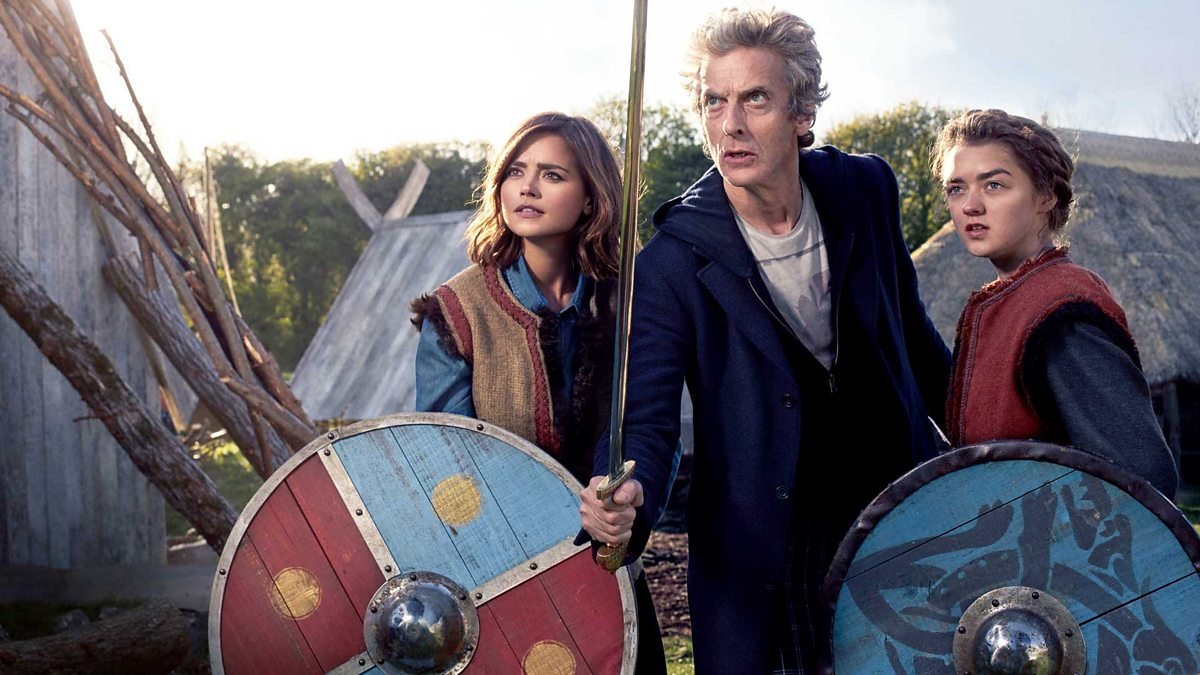
“The Girl Who Died” is the first half of a Series 9 two-parter in which the Twelfth Doctor and Clara are captured by Vikings and caught up in a raid by the Mire, an alien warrior race whose leader poses as Odin. The review looks at the village’s desperate defence, the Doctor’s discovery of why he has the face he does, and Maisie Williams as Ashildr.
It enjoys the comedy of the Viking material and the strength of Ashildr, and singles out the ending, in which the Doctor uses alien technology to bring her back to life and makes her immortal, as the best part of the episode. It rates the episode 3.5 out of 5.
I’ve always had a soft spot for Doctor Who when it goes back in time, and a Viking village is about as good a setting as the show has picked in a while. “The Girl Who Died” opens with the Doctor and Clara being hauled off by a band of Vikings, the sonic sunglasses snapped in half, and the Doctor trying to convince them he’s Odin with the help of a yo-yo. It doesn’t work, which is half the fun. Then Odin actually turns up, a giant face in the sky, and takes the village’s best warriors away to a feast in Valhalla that turns out to be something much nastier. What follows is a funny, slightly slight story that saves its best idea for the last five minutes. I enjoyed it, but it’s the ending I’ll remember.
Vikings, eels and a very bad plan
The Mire, it turns out, are an alien warrior race who harvest adrenaline and testosterone from their victims, and the Vikings they took have been turned into a drink. That leaves a village of farmers, fishermen and a young girl called Ashildr, and the Mire promise to come back the next day and wipe them out. The Doctor’s first instinct is to leave, and Clara, as usual, won’t let him. So he has to turn a group of people who’ve never held a sword into an army in a single night, which the episode plays for comedy, and a lot of it lands. The training montage, with the villagers failing at every weapon he hands them, is the funniest few minutes of the series so far.
There’s a lovely small moment in the middle of all this, when a baby starts crying and the Doctor translates it. He speaks baby, apparently, and the baby is crying about the fire and the fighting and about being frightened, and it’s what finally stops him from walking away. It’s a very Doctor way of being talked into something. Clara has a go at talking the Mire out of it herself, and very nearly succeeds, until Ashildr loses her temper and declares war on them on the village’s behalf. It’s a funny, busy first half.
The plan they eventually come up with is lovely and very Doctor-ish. Ashildr is a storyteller who makes puppets, and the Doctor uses one of them, a big dragon, together with a trap made from electric eels and the Vikings’ own metal, to turn the Mire’s attack into a humiliating mess. Then he records the whole thing and threatens to broadcast it across the galaxy, which would finish the Mire’s reputation as the deadliest warriors in the universe. They leave rather than be laughed at. It’s a very Doctor Who way of winning, beating a monster with shame rather than guns, and I like that the episode trusts it.
The Mire themselves look good, huge armoured figures who stomp about like they own the place, and the idea that their leader dresses himself up as Odin to farm Viking warriors is nicely nasty. The trouble is they never really feel like a threat, because we’re told they’re the deadliest warriors in the galaxy and then shown them being beaten by a puppet and some eels. That’s the joke, of course, and I laughed. It just means the tension drains out of the middle of the episode, and it’s left to Ashildr to give it any weight.

Where he got his face
The best moment in the episode isn’t the battle, though. It’s a quiet scene where the Doctor finally works out why he has the face he has. He remembers a man in Pompeii, Caecilius, the father he and Donna saved from the volcano in The Fires of Pompeii after Donna begged him to save someone. He realises he chose this face without knowing it, to remind himself that he’s the Doctor and that he saves people. I love that the show made that connection at all, seven years after the fact, and it gives Capaldi something genuinely moving to play. It also tells you exactly what he’s about to do.
Maisie Williams is very good as Ashildr. She’s brave and a little odd, a girl who lives in her own stories, and she’s the one who stands up to the Mire when nobody else will, which is how the village ends up at war in the first place. She’s also the one who pays for it. The strain of using a Mire helmet to work the dragon kills her, and the episode lets that land properly, with the whole village grieving and the Doctor raging at the rules that say he can’t just fix it. After Before the Flood spent an hour explaining why some things can’t be changed, it’s interesting to watch him decide he doesn’t care.
A girl who can’t die
So he saves her. He takes a piece of Mire technology, a repair kit meant for their battle helmets, and uses it to bring Ashildr back to life. The catch is that it doesn’t stop. It’ll keep repairing her forever, which means she’s now effectively immortal, and the Doctor knows it. He leaves her a second chip to use on someone she loves, and walks away. Then the camera stays on Ashildr as the world moves around her, the seasons turning and her expression hardening as the years pass, and it’s one of the most striking images of the series.
That ending is the reason I’d recommend this one. A lot of the episode is light and silly, which is fine by me. But the idea that the Doctor’s kindness has just made somebody live forever, and that forever is a very long time to be alone, is a proper science fiction idea with real weight. Her story carries straight on into The Woman Who Lived, and the two are worth watching together. It’s a good episode that turns into a much better one in its last five minutes, and Maisie Williams’ casting got plenty of attention for good reason.
Rating: 3.5/5. Funny, warm and a little slight for most of its running time, with a villain who never really threatens anyone. What lifts it is Maisie Williams and an ending with genuine weight, plus the best explanation this Doctor’s face was ever going to get. Good, not great, and the last five minutes are worth sitting through the rest for.
