
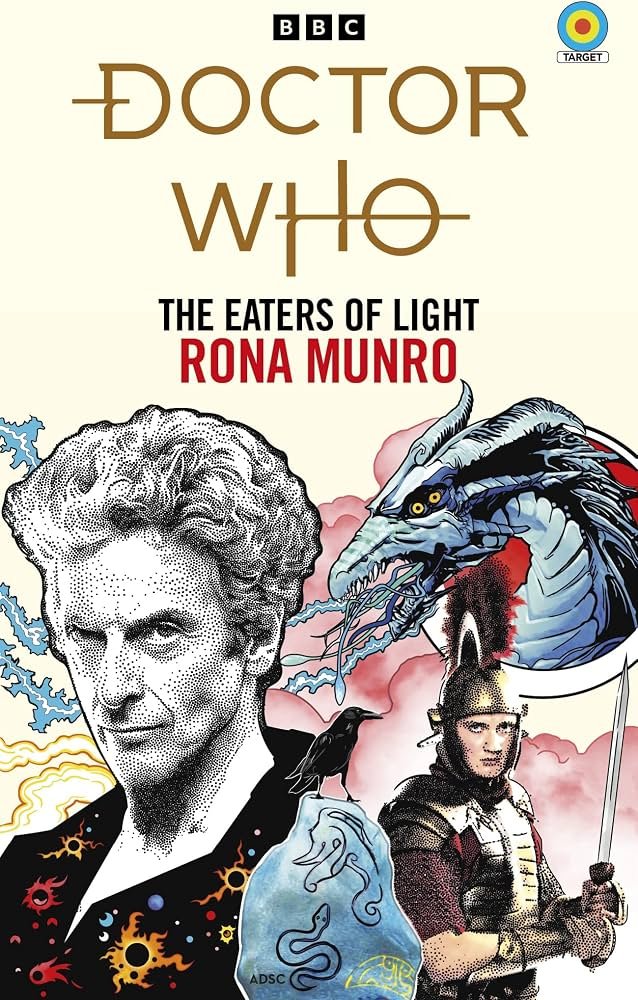
“The Eaters of Light” is a Doctor Who historical episode written by Rona Munro, the only writer to have contributed to both the classic and modern series. Set in second-century Scotland, it follows the Doctor and Bill as they investigate the disappearance of the Roman Ninth Legion, with the Doctor and Bill each ending up among opposing sides of the conflict.
The episode resolves its central mystery by revealing that the legion’s survivors and a Pict war band entered a dimensional gate together to contain a light-eating creature, sacrificing their lives unrecorded. A closing scene featuring Missy, visibly emotional while maintaining the TARDIS, quietly sets up the season finale.
Rona Munro wrote Survival in 1989 — the last serial of the original run, the one that ended with a Doctor and companion walking off into an uncertain future while the programme was quietly cancelled around them. Twenty-eight years later she is the only person to have written for both versions of this show, and “The Eaters of Light” is a good, sturdy, slightly melancholy piece of work that feels genuinely unlike anything else in the season.
It’s also the last quiet episode before the finale takes the roof off, and it knows it.
An Argument About History
The framing is charming: Bill and the Doctor disagree about what happened to the Ninth Legion, which vanished from the historical record in second-century Scotland, and go to settle it. She thinks they were massacred by the Picts. He thinks it’s more complicated. They land, split up, and each ends up embedded with one side of the argument.
That’s a nice structural idea — the companion with the Romans, the Doctor with the Picts — and it lets the episode do the thing historical Doctor Who is best at, which is establishing very quickly that both groups are frightened teenagers rather than armies.
Because that’s the sharpest observation in the script. The surviving legionaries are boys. The Pict war band is a handful of adolescents whose elders are already dead. Nobody in this story is a soldier by choice or a warrior by temperament; they’re children left holding a war that the adults started and did not survive.
The Gate
The creature is a decent invention and sensibly underused: a thing from another dimension that eats light — sunlight, firelight, and by extension the life of anything it touches — that comes through a gate in a cairn.
The Picts have a hereditary job. One of them goes through, holds the gate, and dies doing it, and another takes over. Kar, the current gatekeeper, let the creature through deliberately as a weapon against the Roman invasion, and it went badly, as it always does: the thing she loosed ate her people alongside the legion.
Rebecca Benson is very good as Kar — furious, guilty, and about nineteen — and the episode treats her mistake with real seriousness. She did a terrible thing for an understandable reason and now has to live in the wreckage of it, which is more or less the show’s oldest theme.

The creature itself is mostly light and sound and a few well-chosen shots, and the episode is right not to over-display it. What lands is the rule: on the other side of the gate, time runs differently, so holding it for a lifetime takes minutes here.
The best small invention in the episode is the crows. The Doctor explains that they used to talk — that corvids were part of the conversation until humanity stopped listening — and that they have been saying one word ever since, over and over, for two thousand years: Kar. They’re keeping her name, because somebody had to. It’s a lovely, slightly eerie idea, the sort of folkloric detail that makes a historical feel lived in rather than researched, and it gives the episode its closing image.
Munro’s script also has a distinctive quality that separates it from everything around it in the season: it isn’t structured as a puzzle. There’s no twist, no reveal, no reversal in the last ten minutes. It’s a situation, examined, and then resolved by people deciding to behave better. That’s a very 1980s way to build a Doctor Who story, and coming immediately before the finale’s machinery it feels almost restful.
The Two Good Conversations
There are two scenes people will remember, and neither is about the monster.
The first is Bill discovering that the Roman soldiers regard her preference for women as entirely unremarkable — and, more to the point, find her restrictiveness a bit odd, since most of them assume everyone is broadly interested in everyone. It’s played lightly and comically, it’s historically defensible, and it’s the sort of thing the show has spent decades not saying. Pearl Mackie plays Bill’s mild bewilderment perfectly.
The second is the Doctor’s offer at the end. He decides that he will go through the gate and hold it himself — for the rest of his life, which given the time differential is a very long time indeed — because he can survive it longer than any human can. It’s a genuinely affecting moment, played by Capaldi without any grandeur.
And then the children refuse him. Romans and Picts together, having spent the episode trying to kill each other, decide that it’s their gate and their responsibility and that they’ll go instead. Which is the answer to Bill’s original question: the Ninth Legion didn’t get massacred, and they didn’t get lost. They went through a hole in a hill with the people they’d been fighting, and held a door for the rest of their lives, and nobody wrote it down.
That’s a lovely resolution to a historical mystery — and a properly Doctor Who one, in that the heroism is anonymous and permanent and completely unrecorded.
And in the TARDIS
The coda is the season’s real business. Missy has been let out to fly the ship, and the Doctor comes back to find her doing maintenance and crying — genuinely crying — at the sound of the engines, which she says she can hear properly for the first time in centuries.
Michelle Gomez plays it as a woman unsettled by her own reaction, and the Doctor’s response is the important part: he wants to believe her. He knows better and he wants to anyway. It’s a quiet two minutes and it is the whole engine of the finale.
The location work does a lot of the heavy lifting. Shot in Wales standing in for second-century Scotland, it’s all wet bracken, low cloud and cairns on empty hillsides, and the episode leans into how genuinely inhospitable it looks — you understand immediately why a legion sent north of the wall would feel it had been posted to the end of the world. The interiors of the cairn are less successful, being fairly obviously a set with a lot of atmospheric smoke, but the surface material is among the best-looking historical footage the show has managed.
What The Eaters of Light Leaves Us With
“A sturdy, sad historical from the show’s oldest returning writer” describes the episode well. Here’s what it plants:
- Children left holding a war. The Ninth Legion’s survivors and the Pict war band are all teenagers, and nobody in the story chose to be there.
- A gate held for a lifetime. Time runs differently through the cairn, so a lifetime on that side is minutes on this one. Simple and effective.
- Kar’s mistake. She loosed the creature deliberately, and it ate her own people first. The story holds her accountable without letting her off the hook.
- A conversation about who you fancy. The Romans find Bill’s categories baffling. Played for gentle comedy and left there.
- The Doctor is refused. He offers to hold the gate forever; the children go instead. The Ninth Legion’s fate, unrecorded.
Rating: 3.5/5 — Understated, well written and unusually humane, with a strong central rule, a good guest performance from Rebecca Benson, and an answer to its historical question that’s genuinely satisfying. It’s slow in the middle, the creature never quite becomes frightening, and Nardole is stranded in a subplot — but it’s a proper piece of Doctor Who and a fine note for Munro to bow out on.
They stopped fighting, walked into a hill together, and held a door until they died. Nobody ever knew, and that was the point.
