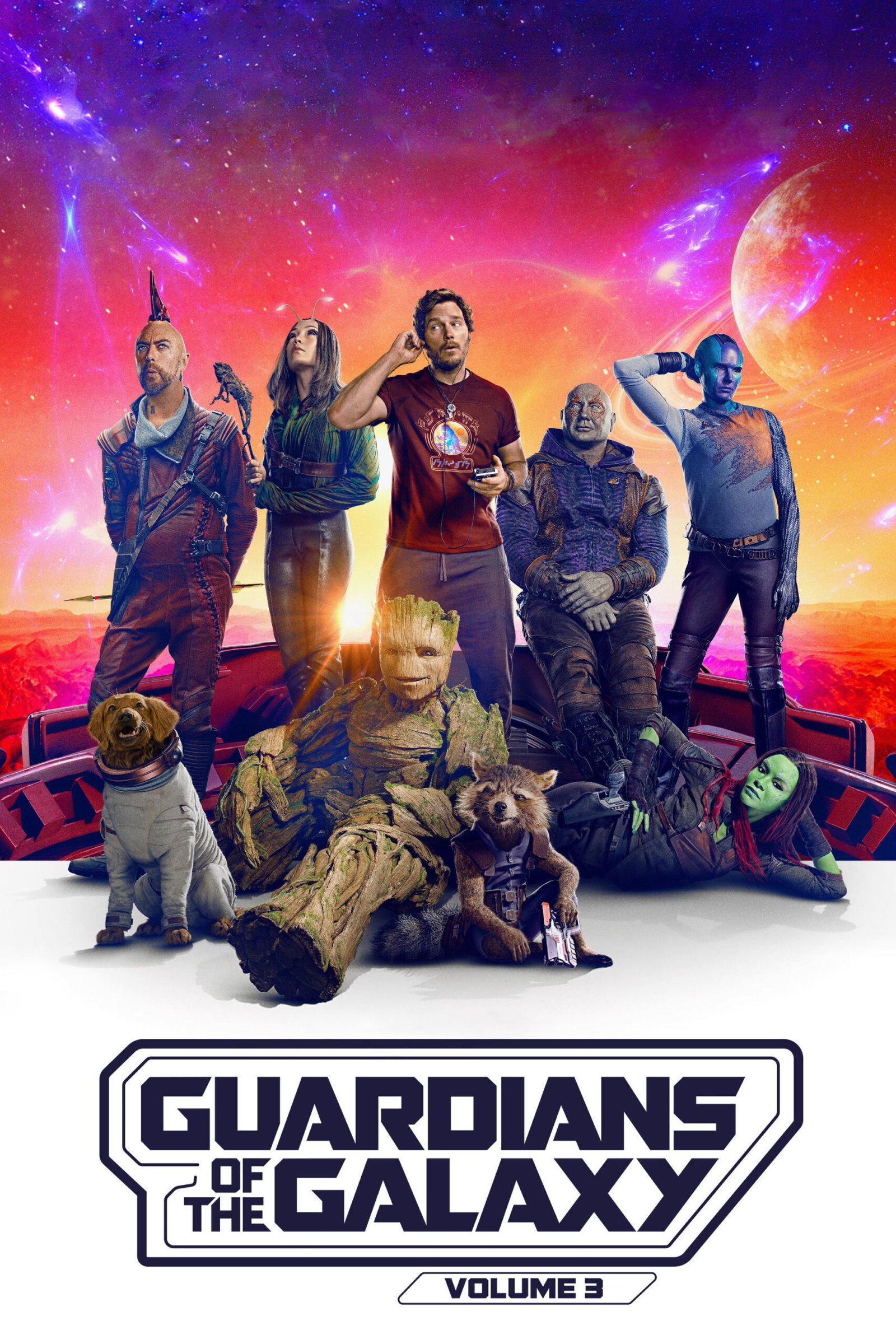
Three films in, it turns out the Guardians trilogy was always Rocket’s story. Vol. 3 is the one that admits it, and it’s the better for finally saying so out loud.
I really enjoyed this one. That’s not a given with late-period Marvel, where I’ve spent more time being mildly entertained than actually moved, and this is the first in a while that got under my guard.
The flashbacks are the film
Adam Warlock attacks Knowhere, leaves Rocket dying, and the team discovers a kill switch buried in him that stops any attempt to operate. He is patented property. Somebody owns him. That somebody is the High Evolutionary, and finding out how that came to be is what the film is actually about.

The origin material is the best thing here. A baby raccoon, designated Subject 89P13, experimented on by a scientist obsessed with engineering perfect societies and discarding every version that disappoints him. Rocket’s friends in the cage, Lylla, Teefs and Floor, are the only affection he has ever had. When Rocket turns out smarter than his creator, the Evolutionary decides to cut his brain out to find out why, and when Rocket escapes, has the friends killed in front of him.
That sequence is genuinely hard to watch, and I mean that as praise. It’s informative and it’s useful, in the sense that it retroactively explains a character who has spent two films being the funny one. Every bit of Rocket’s abrasiveness suddenly has a source. That’s good writing, and it’s the kind of work Marvel usually skips.
The High Evolutionary is exactly the right size of villain
He’s an interesting one. Vicious, mean, genuinely hateful in a way that’s rarer than it sounds, but with an underlying motive that makes complete sense from where he’s standing. He isn’t evil for the sake of it. He believes he’s improving things, and the cruelty is a byproduct of that belief rather than the point of it.
Chukwudi Iwuji plays him at a pitch most Marvel villains never reach. There’s no winking, no quips, no late-stage redemption arc. He’s a bad man doing bad things for reasons he considers excellent.
He’s also clearly a one-shot villain rather than a saga-spanning one, and I think that’s the correct call. Not every antagonist needs to be a multi-film arc. Some of them should turn up, be appalling, and get dealt with inside two and a half hours. Building him into a decade-long throughline would have diluted exactly what makes him work.
Where it sits in the trilogy
Vol. 1 is still my favourite, and I don’t think that’s going to change. It had the advantage of surprise, a soundtrack that felt like a discovery rather than a formula, and a group of characters nobody had any expectations about.
But this is a definite step up from Vol. 2. Two was a bit funky and weird. It had some good moments but didn’t do much to expand the universe, and it spent a lot of its runtime on a father-son plot that never fully landed for me. Three has more purpose to it.
I do realise the Guardians were never the Avengers in terms of interconnected storylines, and I’ve made my peace with that. They’re off doing their own thing at the edge of the map. That’s fine. They were always a fun group to watch, and the fun survives even when the material turns dark.
What the rest of the team gets to do
Worth saying that the supporting cast is better served here than in either previous film. Nebula has quietly become the most interesting person in the group, and Karen Gillan plays her as somebody permanently exasperated by having to be the competent one. Drax gets to be more than a punchline generator, though the film still can’t entirely resist using him as one. Mantis finally reads as a character with her own wants rather than an empathy dispenser attached to the plot.
Adam Warlock is the exception. He’s introduced with a great deal of ceremony, does very little, switches sides at a convenient moment, and gets parked. Will Poulter is good in the role and I’d happily watch more of him. I just couldn’t tell you what the film wanted him for beyond giving Peter a rescue at the end. He feels like a setup for a story that may or may not ever arrive.
The Gamora problem, handled better than expected
Peter spends the film drinking because the Gamora who came back through time is not the one he lost, and has no interest in becoming her. That’s a thread the film handles with more discipline than I expected. Infinity War killed her and Endgame brought a different version back, which was always going to leave a mess.
The easy version of this story has her gradually remembering, or falling for him again. Vol. 3 refuses. She’s a different person with a different history, she doesn’t owe him a relationship, and the film lets Peter sit with that rather than solving it. Given how much of the character’s arc runs through her, and through her and Nebula’s father, that restraint is worth noting.
The adult turn
This one’s more adult than the previous two, and specifically in how Rocket is treated. The animal experimentation material isn’t softened for a family audience, and the film doesn’t cut away when you expect it to.
I’m honestly not sure how well that sits with the marketing, which is still selling a jukebox space comedy. Parents taking small kids on the strength of Vol. 1 are in for a surprise. But as a creative choice it’s the right one. You can’t tell this particular origin gently and have it mean anything.
I’ve never read any of the comics, so I can’t really comment on how accurate any of these characters are to the source. What I can say is they’re all fun, they’ve been consistent across three films, and the version of them that exists on screen has earned its own standing regardless of what the page says.
The soundtrack, and why it works less hard this time
The music has been the trilogy’s signature since the first Awesome Mix, and it’s doing something different here. Vol. 1 used its soundtrack as characterisation, a dead mother’s taste standing in for a whole relationship. Vol. 2 leaned on it as a mood generator. This one mostly uses it as counterpoint, cheerful songs playing over genuinely grim material, and the contrast does a lot of the heavy lifting in the flashback sequences.
Whether that’s clever or manipulative probably depends on your tolerance for the technique. It worked on me. I’d also say it’s the least memorable of the three mixes as a standalone listen, which may be the price of using it structurally rather than as a jukebox.
Does it land as an ending?
It feels like a real one, which is more than most of these manage. Everybody leaves. Rocket takes over as captain of a new roster, Peter goes back to Earth to find his grandfather, Gamora returns to the Ravagers, Drax and Nebula stay behind to raise the rescued children.
Right now the crew is scattered and not really a team anymore, and I genuinely don’t know what the future holds for them. James Gunn is off to DC, which has been public since last October, so whoever picks this up next won’t be the person who built it. That’s a real question mark hanging over anything that comes after.
Let’s see. But I did enjoy this one, and if it turns out to be the last time this particular group is together, it’s a considerably better send-off than most franchises manage.
