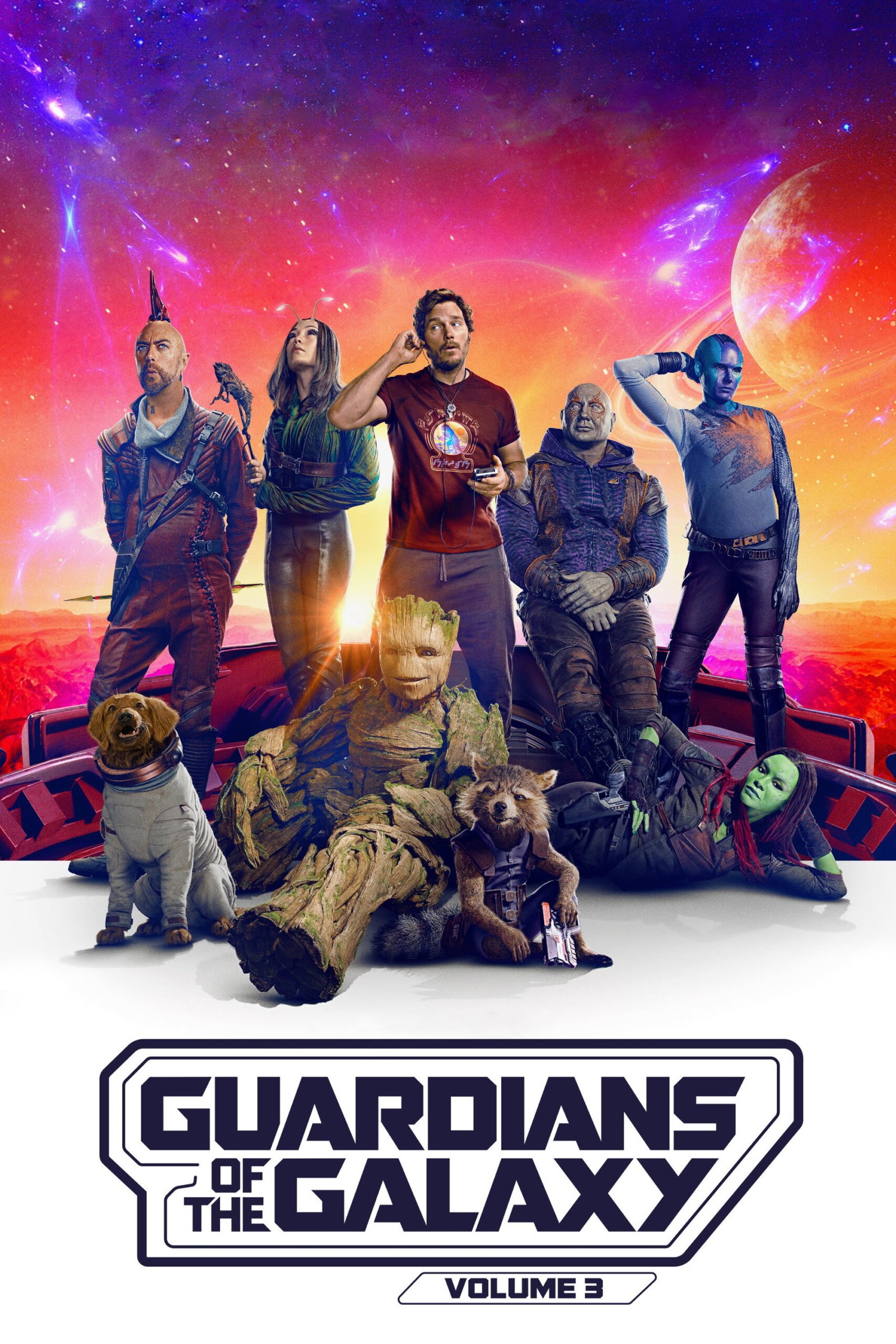
When I reviewed Vol. 3 in 2023 I wrote that the crew was scattered and I didn’t know what the future held for them. Three years later I have my answer and it’s the one nobody expected: nothing. They stayed gone.
No surprise returns, no post-credits reversal quietly undoing the send-off, no Guardians on the Doomsday roster in any meaningful way. The ending I described as feeling like a real one turned out to be exactly that, and rewatching it with that confirmed changes how the whole film sits. Franchise endings almost never stick — characters die and come back, teams disband and reassemble, and audiences learn to treat any farewell as a pause rather than a full stop. I said at the time this felt genuine and I was half-hedging when I said it, because experience suggested otherwise. It held. Rocket is still captaining a roster we haven’t followed, Peter is still on Earth, Drax and Nebula are still raising the children they rescued. The film meant it, and knowing nothing gets undone lets you watch that final act as an actual conclusion rather than scanning it for the loophole. The scenes land heavier for it. Peter going home to his grandfather isn’t a setup for anything, it’s just where he ended up.
Staying out of the machinery was the whole trick
Here’s what I couldn’t see in 2023 and can see plainly now: this film worked because it had almost nothing to do with what the rest of the MCU was building. No multiverse, no variants, no incursion, no sacred-timeline housekeeping. While every other release in that stretch was carrying luggage for a saga that was quietly falling apart behind the scenes, Vol. 3 was telling a self-contained story about a raccoon and the man who made him.

I called the High Evolutionary a one-shot villain and said that was the right call, and I’d put it more strongly now. He’s better than most of the saga-spanning villains he shared a decade with, precisely because he was never asked to survive past his own film. He gets an ending too. Compare that to what happened with the multiverse-tier antagonists over the same period: built up across films and series, positioned as the next Thanos, then scrapped or reworked entirely. The villain who only had to work once is the one that actually worked, which is either a lesson or an accident and I genuinely can’t tell which.
Where I’d revise myself is Adam Warlock. In the period review I complained that he was introduced with ceremony, did very little, and got parked, and I said he felt like setup for a story that might never arrive. It didn’t arrive. Three years on he’s gone precisely nowhere, so I was right about the observation and wrong about the tone. I framed it as a flaw the film would presumably pay off later. In hindsight it isn’t an unpaid setup at all, it’s just a loose thread in an otherwise tightly closed film, and the closure everywhere else makes the one dangling piece more conspicuous rather than less. If I were rewriting that paragraph now I’d be blunter about it. Warlock shouldn’t have been in this movie. He costs it screen time it needed elsewhere and buys nothing.
The Rocket material carries more than I noticed
One thing genuinely changed for me on the rewatch, and it’s the flashbacks. In 2023 I found them hard to watch and said so approvingly. What I didn’t fully register was how much of the film’s structure depends on them. This isn’t a rescue plot with an origin story cut into it, it’s an origin story with a rescue plot wrapped around it as a delivery mechanism, and the present-day material is noticeably thinner every time you notice that.
That’s a mild criticism I didn’t make the first time round. The Counter-Earth section in particular is doing very little except moving the team from one place to the next. On first watch the momentum carries it; on second watch, knowing where the emotional weight actually sits, you find yourself waiting for the film to get back to the cage. It doesn’t damage the film, and it does mean the thing people remember is maybe forty minutes of a two-and-a-half-hour runtime with competent adventure filler around it. Still a good film, just a less evenly good one than I gave it credit for.
I also flagged in the period review that James Gunn was off to DC and treated it as a question mark hanging over anything that followed. That question has been answered in the least dramatic way possible: nothing followed. There’s been no attempt to continue this corner of the universe under a different creative voice, which is probably the correct decision and definitely the least embarrassing one, because handing these characters to somebody else would have produced something that looked like the Guardians and didn’t sound like them. So the trilogy stands as one person’s complete work start to finish, which is close to unique in a franchise built on interchangeable directors.
Should any of them be in December?
I keep going back and forth and I’ve landed on no. The argument for is obvious enough: Doomsday is pulling in everybody, the cosmic side of this universe is badly underrepresented, and Rocket in particular has the emotional weight to hold a scene against anyone on that roster. He’d be good in it. But there’s a practical problem underneath that. These characters work because of how they talk to each other in a confined space with no wider stakes pressing in on them. Drop them into an ensemble event and they become five more people in a crowd scene, and the thing that makes them worth watching doesn’t survive the format.
My ranking hasn’t moved either. Vol. 1 is still my favourite, this is still comfortably ahead of Vol. 2, and the gap between the first and this one is narrower than it felt in 2023, with nostalgia doing some quiet work for the original that this one never got the benefit of. What has struck me is how stable its reputation is. Most of that era has moved in the rankings as the wider plan collapsed and people re-evaluated what turned out to be setup for nothing, and Vol. 3 hasn’t shifted at all, because there was nothing to re-evaluate. It was never holding a promissory note.
What I’d add now is that it’s the only film from that period I’d recommend to somebody with no interest in the wider MCU whatsoever. You need no homework, and nothing in it depends on knowing what happened three films ago in a different corner of the map. Going into Doomsday, with its enormous cast and its decade of accumulated continuity, that self-sufficiency looks a lot less like a limitation and a lot more like the smartest thing the film did.
