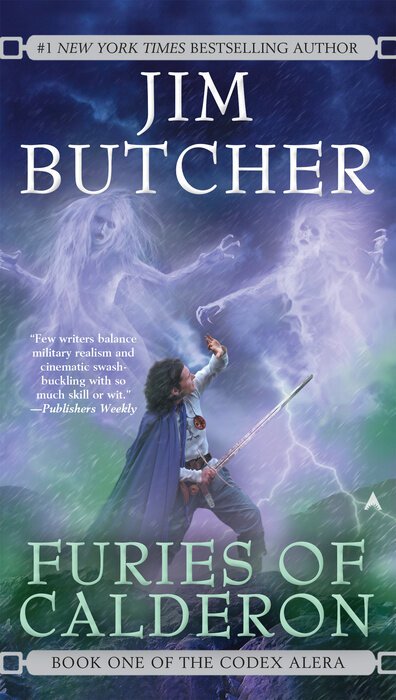
I look at Furies of Calderon, the first book in Jim Butcher’s Codex Alera, a fantasy series about the descendants of a lost Roman legion who’ve bonded with elemental furies, seen through Tavi, the one boy in the Calderon Valley who has none.
I thought it was a really good first book, with likable heroes, villains who aren’t over the top and a magic system that stays consistent, and I tore through the whole series in about two weeks. I rate Character Growth & Development 5/5, Story Growth & Development 4/5 and give it 9/10 overall.
Furies of Calderon is another series I didn’t start until I knew all the books were complete. Unfortunately Robert Jordan‘s death part way through writing the Wheel of Time has permanently scarred me, and I’m frightened to start a new series without knowing that it’ll eventually conclude! I know that sounds dramatic, but if you’ve ever spent years with a set of characters and then had the rug pulled out from under you, you’ll know what I mean, so these days I’d rather wait and then read the lot in one go.
So when I finally picked up the first book of Jim Butcher‘s Codex Alera, all six were already out and sitting there waiting for me. Butcher’s better known for the Dresden Files, his wizard-detective books set in modern Chicago, so a big secondary-world epic with legions and lords was a real change of pace for him, and I wasn’t sure how well it would work. I’d been burned enough by then that I only went back to the Wheel of Time once Brandon Sanderson had picked up where Jordan left off, and having a finished series in front of me took all of that worry away. It meant I could just enjoy it, and I did, a lot more than I expected to going in.
Romans in a land full of furies
The Codex Alera basically deals with the descendants of citizens transplanted from ancient Rome, during the time of the Empire and its legions. You find that out properly later in the series, but it’s not really a spoiler, so I’ll tell you now. A Roman legion ends up in Alera, and over the generations the people settle in and gradually start to develop affinities with one or more furies, which are natural elements, earth and water and wind and fire and so on, that are capable of influencing their surroundings. Almost everyone has at least one, and they use them for everything, farming, healing, travelling, fighting. It reminded me in places of the way Brandon Sanderson builds magic in his Mistborn books, a set of powers with rules you can actually follow rather than whatever the plot happens to need that week.
You’ll notice Roman names for people, places and objects abound, for obvious reasons. Gaius Sextus, the First Lord and ruler of the land, is getting on in years, and his only heir was killed in a battle against the Marat. He’s remarried, but it isn’t likely that he’ll produce another heir, and the great lords can all smell it. With no obvious successor, the question of who comes after Gaius hangs over everything, and the High Lords of the great cities all fancy themselves as the answer, each with their own armies and their own furies to back the claim up. Intrigue and plotting abound, and some of the nobles are even scheming to ally with the Marat, the same group of savages that killed the First Lord’s son in the first place. That’s the maelstrom we’re dropped into, and it’s into the middle of it that we’re introduced to the hero of our story, who couldn’t be further from the court and its politics if he tried.
Tavi, the boy without a fury
Unlike the majority of Alerans, Tavi has no connection to any furies at all. In this he’s an anomaly, and he’s forced to live without a power that everyone else takes for granted, in a world where even the kids can do things with water or earth that he never will. An orphan, he’s been looked after by his aunt and uncle, Isana and Bernard, who are both powerful and well respected leaders in their part of the Calderon Valley. I liked that the book doesn’t make him special in the usual way. He isn’t secretly the most powerful furycrafter ever born, at least not here, he’s a boy who’s had to get clever and quick because he’s got nothing else to fall back on, and you feel that in every scrape he gets into. Calderon itself sits right on the frontier with Marat country, and the valley has history with them, since it’s where the battle that killed the First Lord’s son was fought, so nobody there takes the Marat lightly.
The trouble starts with sheep. Tavi’s responsible for a flock, he’s lost some, and while he and his Uncle Bernard are out searching for them they’re ambushed by the Marat. The Marat have different clans, each with a different totem animal, and the ones they run into are partnered with herdbane, eight-foot-tall predatory birds (possibly also transplanted from Earth in ancient times?). During the fight Bernard is badly injured, and Tavi realises that if he’s going to save his uncle he needs to lure the Marat away, so off he goes into the wilderness on his own, with no furies to help him and a lot of very big birds behind him. It’s a great opening stretch and it gets going a lot quicker than plenty of epic fantasy does.
Amara and a traitor I could admire
Out there Tavi meets Amara, an agent of the First Lord in disguise, who’s hunting Fidelias, her mentor in the spy corps she belongs to. Fidelias has betrayed the First Lord because he believes it’s in the best interests of the land, and that’s what makes him so good. He’s a traitor you could actually admire, not your normal cardboard villain at all, a true patriot who’s made a terrible choice for reasons he can defend. Amara’s chasing the man who taught her everything, and Butcher gets a lot out of that, because she knows how he thinks and he knows exactly how she was trained, so every move one of them makes the other half sees coming.
As the story goes on, Tavi’s gradually introduced to other clans of the Marat and comes to discover that they aren’t all the same faceless, evil savages he was led to believe. That’s one of the threads I enjoyed most, and it pays off more and more as the series goes on. In addition, lots more questions get opened up along the way, about the First Lord, about the Marat and about Tavi himself. One young Marat in particular, Kitai, ends up tangled up with Tavi in a way neither of them expects, and that relationship turns into one of the threads that runs right through the whole series. If I’ve got one gripe it’s with the plotting lords. I’d like to say that allying with your enemy is stupid and why would anyone do it, but unfortunately stupidities of this sort seem to be the nature of the day rather than the opposite, so I can’t really call it unrealistic.
Why I couldn’t put it down
A really good first book. While there are some similarities to the Mistborn series with regards to the powers and the way they’re used, that doesn’t in any way detract from this series. The “magic” is well thought out, and the science of the magic is consistent throughout, which matters a lot to me. Nothing gets solved by someone suddenly discovering a power nobody mentioned before, and the furies have limits you can see. The stronger the bond with a fury the more a crafter can do, so even a big battle comes down to who’s got what and how cleverly they use it, which makes it all the more interesting watching Tavi win with nothing but his wits. It’s packed with action too, and I’m clearly not the only reader who found the pages disappearing at a fair old pace once things got going.
For Character Growth & Development I’d give it 5/5. Really likable heroes and villains, and none of them are over the top in any way at all. It’s a really good read and you’ll definitely come to care about the players in this drama, Tavi and Amara most of all, but Bernard and Isana too, and even Fidelias. Isana’s got her own storyline running alongside Tavi’s, and her watercrafting lets her feel what the people around her are feeling, which drops her right into the middle of the trouble as well. For Story Growth & Development it’s a 4/5, mostly down to that business with the nobles and the Marat. And it’s definitely a great first book in the series, and now that I’ve read the rest of it I can only say it just gets better and better!
Overall Rating: 9/10. A definite page turner, and one you won’t want to put down once you start reading it. I think I finished the whole series in a two-week stretch, and I’m planning on revisiting it again soon!
Would you have trusted Fidelias, or is a traitor still a traitor no matter how good his reasons are? Tell me in the comments.

4 comments
Japan
Hello 🙂 Your method of describing the whole thing in this paragraph is genuinely fastidious, every one be able to simply be aware of it, Thanks a lot.
Rereading my notes on this, the furies remind me a lot of the spren in Sanderson’s Stormlight books. Both are spirits that bond with a person and hand them their powers, and in both the bond matters as much as the power itself, which is a big part of why the magic in each feels so consistent.
[…] but I have heard are really good. I was introduced to him via his Codex Alera series – the first of which (Furies of Calderon) is reviewed here – which I loved. His characters were extremely well thought out and written, the magic […]
[…] Furies of Calderon is the first book in the Codex Alera, and I gave it 9 out of 10. Citizens of an ancient Roman legion were transplanted to a new land, so you get Roman names for just about everything, along with natural elemental spirits called furies that nearly everyone can bend. The hero, Tavi, is an anomaly because he has no connection to any furies at all, and he’s forced to live without a power everyone else takes for granted. Fidelias is a traitor you can actually admire as a true patriot. It’s a definite page turner, and I finished the whole series in a two week stretch and plan to go back to it. The magic is well thought out and consistent, and while the way the powers are used reminded me a little of Mistborn, that never bothered me. I gave the characters 5 out of 5 and the story 4 out of 5, because they’re likable heroes and villains that aren’t over the top in any way. […]