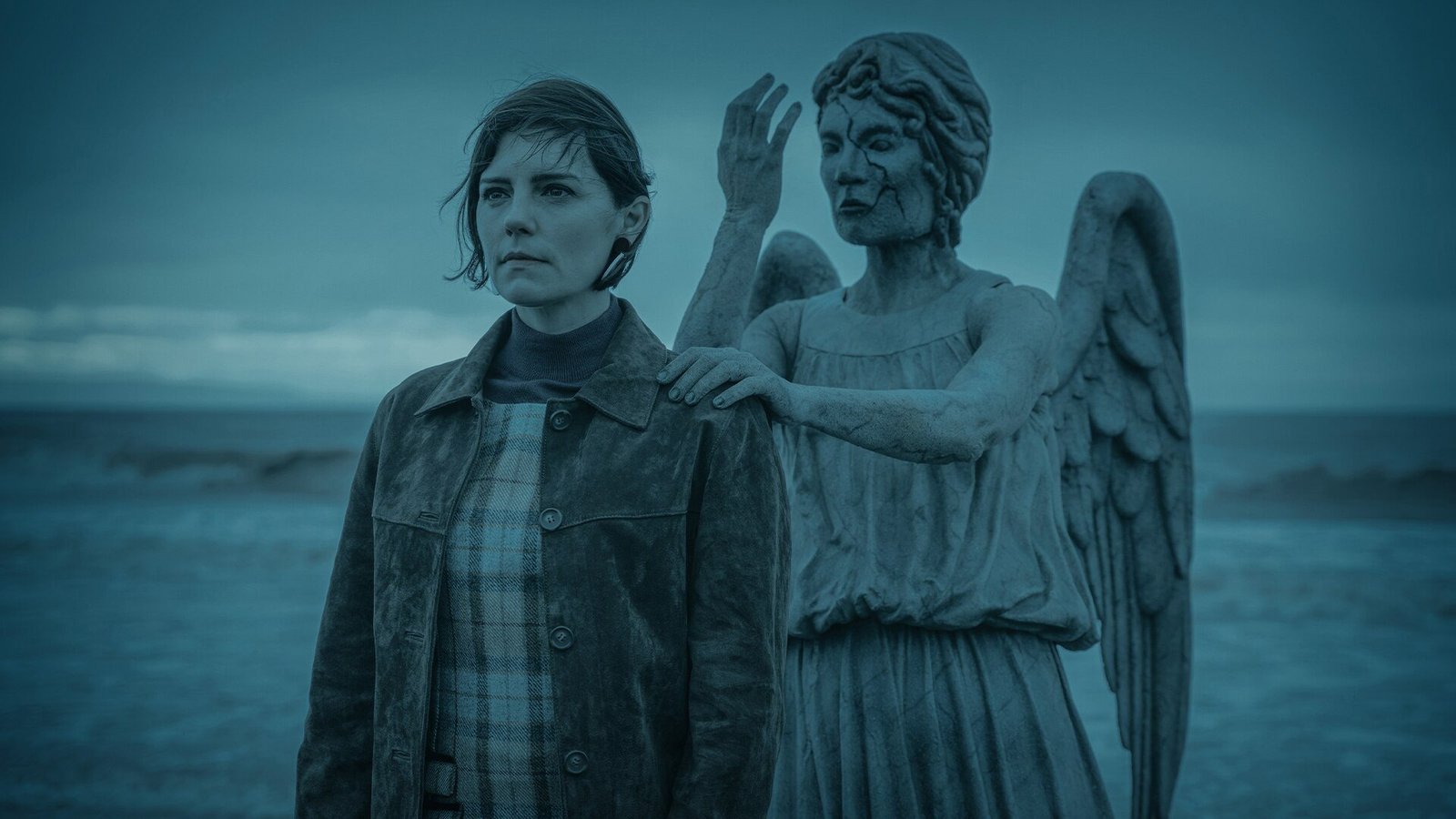
Finally. Four chapters in, Flux stops sprinting between six plots and puts almost everything into one village on one night, and the result is the best episode of the Whittaker era by a comfortable distance. “Village of the Angels” is a proper horror story with a proper monster and a proper sense of place, and I really enjoyed it. Whatever reservations I’ve had about this run, and I’ve had plenty, this hour is the show operating at full strength.
The setup is old-fashioned in the best possible way. It’s Medderton, Devon, in 1967, where a little girl has vanished and a professor is running psychic experiments in a big cold house. There’s a body in a field, a village that won’t talk about it, and something in the churchyard that moves when you look away. It plays like proper folk horror, all lamplight and hedgerows and people being unhelpful on doorsteps, and it’s the first time all series that the setting has felt like somewhere rather than a backdrop to be cut away from.
The Angels are frightening again
I’d started to think the Weeping Angels were spent. Blink is a masterpiece, The Angels Take Manhattan got a decent farm-the-humans idea out of them, and everything since has felt like a design being wheeled out because it tests well. This episode fixes that by adding rules rather than repeating the old ones louder. An Angel can live inside an image of itself, so a pencil drawing on a page is every bit as dangerous as a statue in a graveyard. An Angel can inhabit a person too, speaking through them, arguing with them, taking their body a piece at a time. Best of all, an Angel can be a fugitive from its own kind, which means this isn’t a hunt, it’s an extradition, and the village is simply where a deserter went to ground.
The images throughout are superb. The drawing grows a little each time somebody checks on it. There’s an Angel in the television screen. Then the walls of the house turn out to be lined with them, standing perfectly still in the dark while a torch beam sweeps past and doesn’t quite reach. Somebody on this production understood that the trick with these monsters was never the pounce, it’s the waiting, and they built the whole hour around it.

Claire, Jericho and a village that behaves like one
Annabel Scholey is excellent as Claire, who has been carrying an Angel in her head since she met the Doctor in a Liverpool street in the fog back in chapter one. Playing a woman arguing with something inside her own skull could go badly wrong in about four different directions, and Scholey keeps it small and exhausted instead, which is far more upsetting than hysteria would have been. She’s tired of it. That’s the detail that sells it. Kevin McNally is the other gift here. Professor Jericho is a slightly pompous psychic researcher who turns out to be brave in an entirely unshowy way, and when he decides to stay and help rather than run, it lands because the episode bothered to make him a person first.
The village works too, and that matters more than it sounds. Gerald and Jean bicker in their kitchen, the search party works its way across the fields, and there’s a quiet sense that everybody knows something happened here in 1901 and nobody wants to be the first to say so. The 1967 setting earns its keep as well: late enough for a television set to matter, early enough that a Devon village is properly cut off after dark. No mobile phones, no streetlights past the green, one road out. Horror needs isolation and a period setting hands it to you for free, and The Haunting of Villa Diodati showed last series that this era is at its best when it gives people rooms and lets them be frightened in them.
Yaz and Dan get something to do at last
I’ve complained for three weeks that Mandip Gill has been handed nothing, so credit where it’s due. Yaz is properly in this one, leading, deducing, keeping Dan steady and working out the 1901 material on her own. She does it by talking to people and paying attention, which is exactly what a police officer would do and exactly what the show has spent two series forgetting she is. Gill has always been good, and one episode of decent material is all it takes to prove the material was the issue. Sending the pair of them back sixty-six years by Angel touch is a smart use of the monster’s oldest trick, and their scenes stuck in a village that hasn’t happened yet carry real charge.
Dan continues to be the best thing Chibnall added to the show. Bishop plays fear well without playing it broad, and his running commentary keeps the hour from tipping over into po-faced misery. The reveal that Peggy is the missing girl, displaced in exactly the way Yaz and Dan have just been displaced, closes a loop the episode quietly set up in its first five minutes and never once underlines. It’s a neat little bit of plotting, and it’s typical of an hour that trusts me to notice things.
The ending is the boldest thing this era has done
And then the Doctor loses. Not partially, not cleverly, not with a hidden escape route she’d set up earlier. Division turns up, the Angel that’s been hiding inside Claire finishes its work, and the Doctor is turned into a Weeping Angel and taken, frozen mid-sentence, while her friends stand and watch it happen. What makes it work is that the episode has spent fifty minutes teaching me the rules that make it possible. An Angel can inhabit a person, an Angel can be sent somewhere as a punishment, and Division has the authority to order it.
None of that is invented in the last thirty seconds to make the shock land, which is the usual failing of a big cliffhanger, and the difference is enormous. The ending is startling because it’s the logical end of everything the hour has already told me, not because the show suddenly changed the rules. It’s an extraordinary cliffhanger and the one fearless swing in the whole run. The reason that last shot lands so hard is that the previous forty-five minutes never once wander off to check on a subplot on another planet. Discipline is what makes the shock work.
Rating: 4/5. Really enjoyed this one. Genuinely frightening, beautifully shot and properly written, with the best guest cast of the series and a monster restored to something worth being scared of again. It’s the episode that shows what Flux could have been all the way through if it had only trusted one story at a time.
