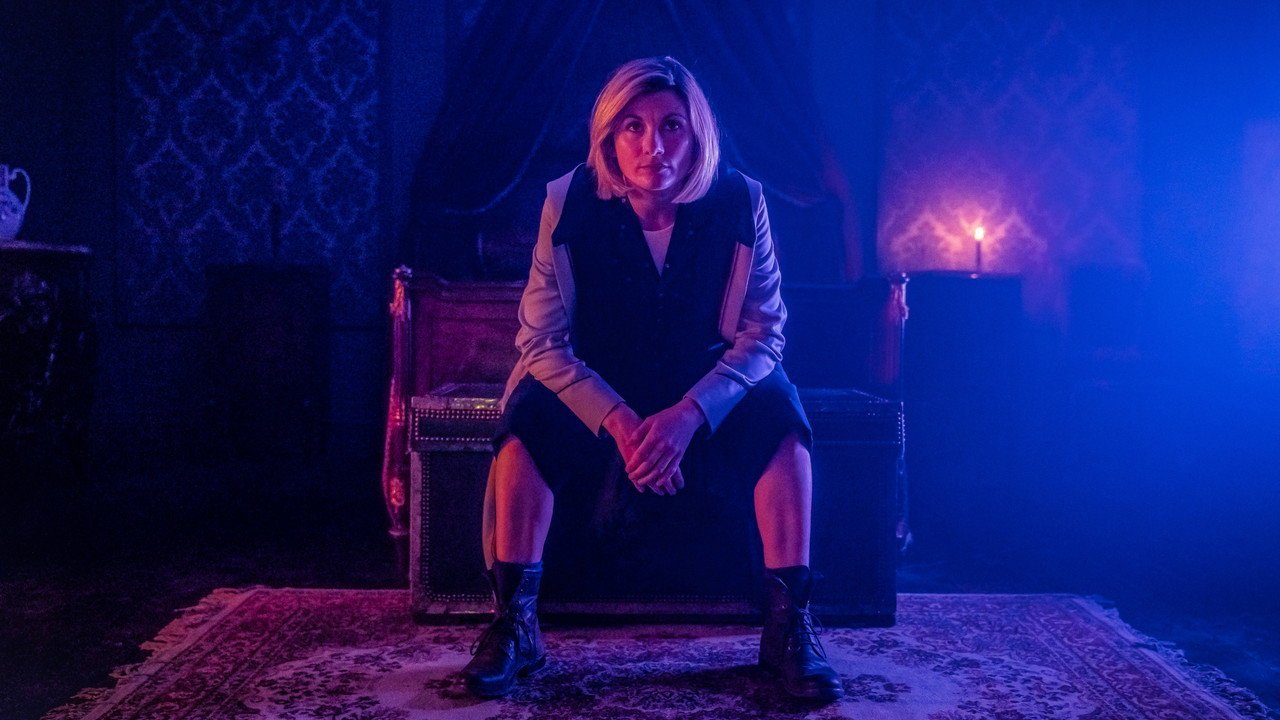
Put the Doctor in a haunted house on the night that Mary Shelley conceived Frankenstein, and then walk a half-converted Cyberman through the front door. It should be too much. Maxine Alderton’s script makes it look easy, and “The Haunting of Villa Diodati” is the most confident, best-directed and most genuinely frightening hour the Whittaker era produced. It is also the one episode of this run that does what I keep asking the era to do: it builds a monster first, and lets the meaning come out of what the monster does.
A proper ghost story
The first half is played completely straight as gothic horror and it works.
Lake Geneva, 1816, the year without a summer. Byron is preening, Percy Shelley is missing, Polidori is sleepwalking, and the house will not let anybody leave. Corridors loop back on themselves. A door leads to the room you just left. The fam keep walking down the same passage and arriving where they started, and Emma Sullivan directs the whole thing with a patience the era has rarely shown, holding shots long enough for the geometry to feel wrong rather than cutting away to reassure you.
The period detail is good and the casting is better. Jacob Collins-Levy plays Byron as a vain, faintly ridiculous man who is nonetheless dangerous to be near, and his attempts to flirt with the Doctor are both funny and slightly appalling. Lili Miller’s Mary is watchful and unimpressed and clearly the cleverest person in the building, which is exactly right for someone about to write the book that invents modern science fiction.
There are a dozen small horrors before anything alien turns up. The skeletal hand that scuttles across the floor and goes for a throat. The portrait that follows people. Polidori fighting a duel in his sleep. Graham looking for a lavatory and finding the same corridor four times, which is played for comedy and then quietly stops being funny. The show has not committed to atmosphere like this since Blink, and it holds for a full twenty-five minutes before the plot arrives.
Ashad is the best Cyberman in fifty years
And then the lone Cyberman that Captain Jack warned about in Fugitive of the Judoon comes through the wall, and the episode gets even better.
Ashad is a broken conversion. Half his face is still human, the metal has failed across his chest, and he is in constant pain from a process that did not take. Which means he has feelings, and hates having them, and cannot stop. Patrick O’Kane gives the finest guest performance of the era, all shaking rage and disgust, a creature who despises what he is and cannot go back to what he was. He talks about his own children, whom he had converted, and the memory clearly still costs him something.
This is what the Cybermen should always have been. The horror of the concept was never the marching or the shouting, it was the person still trapped somewhere inside. Ever since 2006 the show has mostly been using them as generic robots with a good silhouette, and I have been complaining about it since Closing Time. Here, finally, is a Cyberman who is frightening because of what was done to him rather than because he is large.
The scene where he demands the Cyberium, and the Doctor realises Percy Shelley has absorbed it, gives Whittaker her best material of the run. She is genuinely out of options. She can hand over a weapon that will doom billions, or refuse and let Shelley die, which erases Frankenstein and most of the literature that followed. Her fury at the fam when they push her towards the easy answer, that sometimes even she has to choose, is the closest this Doctor gets to the steel the part usually carries. The Guardian picked this one out as the point the season found itself, and that is about right.
The house itself deserves credit as a piece of design. Villa Diodati is all candlelight and heavy furniture and doorways that lead somewhere they should not, and the production resists the urge to over-light it. You spend a lot of the episode not quite able to see the corners of rooms, which is exactly right for a ghost story and almost unheard of in modern television, where everything tends to be lit for clarity. When Ashad finally appears he does so out of that same darkness, and the two halves of the episode share a visual language even when they do not share a plot.
The fam are also used better here than anywhere else in the run. Splitting them across the household gives each of them somebody to play against: Yaz with Mary, Ryan with Percy, Graham lost and looking for a toilet. It is the difference between three companions and a crowd, and it makes you wonder why the era so rarely bothered. Mandip Gill in particular benefits from being paired with someone who takes her seriously, and her scenes with Lili Miller have an easy warmth that Yaz has almost never been allowed.

What makes it work when the rest doesn’t
I keep saying the era delivers its ideas in speeches instead of dramatising them. This episode is the proof that the team could do otherwise whenever they chose.
There is an idea here about creation and monstrosity, about a woman inventing Frankenstein on the same night she watches a man made of stitched-together parts beg for something, and nobody ever says it. No character explains the parallel. No caption appears. Mary Shelley simply watches Ashad, and you can see her filing it away, and the episode trusts you entirely. That is the difference between this and Rosa, which had a better subject and a worse method.
The Doctor loses, too, which matters. She hands over the Cyberium to save one life and one book, and she knows exactly what it will cost, and the episode ends with her walking towards a war she has just armed. After a season and a half of problems being solved by a clever technical trick in the last four minutes, an ending where the right choice is also the catastrophic one is bracing.
If the era has a single episode I would point to as evidence that the criticism was never about the cast or the production, it is this one. Same Doctor, same companions, same budget, same year. The difference is a script that builds a situation and lets the people in it react, rather than deciding on a message and constructing a delivery route. Everything I have complained about across two seasons is absent here, which tells you it was always a choice.
What it leaves behind is Ashad, a conversion that failed halfway, in agony and ashamed of it, the best Cyberman the show has built since the 1960s. It leaves a house that will not let anyone leave, and twenty-five minutes of gothic horror played entirely straight. It leaves Mary Shelley, watching a stitched-together man plead, and saying nothing at all about what she is about to write. It leaves the Doctor choosing wrong on purpose, with her eyes open, because the alternative was worse. And it leaves a Cyberium loose in the hands of something that hates itself.
Rating: 4/5. Atmospheric, superbly cast and genuinely frightening, with a monster that finally understands what Cybermen are for and a Doctor who is given a real choice and gets it wrong. It falls just short of the top only because the ghost-story half and the Cyberman half never quite fuse. Everything else here is the era at its absolute best.
