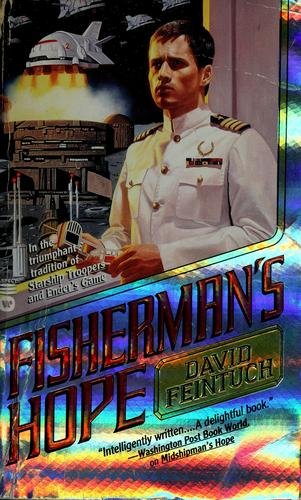
I review Fisherman’s Hope, Book 4 of David Feintuch’s Seafort Saga, where Nick runs the naval academy until the Fish attack the home system. I recap the story (with spoiler warnings), say what works and what doesn’t and explain why I rated it 6.0 out of 10 against the first book.
I enjoyed it, even though I gave it a 6.0. It’s a solid read that suffers next to Midshipman’s Hope.
Fisherman’s Hope is the fourth book in the Seafort Saga, released in 1996, and I gave it 6.0 out of 10. I want to be fair about that score, because I enjoyed the book and I’d still say it’s worth reading if you’ve come this far. The 3 is a comparison to Midshipman’s Hope, which I rated a 10.0, and it isn’t a verdict on this one by itself. Measured on its own, it’d probably have been a point higher.
This is the book where the first arc of the series wraps up. Nick is no longer fighting his way up the ranks, he’s at the top of the academy and trying to settle down, and the book is about what happens to a hero after his greatest moments have passed. It’s a quieter, more reflective story than the first three, at least until the Fish come back. It follows Prisoner’s Hope directly, and it leans on what happened in Challenger’s Hope too, so it’s best read in order. I’ll walk through what happens, with a warning before the spoilers. If you want to pick it up, it’s available as an ebook from the publisher, Open Road Media.
What happens (spoilers ahead)

Nick becomes commandant of the naval academy, a job he finds frustrating because of the political pressure that comes with it. His wife Annie is still traumatized, and she runs away from her clinic into Old New York. Nick asks for help from a man named Eddie Boss and goes searching the dangerous streets for her. The book also alternates between the main story and flashbacks to Nick’s own training, which fill in who he was before the Hibernia of Midshipman’s Hope.
Then the Fish attack the home system. Nick comes up with a desperate plan that could save Earth but may cost him his life and the lives of the cadets who trust him. He survives, but it scars him deeply, and he resigns his commission. An epilogue finds him in a monastery, where he’s encouraged to write his life story as part of his healing. After years of seclusion he goes into politics, divorces Annie and marries Arlene Sanders, and his honesty costs his government the next election, though he keeps his integrity.
The Annie plot deserves a bit more attention. After the events of the last book she’s broken, and Nick can’t fix it, which is the thing he finds hardest. When she runs from the clinic into Old New York, the book turns into a search through some very dangerous streets, and Eddie Boss is the guide Nick has to trust. It’s an early look at the city that the fifth book returns to, and it gives the middle of the book a different feel to the academy scenes. The two threads, the cadets and the search, pull against each other in a way that I thought was effective.
What works and what doesn’t

This is the book I’d say works best on its own of the first four. The academy turns into a better than average boarding school story, and it’s the strongest standalone volume of the early books. It’s also a rarity in the genre, a novel about a hero after his greatest moments have passed, and the writing has improved dramatically by this point. Nick is tortured but never self pitying, and the bittersweet ending closes the cycle without wrecking the character or giving him a fake happy ending.
My feelings are more mixed than that sounds, and I can see why some people think it’s the least enjoyable of the early books, because the middle drags and you’re stuck inside Nick’s negative worldview for a long time. Others call it hard hitting and emotional and love the cadets and the sarcastic Tolliver. The whole series can feel repetitive and formulaic, but it’s also a guilty pleasure that rolls on from one humiliation to the next, and that’s a pretty accurate description of what it’s like to read.
A book about a hero after his greatest moments have passed is a rarity, and I think that’s what I liked most about this one. Most military SciFi stops when the hero wins, and this one asks what comes after. Nick is a famous man now, he’s good at what he does and he’s miserable, and the book gives him a place to be miserable in. The academy gives the story a human scale, with cadets who remind him of himself at that age, and you can see how much it matters to him that they do well.
There’s a darker side to the book too. Annie’s breakdown is hard to read, and it adds to the sense that Nick can’t keep anyone safe, including the people he loves. I thought the book handled it with more care than I expected from a series that’s been rough on its characters. It’s one of the reasons the later part of the book hits as hard as it does, because by the time the Fish arrive, you know what Nick has to lose.
What I made of it
The thing I liked best is the academy setting. After three books of command and crisis, Midshipman’s Hope, Challenger’s Hope and Prisoner’s Hope, it was a nice change to see Nick in a classroom with a bunch of bright young cadets to look after. It’s the first time he has people around him who look to him for guidance and not just orders, and you can see him struggle with that. He wants to be a good teacher and he’s still a man who finds it hard to forgive himself, and watching those two things pull against each other is what makes the book work. If cadets under pressure are your thing, Ender’s Game is the other book I’d hand you.
Nick isn’t good at being safe. Give him a quiet job and he’ll find something to feel guilty about, which is true to the character. I love the honor and honesty of the guy, and you can’t have that without the way he punishes himself for falling short of it. It’s also the least cheerful of the books so far, and you spend a lot of time inside his head, which can get heavy.
The ending deserves a mention. Nick saves the day, but it doesn’t feel like a triumph, and he leaves the navy changed. The monastery epilogue, with Nick being encouraged to write his story, is a nice touch and closes the cycle without a fake happy ending, which is what I wanted. I appreciated that the series was willing to let its hero lose something permanent, and it’s part of why the first four books feel like a complete arc.
What stuck with me most is the commitment to honesty at a cost. Nick’s honesty costs him the next election, and he accepts it, because the alternative is to lie. That’s the thing about the character I love, and it’s what makes him so different from most heroes in the genre. Whatever my score says about this book, the idea that a man can lose power for telling the truth and keep his self respect is one I enjoyed seeing.
Why it scored a 6.0
The honest answer is that it didn’t surprise me the way the first book did. By now I knew Nick, I knew how the series worked and I could see some of the beats coming. That’s no knock on the book, and it’s what a 3 means to me here. It was ok, it was enjoyable, and it isn’t the one I’d hand to someone first. If I’d read it cold, I’d probably have liked it more.
If you’ve read the first three and you’re wondering whether to keep going, I’d say yes. The return of the Fish gives the book real stakes, and the academy gives it a different flavor from the earlier ones. Just go in knowing that you’re reading the fourth book of a series that started on a high point, and enjoy it for what it is. It’s also a natural place to stop if you’ve had enough of Nick, because the arc closes properly.
I’d also say the book is easier to enjoy if you know it’s the end of an arc. Four books in, you’ve seen Nick go from a boy in command to a man in a classroom, and the last third lets him close the loop. I enjoyed that sense of completion, and it’s why I’d say a reader who’s content with a finished story could stop here. I kept going, and I’m glad, but it’s a good spot to stop.
One last thing worth saying is that it has the best sense of place of the first four. The academy feels like a real school, with cadets who joke, fail and surprise him, and that makes the stakes feel personal when the Fish arrive. It’s a small touch, but it made me care about people I’d only just met.
Did the academy setting in Fisherman’s Hope work for you, or did you miss Nick on the bridge of a ship? Tell me in the comments.
