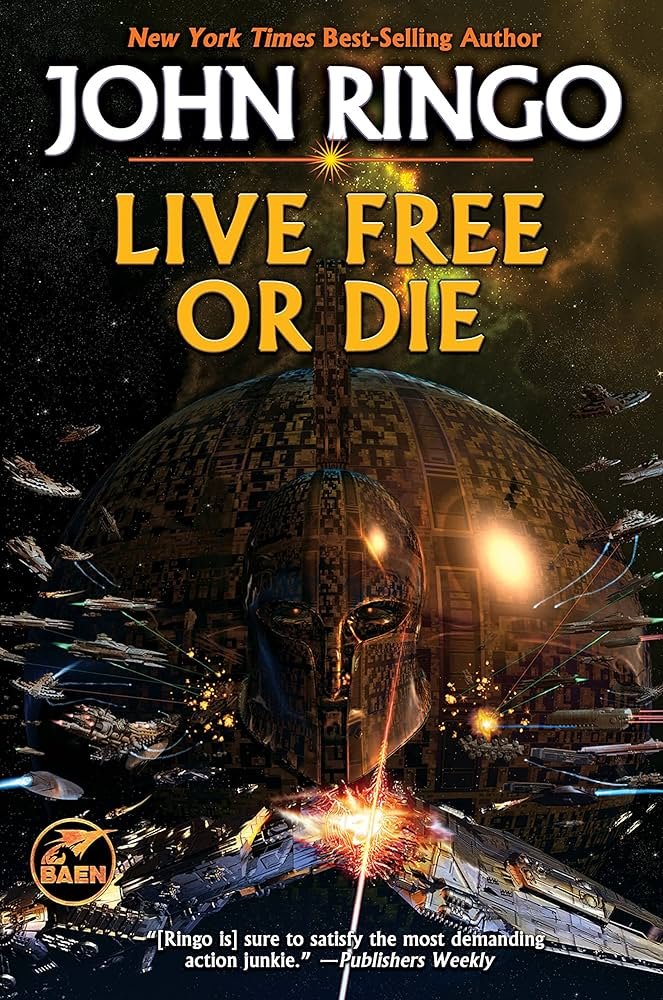
I have reread Live Free or Die more times than anything else John Ringo has written, and it isn’t the space battles that keep bringing me back. It’s the economics.
That sounds like faint praise for a book that ends with a weaponised asteroid. It isn’t.
The first contact everybody else skips
Most first-contact novels hand humanity a seat at the table and cut straight to the interesting part. Ringo does the boring part first, and the boring part turns out to be the best thing in the book. Aliens arrive, a gate opens near Earth, and inside a couple of chapters the entire human IT industry is worthless. Why would anyone buy a chip we designed when Glatun hardware exists and is centuries ahead? Whole sectors of the economy stop having a reason to exist. He does the same thing to science fiction as a genre, which is a genuinely funny bit of self-awareness from a man writing science fiction.
I have read a lot of first contact stories that skip all of this. Ringo builds his first act out of it.
Occupation by arithmetic
Then the Horvath take the orbitals, and that phrase carries the whole trilogy. There is no invasion. No landing craft, no war of the worlds, no heroic last stand at the city limits. They park at the top of the gravity well, drop rocks on anyone who objects, and demand tribute in metals.
Earth becomes a slave planet by arithmetic rather than conquest. It is the most convincing occupation I have read in this genre precisely because it needs almost no soldiers. Nobody has to hold ground when they own the sky.
Maple syrup, and yes, I am aware
Tyler Vernon is a webcomic artist who becomes the most important human alive because he notices that a Glatun trader cannot stop eating his pancake syrup. That is the plot. Maple syrup turns out to be a narcotic-grade luxury good to one species, Earth is the only place it grows, and a broke cartoonist corners the market.
If you have run into maple syrup used as the joke trade good in other books since, this is where it started.
I am Canadian. I would love to tell you I read that with detached critical distance. I did not.
What saves it from being a one-note gag is that Ringo takes the money seriously. The syrup fortune is the opening move in a three-book industrial argument: get capital, buy infrastructure, build the thing that builds the next thing. Tyler never wins a war in this book. He builds an economy that can afford one, and then the war becomes winnable. That is a rarer story than it should be.
SAPL is the best piece of hardware in the series
The Solar Array Pumped Laser is where the book stops being clever and starts being exciting. Mirrors in solar orbit, feeding a beam that starts life as a mining tool and quietly turns into the largest weapon in the sector. It is industrial infrastructure with a second use, which is a much better idea than a purpose-built superweapon would have been.
The first time the Horvath come back and Tyler simply cuts their ship apart with the mining laser is one of the great “oh no” moments in military sci-fi. Nothing about it is a surprise. He told you exactly what he built and what it does. You just did not connect the two until the beam went on.
Inflating an asteroid is the idea of the decade
And then there is Troy.
Take a nickel-iron asteroid. Drill it, fill it with water, wrap it in reflective film, and pour SAPL into it until the whole thing goes soft and the steam blows it up like a glass bauble. What you get is a hollow sphere with walls measured in kilometres instead of centimetres, sitting on top of the only gate into the system, with the mining laser as its main gun.
It is such a good idea that it reorganises everything after it. Every problem in the rest of the trilogy is downstream of that one engineering trick: how you crew a fortress that size, how you build a second one, what happens when the enemy learns to plan around it. Half the sci-fi I have read since 2010 has a variation on it somewhere. Ringo got there with the version that actually shows you the mass budget.
The bill still comes due
For a book with this much triumph in it, Ringo does not let humanity off cheaply. The Horvath leave a tailored plague behind on their way out, and it guts Earth’s population. Not as an offstage statistic either. The demographic hole it leaves is the reason the follow-up books are crewed by teenagers, which is the sort of consequence most authors would have quietly forgotten by chapter three of the sequel.
The part I read differently now
Here is my one honest caveat, and it is about me rather than the book.
This is a story where American ingenuity, American money and one American entrepreneur save the species while most of the planet negotiates. I read it the first time completely sold on that premise. Watching the last few years of American politics and leadership, I am no longer as convinced of the infallibility underneath it. That does not make Tyler Vernon a worse character or the SAPL a worse idea. It just means the flag-waving reads as a choice now, where it used to read as background. Worth knowing going in. It gets much louder later in the trilogy, which I will get to in the Hot Gate review.
Where it lands
Five stars, and the one Ringo book I would hand to somebody who has never read him. If you want to see where his other ideas go, Into the Looking Glass and Von Neumann’s War are both worth your time, and a lot of his back catalogue used to live in the Baen Free Library if you want to sample before buying. For competence-porn engineering with a similar flavour, Old Man’s War and Starship Troopers sit on the same shelf in my head.
I wrote about the trilogy as a whole back in 2015 and my opinion of this one has not moved an inch since. Citadel is next, and that is where things get complicated.

1 comment
[…] first big chunk of Citadel covers ground Live Free or Die already covered, this time from the deck plates instead of the boardroom. We follow Dana Parker and […]