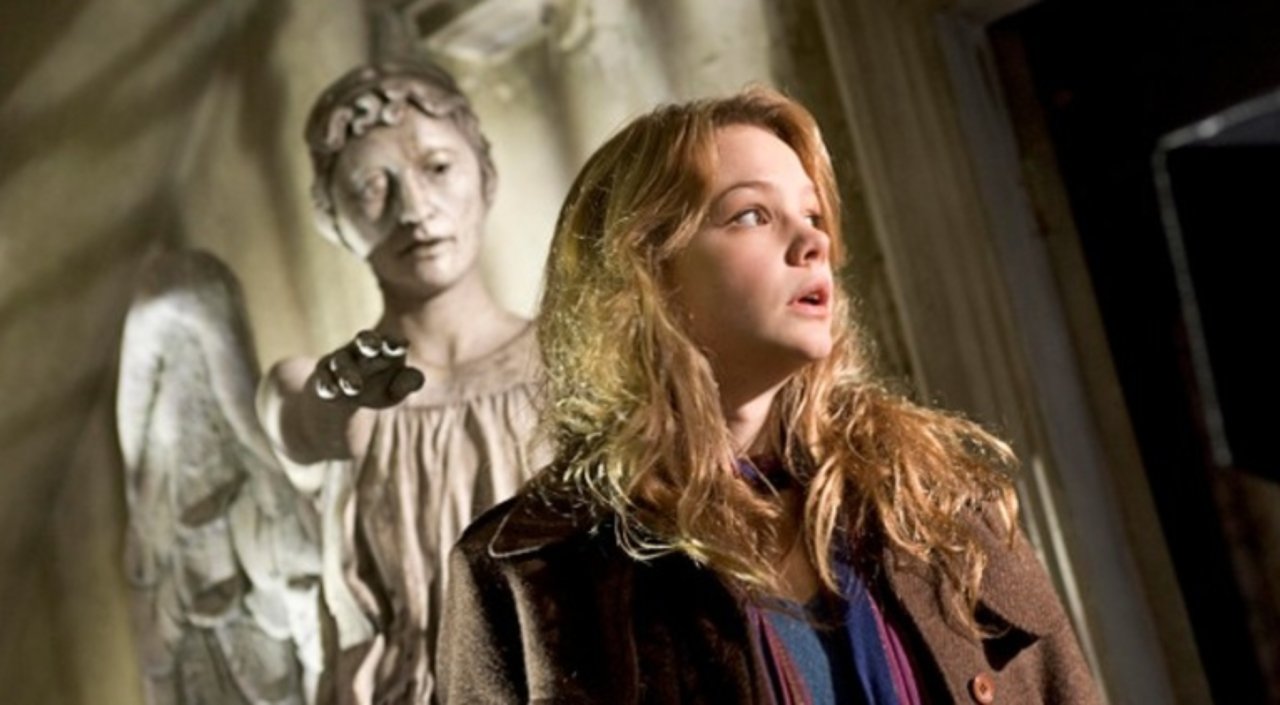
A review of Blink, the Doctor Who Series 3 episode that barely features the Doctor and follows Sally Sparrow as she finds his warnings hidden under wallpaper and on DVD Easter eggs. The post covers Sally as a lead, the Weeping Angels and how they work, and the closed time loop the plot is built on.
It calls Blink the best episode of Doctor Who it has seen, praising Carey Mulligan, the Angels as one of the great screen monsters, Billy Shipton’s lost lifetime and the cellar climax, and names it the one episode to show someone new to the series. Rating: 5/5.
I’m going to say this plainly: “Blink” is the best episode of Doctor Who I’ve ever seen. Yes, I said something very close to that about The Family of Blood only last week, and I meant it, but this one’s got it beat and I’m not going to argue with myself about it. It’s got almost no Doctor in it, its hero is a young woman we’ve never met and probably won’t see again, and it’s still a flawless, terrifying, perfectly put-together hour of telly that I reckon people will still be talking about in twenty years.
Sally Sparrow
Our lead is Sally Sparrow, played by Carey Mulligan, who breaks into a derelict house called Wester Drumlins because she likes old things and finds a message under a peeling strip of wallpaper. It’s a warning, it’s addressed to her by name, it’s signed by the Doctor, and it was written in 1969. What a way to open. Mulligan is tremendous, curious and dry and frightened but never helpless, the kind of hero who runs toward the mystery and then handles it sensibly once she’s in it. Putting a complete stranger at the centre instead of the Doctor is the boldest thing the episode does, and it works because Sally’s such good company I’d happily have watched her for another hour.
She’s got one of the best throwaway lines the show’s ever had, too, when she’s asked why she’s sad and says sad is happy for deep people. She’s a delight, and she never once feels like a stand-in for somebody else, which is quite something in an episode where the Doctor is mostly a face on a telly screen. Larry, Kathy’s brother, is great value too, a DVD nerd who’s been obsessing over these weird Easter eggs for ages without a clue what they are, and he turns out to be exactly who she needed. And where the last Doctor-lite go, Love & Monsters, swung wildly and connected about half the time, this one never puts a foot wrong. Same constraint, completely different result. The difference is that Blink turns the Doctor not being there into the actual engine of the plot rather than a gap to be worked around, so the whole thing depends on him being stuck somewhere else.
The Lonely Assassins
And then there are the Angels. My God, the Angels. The idea is so clean it feels like it’s always existed, they’re quantum-locked, so they can’t move while anything’s looking at them, and in front of any living thing they’re just stone statues, harmless. Look away and they cross the room. Blink and they’re on you. They’re the fastest, deadliest things in the universe and you can stop them completely just by staring, right up until your eyes water. Don’t blink. Don’t even blink. Blink and you’re dead.
It’s the rare monster that turns watching telly into something physical, because I started noticing my own blinking, I started distrusting statues. And the episode’s brutally disciplined about it, no transformation shots, no big reveal, barely any music in the worst moments, just a hard cut and the thing’s suddenly six feet closer with its hands away from its face and its mouth open. The scene in the cellar with the lights failing is one of the most frightening things this show has ever done. They’re barely an effect at all, people standing very still in stone make-up while the camera cuts, and all the horror lives in the gaps between shots and in me not being able to stop watching.
Even better, they don’t kill you. They send you back in time and let you live to death, feeding on the energy of the life you would’ve had, which is a beautifully cruel idea, a monster that murders you with a long, complete, ordinary life somewhere you never wanted to be. That’s a far more haunting fate than being exterminated. They’re easily the best new monster since the show came back, and one of the great screen monsters full stop.
Timey-Wimey
The plot is a machine and every gear meshes. Sally’s friend Kathy gets touched by an Angel and wakes up in 1920, lives a full life, marries, has kids, and arranges for her grandson to hand-deliver a letter to Sally at the exact moment she vanished. A young policeman, Billy Shipton, gets sent back to 1969, ends up in publishing, and meets Sally again the same night she met him, as a dying old man in a hospital bed. It’s about four minutes of screen time between his two scenes and a whole human lifetime goes by in between, and it’s quietly devastating.
The Doctor, meanwhile, is stranded in 1969 with Martha and talks to Sally the only way he can, as a hidden Easter egg on seventeen unrelated DVDs, holding up his side of a conversation with someone he can’t see. How that works is the single most satisfying bit of plotting I’ve seen on this show. Larry is writing down the Doctor’s half, Sally’s speaking the other half, and the transcript in Larry’s hands is the one Sally will eventually give the Doctor so he knows what to say. A closed loop with no loose ends, and the show’s confident enough to let the Doctor shrug at it, because time isn’t a straight line, it’s a big ball of wibbly-wobbly, timey-wimey stuff.
There’s a lovely joke buried in his predicament as well. Stuck in 1969 without his ship, the cleverest being in the universe is reduced to leaving cryptic messages on home video and hoping somebody watches the special features, so for once he’s the one who needs rescuing, and the only way he can ask for help is more or less by post. It’s got the same obvious delight in playing with time as the windows in The Girl in the Fireplace, and the same creeping dread as The Empty Child, where one repeated phrase was enough to terrify a nation of children. Blink welds the two together into the tightest thing the show’s done, the horror and the clockwork locked so closely that neither would work without the other. Nothing’s arbitrary. Every apparent coincidence turns out to be cause and effect running backwards.

Don’t Blink
The climax is beautifully simple. Sally and Larry are trapped in the cellar with the TARDIS and four Angels closing in, the lights failing, nothing to defend themselves with except their own eyes, and the way out doesn’t need a weapon at all. The TARDIS dematerialises out from between them, and the Angels, lunging in from four directions, are left staring straight at each other, frozen forever by the only thing that can stop them. It’s clever and it’s funny and it’s the perfect use of a rule the episode set up earlier. And then a year later, with Sally and Larry running a shop together selling old books and rare DVDs (Sparrow & Nightingale, which is lovely), she spots the Doctor and Martha in the street. For them it’s before any of this has happened. He’s never met her, he’s got no idea what she’s on about, and she hands him the folder of notes anyway, and the loop closes right there on a pavement with him looking baffled and her looking like she’s finally put something down she’s been carrying for a year.
Then the very end turns it all sour again, a montage of statues, in parks and churchyards and on the sides of buildings, while the Doctor’s voice tells us they could be anywhere and the only defence is to keep looking. It’s a closing gag and a genuine threat at the same time, and it sent me to bed uneasy. I’ve been checking the garden ornaments all evening and I’m not entirely joking.
Rating: 5/5. Perfect, and I loved every second of it. Tightly plotted, genuinely frightening and emotionally sharp, and if someone’s never watched Doctor Who and wants one episode to explain why the rest of us are like this, it’s this one.

8 comments
[…] Angels here are meaner than the ones in Blink, and the story keeps adding rules to them. They snap necks now rather than politely displacing […]
[…] idea the Angels have ever been given, and a real escalation from the relatively clean predation of Blink. Those Angels were a burglar’s trick, a life stolen and lived somewhere else. These are livestock […]
[…] comedy and then quietly stops being funny. The show has not committed to atmosphere like this since Blink, and it holds for a full twenty-five minutes before the plot […]
[…] five episodes built around something ordinary being made frightening: gas masks, the statues in Blink, clockwork, and now shadows. “Silence in the Library” takes the simplest possible thing, the […]
[…] the same logic that made the Weeping Angels work in Blink and then wore them out over the following decade. Scarcity does most of the heavy lifting. The show […]
[…] started to think the Weeping Angels were spent. Blink is a masterpiece, The Angels Take Manhattan got a decent farm-the-humans idea out of them, and […]
[…] design is beautiful. It’s been a good year for angels as monsters, what with the statues in Blink, and these are the opposite trick, all movement and polish where those never moved at all. Copper […]
[…] and the Weeping Angels are back, which is the bit I was waiting for. They were first introduced in Blink and they’re just as horrific now, easily one of the scarier new villains from the David […]