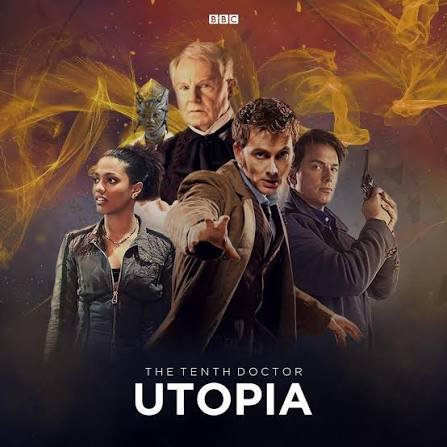
A review of Utopia, the eleventh episode of Doctor Who Series 3, in which the TARDIS carries the Doctor, Martha and a returning Captain Jack to the year one hundred trillion. There they meet the gentle Professor Yana, his assistant Chantho and the last of humanity, and Yana keeps a fob watch he has never opened.
The post praises the bleak end-of-the-universe setting, Jack’s uncomfortable reunion with the Doctor and the long-planned payoff of the Face of Boe’s final words, and calls the watch reveal one of the great moments of the season. It rates the episode 4.5/5, losing half a mark only because so much of it is setup for what comes next.
Every so often a season quietly loads a gun in episode three and fires it in episode eleven, and Utopia is that shot. It starts out as a fairly straightforward last-outpost-of-humanity story, spends forty minutes being perfectly good, and then pulls off a reveal so well set up and so beautifully played that I actually said something out loud at the television. I loved it. This is where Series 3 stops being a run of separate adventures and turns into one story, and I didn’t see it coming at all, which is the bit that still gets me. For most of the hour it’s a Doctor Who episode doing Doctor Who things, a base under siege, a rocket that won’t launch, some monsters howling outside the fence. It’s good, it’s really good, but it gives no sign it’s about to pull the rug out, and that’s exactly why it works when it does.
It opens with a lovely bit of housekeeping, the TARDIS putting down on the Cardiff rift to refuel, the same crack in the world the Doctor was tinkering with back in Boom Town. Nothing much is supposed to happen. And then sprinting across the plaza toward it, rucksack flapping, comes Captain Jack Harkness, and his return is handled beautifully. The Doctor sees him on the monitor and sets off anyway, so Jack grabs hold of the outside of the ship as it dematerialises and just hangs on. It’s a great entrance because it’s so undignified, and because it tells you straight away that the Doctor isn’t as pleased to see him as I was.
Jack Can’t Die, and the Doctor Can’t Look at Him
Jack’s been waiting a very long time. He was killed on the Game Station at the end of The Parting of the Ways, brought back to life by Rose when she held the time vortex, and left behind while the TARDIS flew off without him. And now he can’t die. Not hard to kill, not lucky, actually unable to stay dead, which the episode shows you rather gleefully more than once. The TARDIS itself tried to shake him off, which is how they end up flung all the way to the end of the universe, and the Doctor admits he ran too, because a man who can’t die is a fixed point and every Time Lord instinct he has says Jack is wrong.
That conversation is the best character stuff in the episode for me. Jack is owed an apology and doesn’t really get one, and the Doctor is honest about his revulsion in a way that isn’t flattering to him at all, telling a friend to his face that just looking at him feels wrong. But the affection underneath it survives, somehow. The two of them bicker like they’ve never been apart, and the back-and-forth between the Doctor and Jack just sparkles. There’s a real sting under the jokes, though, and neither of them fully says what they mean.
John Barrowman slots straight back in like he never left, and the three-hander of Doctor, Martha and Jack has an easy energy the season hasn’t had before. Martha finds herself with this handsome stranger who knew the Doctor first and knew Rose, one more person from before her time, and she just gets on with it. Jack, meanwhile, deserves a lot better than the way he’s treated here and mostly takes it with grace.
One Hundred Trillion Years and the Stars Gone Out
They land on Malcassairo in the year one hundred trillion, and it’s magnificently bleak. The stars have gone out, the universe is running down, and what’s left of humanity huddles in a concrete silo while the Futurekind hunt them across the wastes, feral people with filed teeth who used to be human and have given up on it. The show has done far-future stories before, but never this far out and never this hopeless. This isn’t the heat death of a physics lecture. It’s a black sky with nothing in it at all, a rust-coloured wasteland, and the last few people alive queuing in a bunker to board a rocket aimed at a rumour.
There’s something close to unbearable in that, a whole civilisation reduced to hoping a signal nobody can decode is coming from somewhere better than here. And in the middle of the ruin is Professor Yana, cobbling the rocket together out of salvaged junk to send everyone toward that signal, Utopia, the last rumoured refuge at the end of everything. Derek Jacobi plays him gentle, apologetic, a little defeated, a brilliant man who’s spent decades doing impossible work with rubbish tools and no thanks. He’s delighted by the Doctor. He’s almost overwhelmed to finally have someone who understands his equations, and it’s genuinely sweet.
His only company is Chantho, an insectoid assistant who starts every sentence with “Chan” and ends it with “tho”, and who is quietly, hopelessly in love with him. She’s a small gem, and the episode gives her far more dignity than a comic speech tic has any right to carry. Her scenes with Martha, two women comparing notes on being devoted to a brilliant man who hasn’t noticed, are gently funny while you’re watching and pretty brutal once you think about them. Martha recognising her own situation in somebody else’s is one of the better quiet beats of the season.
The Watch on the Desk
Yana is the most likeable guest character of the season, and Jacobi plays him with such decency that I spent the whole hour rooting for him. Which is, of course, the trap. The clues have been sitting in plain sight the entire time. He’s been troubled all his life by a sound in his head, a relentless four-beat drumming that’s been there since he was a child and that nobody explains. He was found as a boy at the edge of the Silver Devastation with nothing but a battered fob watch, which he keeps on his desk and has never opened because he’s sure it’s broken and it makes him uneasy.

And Martha, who spent months in 1913 guarding exactly the same kind of object in Human Nature, sees it and knows the circular Gallifreyan engraving straight away. I got there maybe half a second before she said it, and the horror arrived with the understanding, which is just brilliantly put together. Then the season’s other loose thread snaps tight. The Face of Boe used his dying breath in Gridlock to tell the Doctor four words with no context, you are not alone. Not a prophecy, an acronym. Y-A-N-A. It’s been sitting there since April, eight episodes back, and I never once saw it.
Yana opens the watch, Jacobi’s face changes, and the kindly old professor is just gone. What’s left introduces itself with four words and a smile: “I… am… the Master.” It’s a masterclass, the same actor in the same room playing an entirely different person, done with no makeup to speak of and nothing but his face and voice. He’s on screen as the villain for a matter of minutes and he’s completely unforgettable, so good in that little window that it’s almost a shame he doesn’t get to stay.
Locked Out at the End of the Universe
Because he doesn’t. He electrocutes Chantho with a live cable, and poor Chantho, loyal to the end, shoots him as she dies, which forces a regeneration into a younger, wilder man who takes one look at the situation, laughs, and steals the TARDIS. The Doctor, Martha and Jack are left locked out at the end of the universe with the Futurekind breaking into the base, hammering on the door while the ship fades away without them. No ship, no way home, the literal end of time, and his oldest enemy has just walked off with the only way out. That’s a cliffhanger.
What really sells it is Tennant. The Doctor’s spent all this time defining himself by one fact, last of the Time Lords, sole survivor, the one who was left behind, and watching that fact come apart in front of him turns out not to be any kind of relief. He goes white. He pleads through a locked door, trying to reach whatever might be left of the professor in there, and it doesn’t work, and the look on his face as the ship goes is the first time all season he’s looked properly, helplessly frightened. And the drumming is still there, four beats, never explained, which I’m fairly sure is the key to something.
Rating: 4.5/5. I absolutely loved this one, slow and sad and beautifully acted right up until it goes off in the last fifteen minutes. It loses half a mark only because so much of it is setup for what comes next, but as a piece of season-long planning it’s about as close to flawless as the show’s got. The whole season suddenly looks different looking back from here.

3 comments
[…] Toclafane are humanity. Specifically, they’re the people from Utopia — the last few thousand survivors at the end of the universe, who boarded that rocket and […]
[…] were for. “The Sound of Drums” picks up from the locked door at the end of the universe in Utopia and drops the Doctor into a Britain that has just elected his oldest enemy as Prime Minister. It is […]
[…] I’d seen that face before, the last time he found out another Time Lord was alive, back in Utopia, and it didn’t end well then either. Matt Smith plays the hope and the refusal to look at the […]