
Just finished A Memory of Light, and I’m going to be honest, it took me a couple of days after closing the book before I felt ready to write this one. Fourteen books, a small library’s worth of pages, a series I’ve been rereading since long before the show existed, and it all comes down to this. It sticks the landing. I didn’t know how much I needed it to until it did.
The Last Battle, everywhere at once
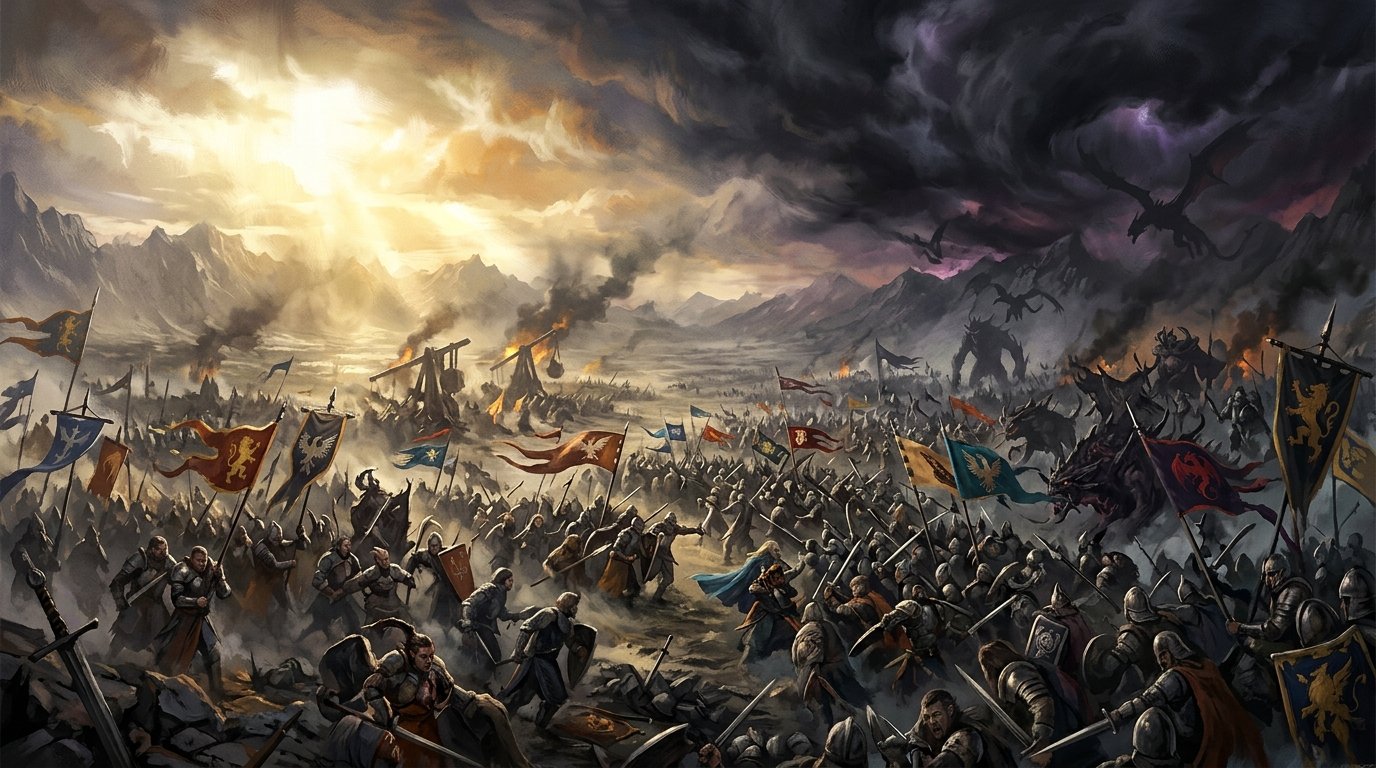
The choice here is bold and it works: the Last Battle isn’t one fight in one place, it’s a war spread across multiple fronts simultaneously, and the book jumps between them constantly. Perrin commanding a defense with everything he’s learned about leadership since a Trolloc raid on his hometown feels like a direct payoff to who he was in The Eye of the World. Egwene leading the combined Aes Sedai, wielding an authority she spent thirteen books earning one difficult decision at a time. Generals and soldiers and channelers all thrown together against an overwhelming Shadow army, and Jordan’s notes combined with Sanderson’s execution make the scale of it feel genuinely apocalyptic instead of just big for the sake of being big. It’s a lot to track, and I won’t pretend every transition between fronts landed perfectly for me on this reread. But the ambition of it, trying to actually show what the entire world going to war at once looks like instead of narrowing the focus down to make it manageable, is exactly the kind of swing a series finale this size needed to take.
I need to talk about Egwene, because her death in this book still hits like nothing else in the series. After everything she’s built, the rebel Aes Sedai and the Tower’s reunification and becoming genuinely one of the most capable leaders in the entire cast, watching her give everything she has left to turn the tide against one of the Forsaken is devastating precisely because of how earned her authority is by this point. This isn’t a character getting killed off for shock value. It’s the culmination of an arc that’s been building since she was just Rand’s friend from Emond’s Field fourteen books ago, and it made me set the book down for a minute before I could keep reading. Rereading her death in the context of the entire series rather than just this book made it land even harder than it did the first time through. She started as the girl everyone assumed would end up quietly supporting Rand’s story from the sidelines. Instead she became the person who reunified a shattered White Tower through patience and integrity, and her final act in the Last Battle is a direct extension of everything she’d already proven about herself for thirteen books. It’s the kind of death that only works because the character earned every bit of the authority she’s spending in that moment, and on this reread, knowing the whole shape of her journey, I don’t think any other ending for her would have felt as true to who she’d become.

Rand and the Dark One
Rand’s confrontation with the Dark One at Shayol Ghul is unlike anything else in the series, and I think that’s exactly the right choice. Instead of a straightforward magical duel, it becomes something closer to a philosophical argument about the nature of existence itself, about whether a world with genuine choice, including the choice to do evil, is worth preserving over one where evil simply can’t happen because nothing can really choose at all. It’s a strange, ambitious way to end a fantasy epic, and I remember being unsure about it on my first read years ago. On this reread, knowing it’s coming, I appreciated it more. Rand’s answer, and what he does with the choice he’s given, fits everything his arc has been building toward since Dragonmount. He’s spent the whole series being pushed toward becoming a weapon. The ending is him refusing to stay one.
What Rand does with his own fate afterward is one of my favorite touches in the whole series. Letting the world believe the Dragon Reborn died fulfilling the prophecy, while he quietly walks away to live a life nobody expects him to get to have, feels like the most human ending this story could have given him. He spent his whole life not getting to choose. The very last thing he gets is exactly that.
Mat, Perrin, and everyone else
Mat gets his own massive moment in the Last Battle, and it’s everything his character has been building toward since he first picked up that cursed dagger back in book one, all that luck and all those memories of other men’s battles finally deployed at the scale the whole series has been saving him for. Perrin’s arc closes out just as fully, with the wolf-dream storyline he finished in Towers of Midnight paying off in ways that matter for the actual outcome of the war rather than just his own personal growth. Every major character gets a real, weighted final chapter in this book, and it’s clear how much care went into making sure nobody’s fourteen-book journey got shortchanged at the finish line. Even characters who’ve spent most of the series in supporting roles get moments that land here. It would have been easy for a book this focused on its biggest stars to let the rest of the cast fade into the background for the finale, and instead there’s a real sense that everyone who’s bled for this story gets to be present for how it ends, one way or another.
What surprised me most on this reread is how many quiet, human-scale moments Sanderson and Jordan’s notes manage to preserve inside a battle this massive. Old grudges get settled. Old friendships get one more scene together before everything changes. Characters who’ve barely interacted across fourteen books cross paths in the chaos for exactly one meaningful exchange. It would have been easy for a finale this size to lose the individual people inside the scale of the war, and instead the book keeps finding ways to zoom back in right when it matters most.
Looking back at the full reread now that it’s done, what strikes me most is how well the ending actually answers the questions the early books ask. This started as a story about ordinary people getting swept up in something bigger than themselves. It ends with those same people, older and harder and changed in ways they couldn’t have predicted, actually being the ones who decide how the story ends. That’s a hard thing to pull off across fourteen books and two authors, and Jordan’s notes combined with Sanderson’s execution manage it. I’ll say plainly what I hinted at through the slower stretch in the middle of this series: books six through nine test your patience in places, and I don’t think that’s a controversial thing to admit about a series this long. But rereading start to finish, the strength of books like The Shadow Rising, The Fires of Heaven, and this entire final run more than make up for it. This is genuinely one of my favorite series of all time, and finishing this reread reminded me exactly why.
Thanks for following along on this one. If you’ve made it through the whole series yourself, I’d love to hear how the ending landed for you.
