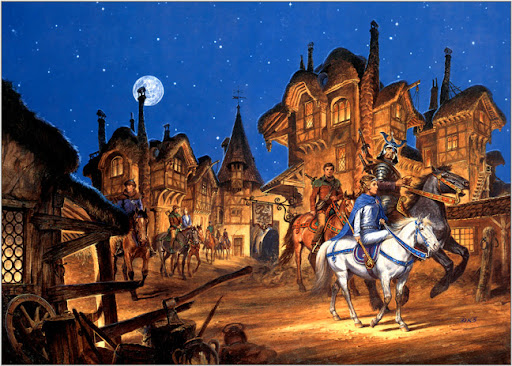
A reread of Robert Jordan’s The Eye of the World finds the novel holding up well despite familiar fantasy trappings. The Winternight attack, Shadar Logoth’s horror, and the scattered journeys of the Emond’s Field group all demonstrate Jordan’s pacing and structural confidence across a sprawling cast.
The review emphasizes how much foundational worldbuilding Jordan accomplishes without the narrative feeling labored. Familiar archetypes mask a deliberately constructed, much larger world, and the book’s climax — Rand channeling and being named the Dragon Reborn — lands with genuine weight.
Restarted the reread from the very beginning, and finishing The Eye of the World again is always a strange feeling. I know exactly what’s coming — I know who Rand really is, I know what the dagger does, I know where the Ways lead — and it still works. That’s the thing about this book I keep forgetting between rereads. It gets called derivative a lot, and sure, a farm boy getting swept out of a quiet village by a mysterious woman in gray isn’t the newest idea in fantasy. Doesn’t matter. Jordan executes it so well that I fall for it every single time.
Trollocs Come to Emond’s Field
The opening still gets me. Winternight, Trollocs pouring into Emond’s Field, and suddenly Rand, Mat, and Perrin are running for their lives with a Warder and an Aes Sedai they’d never so much as spoken to a day earlier. What I noticed more this time through is how fast Jordan moves once the attack starts — there’s no lingering, no drawn-out setup. One chapter you’re getting a feel for a sleepy farming village, the next it’s on fire and three teenagers are fleeing into the night with Moiraine and Lan. It’s a genuinely great inciting incident, and it earns the “nothing will ever be normal again” feeling it’s going for.
Moiraine and Lan are exactly as good as I remembered. Moiraine playing her cards close to her chest, giving half-answers wrapped in more questions, sets the tone for basically every Aes Sedai interaction for the next thirteen books. Lan is just Lan — quietly, effortlessly competent in a way that makes you trust him even when you don’t fully trust Moiraine. I love that the story never really explains their full relationship in this book. You just know it matters.
Nynaeve doesn’t get left behind either, and I’d forgotten how much I enjoy her introduction. She refuses to just let the village’s young people vanish into the night with a stranger, so she goes after them herself, tracking Moiraine’s party on her own with nothing but stubbornness and a genuine talent for reading the land. By the time she catches up, she’s already established as exactly the person she’s going to be for the rest of the series — furious, capable, and completely unwilling to be told what she can’t do.
Shadar Logoth and the Dagger
The detour into Shadar Logoth is where the book turns genuinely creepy, and I think it’s underrated as a piece of horror writing. A dead city, poisoned by its own history, with something ancient and hungry — Mordeth — still lurking in it. Mat picking up that ruby-hilted dagger without anyone noticing is such a quiet, almost throwaway moment the first time you read it. Knowing what that dagger does to him over the next two books makes it land completely differently on a reread. You want to reach into the page and stop him.
The chaos in Shadar Logoth that splits the group is one of my favorite structural choices in the whole series. Instead of keeping everyone together for a nice, tidy journey, Jordan scatters Rand, Mat, Perrin, Egwene, and even Moiraine and Lan across the map, and the book just… follows them separately. It shouldn’t work as well as it does.
What really sells Shadar Logoth for me is how it doesn’t explain itself much at all. You get pieces — a fallen kingdom that turned on itself out of hatred for the Shadow, something called Mashadar creeping through the ruins, Mordeth’s oily desperation to leave the city inside someone else’s skin — and you’re left to piece the rest together. Jordan trusts the reader here in a way a lot of first-book fantasy doesn’t, and it makes the whole sequence feel a lot bigger and older than the handful of chapters it actually takes up.

Two Paths Through the World
Perrin and Egwene end up with Elyas Machera, and this is where we get the first real hint of what Perrin actually is. His connection to the wolves starts here, quiet and a little frightening even to him, and I like that Jordan doesn’t oversell it. It’s presented almost matter-of-factly, which somehow makes it creepier. Egwene gets pulled into all of it too, and her friendship with Perrin during this stretch is easy to overlook on a first read but really sweet once you know how much both of their arcs are going to grow.
Rand, Mat, and Thom Merrilin take a completely different road through Caemlyn, and I’d honestly forgotten how much fun this section is. Thom is a great addition — a gleeman with more going on under the surface than he lets on — and the busking sequence in Caemlyn gives the book a breather from the constant danger. Min shows up here too, seeing those strange flashes around Rand that she can’t explain, and it’s a nice bit of foreshadowing dressed up as a simple street-fair scene.
Perrin and Egwene’s road is a lot rougher. Getting picked up by the Whitecloaks is a genuinely tense stretch — Geofram Bornhald running things with a kind of weary discipline, while Child Byar makes it very clear how the Children of the Light treat anyone who even looks like they might be a Darkfriend. It’s the first real look at how dangerous the Whitecloaks are, not because they’re evil in some cartoonish way, but because they’re absolutely certain they’re right. Getting Perrin and Egwene free of them, with the wolves circling in the background the whole time, is a nervy little sequence that doesn’t get talked about as much as the bigger set pieces but does a lot of work establishing what this world’s various flavors of danger actually look like.
The Eye of the World
Everything funnels back together in Shienar and then out into the Blight, and this is where the book goes from “solid fantasy adventure” to genuinely epic. The trip through the Ways with Loial is unsettling in exactly the right way — I love Loial as a character, and this is a great introduction to him, all nervous energy and genuine warmth even while surrounded by something ancient and wrong.
The climax at the Eye of the World itself still hits. Rand, Mat, and Perrin facing down Aginor and Balthamel — two actual Forsaken, awakened and unleashed on a handful of teenagers who had no idea any of this existed a few weeks earlier — is a great payoff for everything the book’s been building. The Green Man himself is a fantastic bit of imagery, this ancient, half-forgotten guardian showing up right when things are at their worst, and it gives the final stretch a real sense of scale after so much of the book has been small groups running and hiding.
And then Rand channels. He burns through Aginor without fully understanding what he’s doing, and the book doesn’t soften the moment at all. He’s the Dragon Reborn, he can channel, and he’s going to go mad and die from it eventually unless something changes. Moiraine doesn’t dress it up for him either, which I appreciate on this reread more than I used to — she gives him the truth, brutal as it is, instead of coddling him through it. That’s a heavy note to end a book on, and Jordan doesn’t flinch from it.
Wrapping Up
What strikes me most on this reread is how much groundwork gets laid here without the book ever feeling like homework. The Whitecloaks capturing Perrin and Egwene, the wolves, the Ways, Min’s viewings, Thom’s hidden past — none of it pays off yet, but all of it matters eventually, and I can feel Jordan setting pieces on the board with real patience. For a book this many people call “just a Tolkien knockoff,” there’s a lot more going on under the hood than it gets credit for.
The comparison isn’t even wrong, exactly — there’s a Gandalf-shaped hole where Moiraine stands, a Fellowship-shaped hole where the Emond’s Fielders scatter across the map, a Mordor-shaped hole out past the Blight. What the comparison misses is that Jordan uses those familiar shapes to smuggle in a much bigger, stranger world than one book can show you. By the last page, you’ve barely scratched the surface of Aes Sedai politics, the Aiel, the Seanchan, the Forsaken, or what “ta’veren” even really means, and that’s exactly the point. This is a foundation, not the whole house, and on a reread you can appreciate how deliberately Jordan built it.
Already looking forward to jumping back into The Great Hunt next, where things really start moving. If it’s been a while since your own first read of The Eye of the World, it holds up better than you might remember — go give Emond’s Field another visit.

1 comment
[…] about leadership since a Trolloc raid on his hometown feels like a direct payoff to who he was in The Eye of the World. Egwene leading the combined Aes Sedai, wielding an authority she spent thirteen books earning one […]