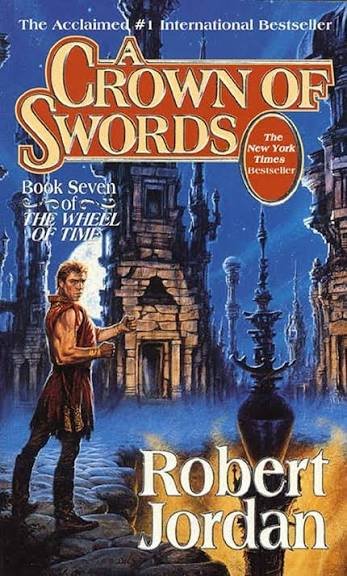
Just finished A Crown of Swords, and this is the first book on the reread where I had to actually push through some sections instead of racing through them. There’s still good stuff here — genuinely good stuff — but this is where I started feeling the difference between a Wheel of Time book that’s firing on every cylinder and one that’s mostly setting the table for later.
Rand Moves on Illian
The strongest thread by far is Rand’s campaign against Sammael in Illian. After a whole book of Sammael working through proxies and staying just out of reach, watching Rand finally move directly against him is satisfying in a way this particular rivalry has been building toward since The Fires of Heaven. Rand takes the city, and the way Jordan stages it — political maneuvering as much as open combat, Rand having to actually think about what ruling a conquered city means rather than just winning a battle and walking away — makes it feel like a genuine turning point rather than another fight scene.
What I like most is how it forces Rand to start acting like the ruler he’s going to have to become instead of just the weapon everyone keeps trying to point at the Shadow. He’s got a city to run now, on top of an army, on top of the Aiel, on top of trying not to go insane. You can feel the job getting bigger than any one person should have to carry, and Jordan lets that show on the page instead of just telling us Rand is stressed.
There’s a real cost to how Rand handles the aftermath too. He’s not gentle about consolidating power in Illian, and the reread made me notice how much colder his decision-making has gotten since the early books. This is the guy who used to agonize over every hard choice back in Emond’s Field. By this point he’s making calls that would have horrified that version of himself, and mostly justifying it as necessary. It’s good, uncomfortable character work, even when it’s not always comfortable to read.

Enter Cadsuane
And then there’s Cadsuane, who shows up determined to take Rand in hand whether he likes it or not. I have complicated feelings about her on this reread. She’s clearly meant to be a formidable, no-nonsense counterweight to a Dragon Reborn who’s getting colder and more dangerous by the book, and there’s something satisfying about a character who simply refuses to be intimidated by him. At the same time, her introduction is the start of a dynamic between them that I remember taking a while to really click, and on this read I found myself wanting her to just say what she means instead of playing quite so many games with a man who’s already surrounded by people playing games with him.
Nynaeve and Elayne in Ebou Dar
Nynaeve and Elayne spend a good chunk of this book in Ebou Dar, chasing down leads on the Bowl of the Winds, the ter’angreal that might be able to undo the unnatural weather the Dark One’s influence has been causing across the whole continent. It’s solid material, and I like the introduction of the Kin, ordinary women who left the Tower or never made it past novice but kept using the Power quietly on their own for generations. It’s a nice bit of world-building that fills in a gap I hadn’t thought much about before — what happens to women who can channel but never become Aes Sedai.
Thom and Juilin round out that group nicely, and I appreciate that Jordan keeps at least one or two non-channelers embedded in every major storyline. It would be easy for a series this focused on the One Power to lose track of why anyone without access to it still matters, and having Thom’s street smarts and Juilin’s thief-taking instincts driving parts of the Ebou Dar plot keeps that from happening. Small thing, but I noticed it more on this read than I ever have before.
Mat, Waking Up
Mat spends most of this book unconscious or recovering, which sounds like a strange thing to highlight, but the chapters around his condition and slow recovery give some of the supporting cast, particularly Thom, real room to show how much they care about him without Mat’s usual deflecting humor getting in the way. It’s a quieter use of his storyline than usual, and it works specifically because we’ve spent six books watching him charm his way through everything — seeing him vulnerable and dependent on other people for once adds a dimension that a more typical Mat chapter wouldn’t have provided.
Where the Pace Really Shows
I’ll be straightforward about this one, since that’s the point of doing a reread out loud like this: A Crown of Swords is where I first felt Jordan spending real page count on scenes that could have been tightened up considerably. There’s a stretch in Ebou Dar that meanders more than it needs to, and a few chapters elsewhere that feel like they’re marking time rather than moving anything forward. None of it is bad writing exactly. It’s more that the plot-to-page ratio starts to feel different here than it did across the first six books, and I noticed myself checking how many pages were left in a way I hadn’t been doing before.
Faile’s situation with the Shaido also starts turning genuinely dangerous by the end of this book, and I won’t pretend I’m not a little worried about where that’s headed. Perrin’s been mostly reactive for a couple of books now, and I’m ready for that thread to demand something more from him.
The White Tower schism keeps grinding along in the background too, more maneuvering between the Salidar Aes Sedai and Elaida’s loyalists than any real resolution. I trust it’s building toward something, the way everything in this series eventually does, but this is the first time on the reread where I caught myself wanting Jordan to just get on with it rather than trusting the process completely.
Egwene and the Rebel Aes Sedai
Egwene’s chapters in this book are mostly consolidation work, shoring up her position among the rebel Aes Sedai and continuing to build the case for legitimacy that’s going to matter enormously later. It’s quieter material than Rand’s storyline, and I noticed it more as connective tissue than as a highlight in its own right this time through. That’s not a knock on Egwene as a character — she’s still sharp and still growing into the role — it’s more that this particular stretch of her arc is doing setup work rather than delivering its own payoff, which is a pattern I noticed repeating across a few different threads in this book.
Faile’s Situation Turns Serious
I mentioned it above, but it’s worth sitting with for a minute: by the end of this book, Faile is genuinely in danger, captured by the Shaido in a turn that lands like a gut-punch precisely because so much of the rest of the book has kept Perrin at arm’s length from the main action. He finds out what’s happened almost too late to do anything immediate about it, and the helpless fury in those last few chapters is some of the rawest writing Perrin’s gotten in the whole series. I closed the book genuinely rattled on his behalf, which is exactly the reaction an ending beat like this should get.
Wrapping Up
Rand taking Illian and finally confronting Sammael directly is a real high point, and Cadsuane’s a compelling enough addition that I’m curious where Jordan takes the dynamic between them. But this is the first book in the series where I’d call the pacing a genuine issue rather than just a matter of taste — there’s a good three-hundred-page book in here surrounded by some material that could stand to move faster.
Onward to The Path of Daggers. Hoping the momentum from the Illian campaign carries forward.


2 comments
[…] book in the series and it reads like it. That’s not automatically a bad thing, because after A Crown of Swords ran a little long in places for me, having a leaner entry wasn’t unwelcome. But this is also the […]
[…] getting Faile back makes this one of the most rewarding entries since The Shadow Rising. After A Crown of Swords and Path of Daggers felt like the series catching its breath, this is Jordan reminding me exactly […]