A review of Last of the Time Lords, the Doctor Who Series 3 finale, which jumps a full year past The Sound of Drums to an Earth ruled by the Master, with the Doctor aged and caged and Martha Jones out walking the world alone.
The post praises the bleak year of occupation, Martha’s journey, the truth about the Toclafane, the Master’s death and Martha’s decision to leave, but calls the glowing, floating Doctor resolution a big misstep. It rates the episode 3.5/5.
Series 3 ends with a finale that’s one part triumph, one part misfire and one part genuinely great character writing, and the great character writing wins, just about. Last of the Time Lords picks up a full year after The Sound of Drums left the Master ruling a conquered planet, spends most of its running time somewhere genuinely bleak, fumbles its own resolution, and then claws itself back with two of the best scenes of the season. Frustrating, fascinating, and in the end properly moving. I came away liking it a lot more than the middle bit deserved, if that makes sense.
The jump is brutal and brilliantly done. A year has passed and the Master has ruled unopposed, a tenth of humanity is dead, and the survivors are slave labour breaking up cars and houses for scrap in shipyards on every continent, building rockets for a war with the rest of the universe. He’s carved his own face into Mount Rushmore. The Doctor, aged past anything recognisable, is kept in a birdcage like a pet. Jack’s chained up in the brig on cold mashed swede, and Martha’s family are the household staff aboard the Valiant, fetching and carrying for the man who put them there.
It’s genuinely nasty stuff for teatime telly and the show commits to it. The Master’s rule isn’t a cartoon dictatorship, it’s petty and personal and cruel in ways designed to humiliate specific people, the Doctor most of all. Simm keeps the manic energy from last time but there’s real sadism underneath it now, and the sight of the Doctor reduced to a wizened little thing in a cage is hard to shake. And the whole time the Toclafane are zipping about giggling, which somehow makes it worse.

Martha Jones Walked the Earth
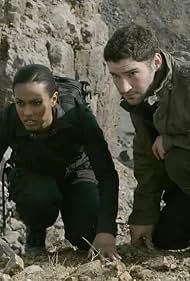
And then there’s Martha, who’s spent that year on foot, and this is the payoff of everything the season built. She got off the Valiant with Jack’s teleport and no plan anyone else could see, and she’s spent twelve months crossing a conquered world alone, through camps and ruins and occupied cities, hunted the whole time, telling everyone she meets about the Doctor. She’s become a legend. People whisper that she sailed the Atlantic, walked across America, was the only person to get out of Japan alive. The Martha who comes ashore on a beach in the dark at the start of this episode is harder and quieter than she was, with none of the eager brightness she had when she was a medical student caught up in a hospital on the Moon in Smith and Jones.
The year’s cost her, and it shows. It isn’t the first time this season has asked her to put up with something alone and unthanked, she spent months as a maid in 1913 swallowing abuse and guarding a fob watch in Human Nature, but twelve months walking across an occupied planet with a price on her head is a whole different order of thing. She came through it. She lost her whole family to that ship for a year and kept walking anyway. And she came back for everyone else, which is the bit that gets me, because nobody would’ve blamed her for just hiding.
It’s a magnificent thing for a companion to have done, and the episode’s right to make it the spine of the whole story. Whatever else this finale gets wrong, it understands that Martha Jones saved the world by walking across it. For me that’s the single most impressive thing any companion has done, and the show gives it the weight it deserves, right up until it has to explain how it actually worked.
Who the Toclafane Really Are
The reveal is the cruellest idea the show’s had in years, and it guts an episode I loved after the fact. The Toclafane are humanity. Specifically, they’re the people from Utopia, the last survivors at the end of the universe who boarded that rocket and flew off to the refuge they’d been promised, and found nothing there at all. No Utopia, no diamonds in the sky, just the dark and the cold and the end of everything. So they cannibalised themselves down into these giggling chrome balls to survive, regressing into children, and the Master brought them back through his paradox machine to slaughter their own ancestors.
That’s horrifying on every level. The hopeful, desperate people I watched queue for that rocket are the childlike voices carving up the Earth, and the last thing they ever did as human beings was give up. When one of them is asked why they’d kill so many of their own species and says it’s because it’s fun, it’s one of the ugliest lines the show’s ever had. Martha works out who one of them used to be from a single phrase about the skies being made of diamonds, a boy she’d actually met at the end of the universe, and that’s just horrible. It also makes the Master’s plan genuinely obscene rather than just villainous. He took Lucy to see the end of the universe, a Time Lord and his human companion, and she came back saying there was no point to anything, not ever. So he took humanity’s despair and turned it into an army.
The Word, and the Problem
Which brings me to the resolution, and I’ll be honest, it doesn’t work. Martha’s story about a gun that can kill a Time Lord, four chemicals scattered round the world, turns out to be a decoy. Her real weapon is the Archangel Network. For a year she’s been telling every person on Earth to think one word at one precise moment, and when everyone on the planet thinks Doctor at once, the energy pours into him, undoes the ageing and restores him. He rises into the air glowing, arms outstretched, drifts over to the Master, hugs him and says he forgives him.
The idea underneath is sound and rather lovely, the Master’s own instrument of control turned into an instrument of faith, and Martha’s year of talking to people being literally what saves everyone. But the floating, glowing Doctor goes one step too far and tips over into something faintly ridiculous. A beatific Doctor haloed in golden light asks me to accept an awful lot on very little, and after an hour of grounded, ugly, specific misery it lands like a different programme entirely. It’s the one real misstep in the finale, and it’s a big one.
Then the episode starts to recover. Jack shoots up the paradox machine, time snaps back, and the year unhappens for everyone except the handful of people who were aboard the Valiant. Only they remember it. That’s a haunting idea all on its own, a whole planet’s worst year wiped from every memory but a dozen, and Martha’s family having to carry it round in their heads while their neighbours get on with their lives. I’d have liked a lot more of that and a lot less glowing.
Forgiveness, and a Pyre
The Master’s death is where it really comes good. Cornered and beaten, he’s shot by Lucy, the wife who stood beside him through all of it. And he refuses to regenerate. He could survive, he just won’t, because surviving means the Doctor keeps him, locked up in the TARDIS being looked after, and he’d rather die than be forgiven. The Doctor begs him, rattling off the Axons and the Daleks, all the things they’ve done, the two of them the only ones left. And the Master just says “I win” and asks if the drumming will stop.
The Doctor, who’s spent two episodes saying he only wanted his oldest friend back, holds him while he goes, and then burns the body on a pyre on his own. Tennant plays it beautifully. For all the shouting, the last of the Time Lords is now genuinely the last, and he chose none of it. He wanted his friend back more than he wanted to win, and he lost anyway. Refusing to regenerate rather than be forgiven is the most revealing choice the show could have made for the Master.
There’s an odd final beat too, a woman’s hand with red fingernails reaching into the ashes to pick up the Master’s ring. Nobody explains it, and the camera doesn’t hang around long enough to give me any clue whose hand it is or what they want with a dead man’s ring. I’ve no idea what to make of it, and it’s been bothering me ever since, which I suppose is the point of putting it there.
Martha Leaves
The best scene is saved for last. Martha packs her bag and gets out, not in tragedy, not torn away like Rose at the end of Doomsday, she just looks at the situation clearly and decides she’s had enough of loving a man who won’t love her back. She tells him about her friend Vicky, who spent ages adoring a bloke in her student house who never once noticed her, and then says plainly that she’s not doing it any more. She’s spent a lot of time with him thinking she was second best, and it turns out she’s good. She’s got a family to put back together and a life to get on with.
So she walks out of the TARDIS on her own two feet, on her own terms, promising she’ll see him again. After a season of being second best to a ghost, that’s a superb exit, the healthiest, most grown-up departure a companion’s been given, and completely in character for the woman who walked the Earth. It’s a rare thing for this show to let a companion just choose herself, and I loved that it did. And then, because the show can’t help itself, the prow of a ship smashes through the TARDIS wall and the Doctor picks up a lifebelt with Titanic written on it. Of course it does.
Rating: 3.5/5. The floating-Doctor resolution badly undercuts an otherwise bleak and gripping finale, and it’s the reason this doesn’t score higher, but everything either side of it is excellent. Series 3 has been a strong run, and it ends on more highs than lows. I just wish the highs hadn’t had to share an hour with a glowing Tennant.

3 comments
[…] walked out of the TARDIS on her own terms at the end of Last of the Time Lords, and the show has been sensible about what she did next. She’s finished her training, she’s a […]
[…] that matters enormously here. After the year that never was and Martha’s departure at the end of Last of the Time Lords, he has nobody, and he spends the episode collecting a substitute family out of strangers because […]
[…] and a life she likes, and she tells Donna to look after him. After the year she walked across in Last of the Time Lords, it’s a fittingly undramatic exit for a character who earned an undramatic ending. She gets to […]