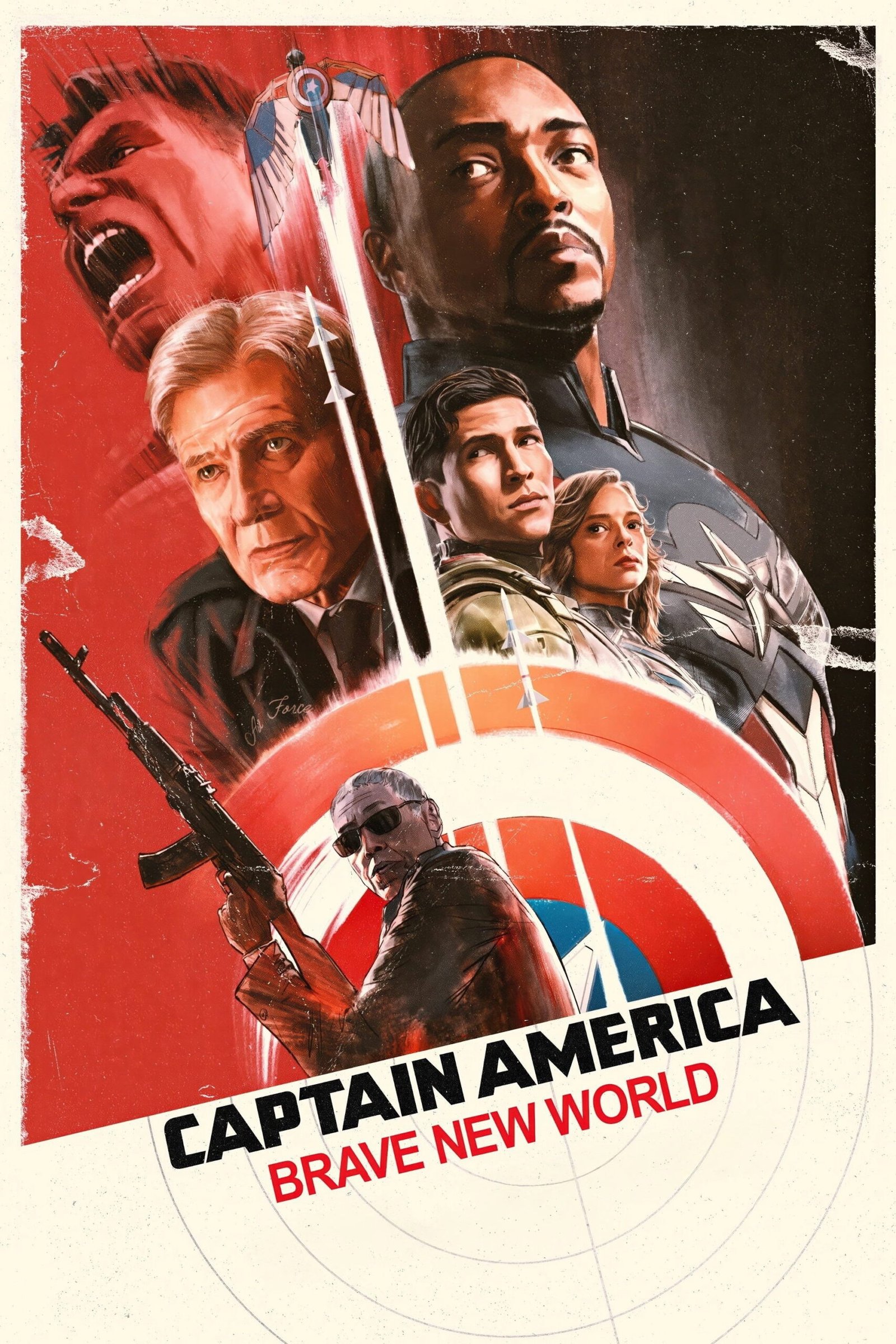
Sam Wilson finally gets to be Captain America without an asterisk in Brave New World, and the movie spends two hours arguing with itself about whether that’s earned.
I’ll say the quiet part first: I always thought Bucky was the more natural fit for the shield. Sam as Falcon could fly and had the gadgets, but he never had the physical presence I want behind Captain America. Cap should feel like he can stop a moving vehicle with his shoulder. Sam feels like a very good pilot with excellent aim, which is a different kind of hero entirely.
The mini-series tried to close that gap by having him train with the shield, and the film leans on that training as settled fact. Here’s the thing that bothers me more the longer I sit with it: none of the Chris Evans movies ever bothered to show that kind of training either. Steve picked up a round piece of vibranium and immediately knew how to ricochet it off three surfaces and catch it on the rebound. Nobody asked. It just came naturally, because the serum was doing narrative work as well as physical work.
So holding Sam to a standard the franchise never actually established for Steve feels a little unfair. That doesn’t fully settle my doubts, but it’s worth naming that the goalposts here were never really planted in the first place.
The plot is a political thriller wearing a superhero costume
Thaddeus Ross is president now, trying to rebuild his relationship with his daughter and stake his legacy on a treaty over Celestial Island, the petrified Celestial left over from Eternals. It turns out to be sitting on a deposit of adamantium, and that’s the geopolitical hook: whoever controls it controls the next arms race.

Sam works the case with Joaquín Torres, the new Falcon, after Isaiah Bradley opens fire on Ross at a White House event under what turns out to be mind control. Clearing Bradley’s name is what actually drives Sam through the film, and it’s the right choice. Bradley is the moral weight of this whole corner of the MCU, a Black super-soldier the government experimented on and then imprisoned for thirty years, and the film knows it.
Behind the scenes is Samuel Sterns, the gamma-scarred scientist from the 2008 Incredible Hulk, engineering a slow-motion revenge against the man who used his mind and then locked him away. Pulling that film back into continuity after seventeen years is a bold swing.
Does it land? Mostly, and more because Tim Blake Nelson commits to it than because the script does much heavy lifting. Sterns’ scheme runs on musical triggers and long-game manipulation, which is a genuinely creepy idea that the movie gestures at rather than builds. I wanted more of him and less of the treaty negotiations.
There’s also a question of whether reaching back to 2008 is satisfying or desperate, and I land somewhere in between. Satisfying, in that The Incredible Hulk has spent seventeen years as the MCU’s embarrassing cousin, the one film everybody skips on a rewatch, and giving it retroactive consequence is a genuinely nice piece of housekeeping. Desperate, in that the reach only works if you remember a film most people didn’t like and haven’t seen since. Marvel is asking the audience to do homework for a payoff that isn’t quite worth the reading.
Torres is the best thing nobody’s talking about
Danny Ramirez as Joaquín Torres is the quiet win here. He’s the new Falcon, he’s plainly not ready, and the film lets him be visibly out of his depth without turning it into a joke at his expense. The Sam/Torres dynamic gives the movie something the plot doesn’t: a relationship with actual warmth in it.
It also does something structurally useful. Watching Sam mentor someone into the Falcon role reframes his own promotion. He isn’t the guy who got handed the shield anymore, he’s the guy passing his old job down, and that shift does more to sell him as Captain America than any amount of shield choreography.
Ford is good, but Hurt was better
I love Harrison Ford, and he’s clearly having fun as Ross. But I’ll take the unpopular position: William Hurt was the better actor in this specific role. Hurt played Ross as a man permanently one bad day from doing something unforgivable. Ford plays him as a man giving a speech about redemption. Both are valid readings. Hurt’s was more interesting to watch.
That’s not really a knock on Ford. These movies don’t need Shakespeare, even when they cast people who could deliver it. Marvel has had Patrick Stewart on the payroll and still handed him exposition. The material sets the ceiling, not the cast.
Was the Red Hulk worth the build-up?
The Red Hulk turn is fine as spectacle and thin as payoff. Sterns triggers the pills Ross has been taking, Ross goes crimson, and Sam fights him across Washington with no serum and no realistic chance in a straight brawl.

Sam wins by refusing to kill him and talking him down instead, which is absolutely the right instinct for the character. It’s the most Captain America thing in the movie. My problem is the execution. The resolution lands too simple, in the same way Batman v Superman undercut its entire climax with “save Martha.” One emotional appeal, one turn, fight over.
That’s a good filler movie ending. It isn’t the win this film needed to make its case. If the whole point is that Sam earns the shield without the serum, then the moment he proves it should cost him something more than a well-timed speech.
Did the film earn Sam’s version of the shield?
That’s the real question hanging over Brave New World, and I don’t think it fully answers it. The politics of a Black man taking up Captain America after Isaiah Bradley’s imprisoned decades gives the film real weight to draw on, and to its credit it doesn’t shy away from that history.
I’ll be honest that I could also read some of this as a studio hedge, an attempt to speak to real tension in the US rather than a story decision made for story reasons. Whether it’s an honest exploration or a calculated one is a fair question to sit with, and the film doesn’t fully resolve it either way. What I can say is that it isn’t cynical about Bradley himself. Carl Lumbly gets the film’s best scenes and the script treats that history seriously.

What the film does get right is closing a loop that started with Avengers: Endgame, which first handed Sam the shield and left the question of whether he’d grow into it hanging in the air. Brave New World is where that question finally gets tested against something bigger than a passing-of-the-torch ceremony.
It just tests it in a movie that would rather be a political thriller than a Captain America story. It wants to be The Winter Soldier badly enough that you can see the shape of that ambition in every conspiracy beat, and it never fully commits to either register.
Where it sits against the rest
The original Cap trilogy is far and away better than this, and it isn’t close. Even Civil War, which had to carry half the Avengers roster and a whole ideological schism, used Ross as a sharper antagonist in twenty minutes than this film manages across its runtime.
It’s also a step down from the big swings. Infinity War had the confidence to let the villain win. Brave New World doesn’t have that kind of nerve. It’s a competent, watchable, slightly overstuffed film that resolves everything it raises and surprises you with none of it.
Compare the energy to something like Deadpool, a film with a fraction of the budget and ten times the personality. The gap isn’t money. It’s willingness to take a swing and risk missing.
Worth a watch for Sam’s arc and for Ford chewing on the role. Don’t go in expecting the original trilogy. Current critic scores put it toward the lower end of the MCU’s recent run, and on this one I don’t think that’s wrong. Good movie. Not an amazing one, and not one I’ll be revisiting often.

1 comment
[…] Bradley’s history, which I thought was a strong thread wasted inside a crowded show, became the hinge of a feature film four years later. I wrote then that the series had too much plot for its character work and not enough to sustain the […]