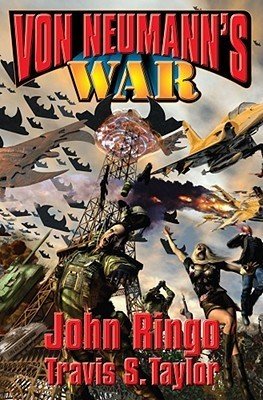
I review Von Neumann’s War, the 2006 standalone SciFi novel where Mars probes keep failing to land and the red planet is turning gray. I go through the Neighborhood Watch crew (Roger, Traci, Gries, Cady and Megiddo), why the title gives the game away and what I liked about how the ideas come together.
I’d highly recommend it to anyone who likes tales of space vehicle development, alien technology and clever people, and I wish it had a sequel.
Von Neumann’s War is a standalone SciFi novel from 2006, and it’s the book I point people to when they want to watch clever people solve an enormous problem with whatever’s lying around. The setup is an alternate version of our own timeline where Mars probes keep failing to land, and where the red planet has started losing albedo and turning gray. It’s a small detail that does a lot of work, because somebody has noticed and somebody else is about to be handed a very large contract to find out why. There’s a loose prequel called Neighborhood Watch – Final Report if you want the backstory, but you don’t need it to follow anything here. What sets it apart for me is that it doesn’t start with a war at all.
That’s what I’d tell you up front. If you’ve been working through something like Swarm, where the alien ships turn up and start sampling humans almost immediately, this is a slower and stranger kind of book. It spends its first stretch on people, meetings and design problems, and the dread builds out of the Mars mystery instead of out of explosions. I liked that, because when the fighting does arrive it has somewhere to come from. Nothing about the opening felt like padding to me, even though it takes its time. And if you’re the sort who needs a firefight by chapter three, you’ll want to know that before you start, because the first part is closer to a techno-thriller about a very odd engineering project than it is to a war story. The payoff is worth the wait, and the wait is never boring.
Who’s who in Neighborhood Watch
Roger Reynolds is the engineer at the center of it, and he’s a true believer in off-the-shelf design. For his high school science fair he built a sounding rocket out of old parts and ordinary materials, won first in category at the International Science and Engineering Fair, and came away with a scholarship and a job at NASA. Later he joins a defense contractor and works on classified projects, which is how his company ends up running Neighborhood Watch, a project to develop, launch and monitor a recon probe to Mars. Roger and his friends already have a flyby plan, so when the National Security Council wants a look at Mars, he pitches it to the National Reconnaissance Office and it goes up to the President. I love that his big idea is cheap and ordinary instead of shiny and new.
Then you get the rest of the cast. Traci is a waitress and an astrophysics grad student at the University of Alabama in Huntsville, and she’s the one who confirms the change in Mars’s albedo. She picks up the background on the problem bit by bit while working her shifts at Hooters, and Roger hires her into Neighborhood Watch because she already knows more than she should and needs almost no briefing. Captain Shane Gries is a company commander back from Iraq who ended up at the Pentagon evaluating new technology, where most of what he saw was premature, irrelevant or worthless. He joins the project to counter whatever the aliens can do, and naturally he gets his old First Sergeant, Thomas Cady, as his assistant. Then there’s Megiddo, a renegade scientist hiding from the government because he knows too much, who calls in to a late night radio show that’s obviously modeled on Coast to Coast (a great one to listen to if you’re up late, by the way). He’s got a few bats in his belfry, but he also sees the obvious and lands on more or less the right answer.
Why the title gives it away
The book jacket doesn’t say anything about machines, but the name of the novel does. A Von Neumann device is a self-replicating machine, and the idea behind it is that one of them could flood a galaxy by copying itself everywhere it lands. Work through the numbers and studies of self-replicating probes put the time to fill a galaxy at somewhere between four million and three hundred million years, which is nothing next to the age of the galaxy. So where are they? Mars, of course! I love that one line, because it takes a real argument about why we haven’t met anyone and turns it into the opening move of a thriller. It’s also why the gray Mars works so well, since a probe that failed to land is a mystery, but a planet that’s being quietly rebuilt is a threat.

What makes it fun is that the book lets you stay half a step ahead of the characters. You’re watching smart people connect dots you already suspect, which sounds like it would drag and doesn’t, because the dots come from such different directions. It’s the same slow reveal I enjoyed in Discovery of the Saiph, where humans find what a long dead civilization left behind and have to work out what it means. The difference is that here the thing they find is still running, and that’s what makes the Mars mystery feel so uneasy. Honestly the scariest part of the whole book is the idea that whatever’s out there is patient, and that it was always going to be Mars.
Clever people and ideas from everywhere
My favorite thing about it is how the ideas come together. The interplay of characters, from rocket scientists to teenage girls, is very interesting in itself, and the way ideas emerge from such divergent sources is much closer to reality than the current corporate approach. Nobody here is the lone genius with the master plan. Roger’s cheap rockets, Gries’s eye for what’s worthless and what isn’t, Megiddo’s late night rants and Traci’s astrophysics all get used, and the book keeps making the point that a good idea can come from anywhere if somebody’s willing to listen. I kept thinking about how rarely a real project works that way, and how much more fun it is when a story pretends it does.
It reminded me a little of Island in the Sea of Time, where the whole island of Nantucket gets swept into the Bronze Age and its people have to adapt and survive with what they’ve got. Here nobody’s stranded, but the problem is just as big and the resources just as odd. There’s real pleasure in a story that lets the engineers be the heroes, and there’s real tension too, because you know whatever they cobble together is going up against something far bigger. The book includes the recon flyby of Mars and quite a bit more, and I’m not going to say what the more is. Gries’s job of evaluating and countering what the aliens can do gives the second half its backbone, and I enjoyed every step of it. It’s also where the book earns its place on the military SciFi shelf, because the ideas from the first half start getting tested against something that doesn’t care how clever they are.
Should you read it?
Apparently there won’t be any sequels, since the conclusion leaves little room for further development, and that’s a pity because the whole scenario is just too good to drop. It’s a complete story, though, and it doesn’t feel like it’s waiting for a second book to finish the job. Whenever I see machines that attack with no attempt at negotiation, in a book or a film, this is where my mind goes first. If you like your military SciFi with a bit of engineering and a lot of dread, it’s well worth a weekend.
I’d highly recommend it for Ringo and Taylor fans, and for anyone who enjoys tales of space vehicle development, alien technology and clever people. That’s the kind of reader I think it was written for, and it’s the kind I was when I picked it up. It isn’t trying to be the biggest battle book on the shelf, and that’s exactly why it’s stuck with me. Enjoy yourself with it.
If you’ve got a friend who says they don’t read military SciFi because it’s all gun fights and acronyms, this is the one I’d hand them. There are fights, and plenty of acronyms, but the real action is people in a room arguing about how to build something that might work, and I find that more gripping than most battle scenes. Megiddo alone is worth the price of admission, and Traci’s the sort of character you root for from her first shift. The characters are quirky enough that you remember them, and the science is believable enough that you keep turning pages to see what they’ll try next.

3 comments
[…] who has never read him. If you want to see where his other ideas go, Into the Looking Glass and Von Neumann’s War are both worth your time, and a lot of his back catalogue used to live in the Baen Free Library if […]
[…] enough to still keep you engaged. I’ve already written about other Ringo books, including Von Neumann’s War and Into the Looking Glass, but I realized I hadn’t included this series, and I think […]
[…] aliens themselves are extremely scary. The way in which they act is very reminiscent of Von Neumann’s War, which I’ve reviewed on this site before, and also the film The Darkest Hour, as well as the […]