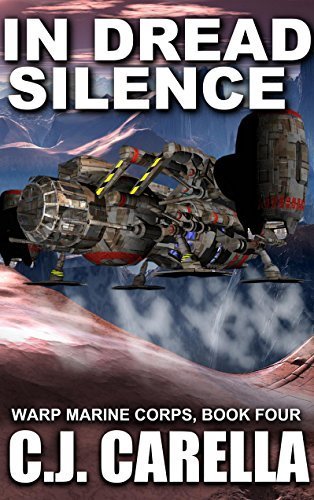
I cover In Dread Silence, Book 4 of C.J. Carella’s Warp Marine Corps series, where a disgraced admiral leads a small expedition to a forgotten planet to find a weapon that might save the United Stars of America while the galaxy’s greatest power launches a major offensive. I go through the setup without spoilers and say how it fits the series.
I enjoyed the whole series and I’d highly recommend it, and this is the book that turns the war toward something much older and darker.
In Dread Silence is Book 4 of C.J. Carella’s Warp Marine Corps series. I re-read the earlier books before starting this one, since it had been much too long since I’d met up with my favorite Warp Marine friends. Military SciFi is one of my favorite genres, and I’ve written about plenty of it, including Troy Rising. The Warp Marines are a series I’d highly recommend to anyone who likes the genre, and I enjoyed the whole run. The book carries a warning for violence, strong language and adult content.
If you’re new to it, a quick recap. Aliens bombed humanity back to the stone age, other aliens helped it back on its feet, and the United Stars of America built a fleet and a Marine corps that made the rest of the galaxy call them Warp Demons. By this point the war has been going on for a while, and humanity has been fighting more than one enemy at a time. This book takes that fight to a new place, and it does it by looking backward as well as forward.
It helps to look at how the series got here. Book 1 was a small unit siege, a platoon of Marines holding an embassy on a hostile alien world against angry mobs. Book 2 moved to the defense of a whole planet, Parthenon, against a Starfarer nation with technology equal to ours, with some real starship combat and a revolution in space warfare at the end. Book 3 then split the story four ways, with a diplomatic mission gone wrong inside a colossal alien habitat, a CIA operative up against immortals, a fighter pilot reaching into warp space and a corporal in Charlie Company. Each book has been bigger than the last, and In Dread Silence is where all that scale gets pointed at a single question.
A mission to a forgotten planet
The setup is a good one. There’s a mission to a forgotten planet, a disgraced admiral facing an implacable foe, and on the forefront of battle, the dreaded Warp Marines. The greatest power in the galaxy launches a major offensive into human space, and a small expedition ventures into the unknown, searching for a weapon that may turn the tide for the beleaguered United Stars of America. It’s a classic military SciFi hook, the long shot that might change everything, and it works because the book is clear about how badly humanity needs it.
A disgraced admiral is a great person to put in charge of that kind of mission. He has something to prove and not much left to lose, and a small expedition to a forgotten planet is exactly the sort of job nobody else wants. That puts the focus on a small group of people under pressure, which is where the series is always at its best. The big fleets are still there in the background, but the heart of the book is a handful of people trying to work out what to do next. It’s the same instinct that made the first book work so well.

The title does a good job of setting the tone. A dread silence is exactly what you’d feel standing in the ruins of a civilization that’s been gone for a very long time, and the idea that something there might still be waiting is a nice way to take a military series into horror territory. I like when a series changes its flavor like that without changing its characters. The Marines are still Marines, and they still do their jobs the same way, but now they’re doing them somewhere that feels old, hostile and wrong, and that’s a good contrast with the high-tech fleets of the earlier books.
The ruins of an ancient evil
What gives the book its flavor is where the expedition goes. They’re digging around the lost ruins of an ancient and evil civilization, looking for answers, and the question the blurb poses is whether that will provide what the US needs or bring destruction to the entire galaxy. That’s a great tension for a military story, because you can’t tell whether the thing they’re searching for is a weapon or a trap. It also ties neatly into the warp space entities that the earlier book introduced, and it gives the series a new layer of history to work with.
Ancient ruins and lost weapons can feel like a cliché, but the series earns it by keeping its feet on the ground. These are Marines and sailors who have to get from one place to another, deal with the people who are shooting at them, and decide what to do when they find something they don’t understand. The grit and small unit tactics that I loved in the early books are still here, and so is the sense that every decision costs somebody. That mix of big mystery and gritty combat is what I look for in military SciFi, and it’s why this one stays with me.
It’s also a good place to think about what the United Stars of America actually is in this series. It’s a country that was nearly wiped out, rebuilt itself in a hurry, and now finds itself standing against the biggest power in the galaxy, and that gives every mission a sense of desperation. Nobody in the story has the luxury of waiting, and that’s why a small expedition looking for a weapon makes sense. When your side can’t win a straight fight, a long shot like that is the only choice you have, and the book makes you feel the weight of that decision.
Big fleets and a big offensive
While the expedition is out digging, the war goes on without them. The greatest power in the galaxy launches a major offensive into human space, and the Marines are at the forefront of the fighting. That gives the book a nice split between the small, tense story of the expedition and the larger fight, which is something I enjoy when it’s done well. If you like big fleet engagements, like the ones I went on about in the Saiph books, the offensive gives the book plenty of that scale.
I’ll leave the story alone, because the surprises are worth finding yourself. What I’ll say is that the book sets things up for the finish of the series in a way that feels earned. Everything the earlier books built, from the Puppies and Snakes to the warp entities and the new weapons, is pulled into a single question about what’s buried on that planet. It’s a great setup, and it means that if you’ve been following the series, this book feels like the point where everything starts to come together.
The Warp Marines are also a good series to pick up if you like to see an author keep ideas going from one book to the next. The warp space entities, the Puppies and Snakes, the new weapons and the warring polities all come back and get used, and nothing is dropped. That kind of continuity isn’t something you see in every series, and it’s one of the reasons I kept coming back. By this point in the run there’s a real sense of history behind the story, and the book uses that history well.
Why I’d recommend the series
I enjoyed the Warp Marine Corps as a whole and I’d highly recommend it. It’s fast, it’s gritty, it has real ideas behind the combat, and it never loses sight of the people at its center. You do need to start at the beginning, with Decisively Engaged, because each book builds on the one before it. If you like small unit tactics, big fleets and a bit of cosmic mystery, this series has all three, and In Dread Silence is a good reminder of how well the author mixes them.
If you’ve read the first three books and you’re wondering whether to keep going, I’d say yes. This one pushes the story somewhere new while keeping everything that made the earlier books work, and it sets up the finish of the series very well, with a lot of threads still open for the final book. If you haven’t started yet, begin with Book 1 and work through them in order, because the payoff is much bigger when you’ve seen the whole path from the embassy to the ruins.
