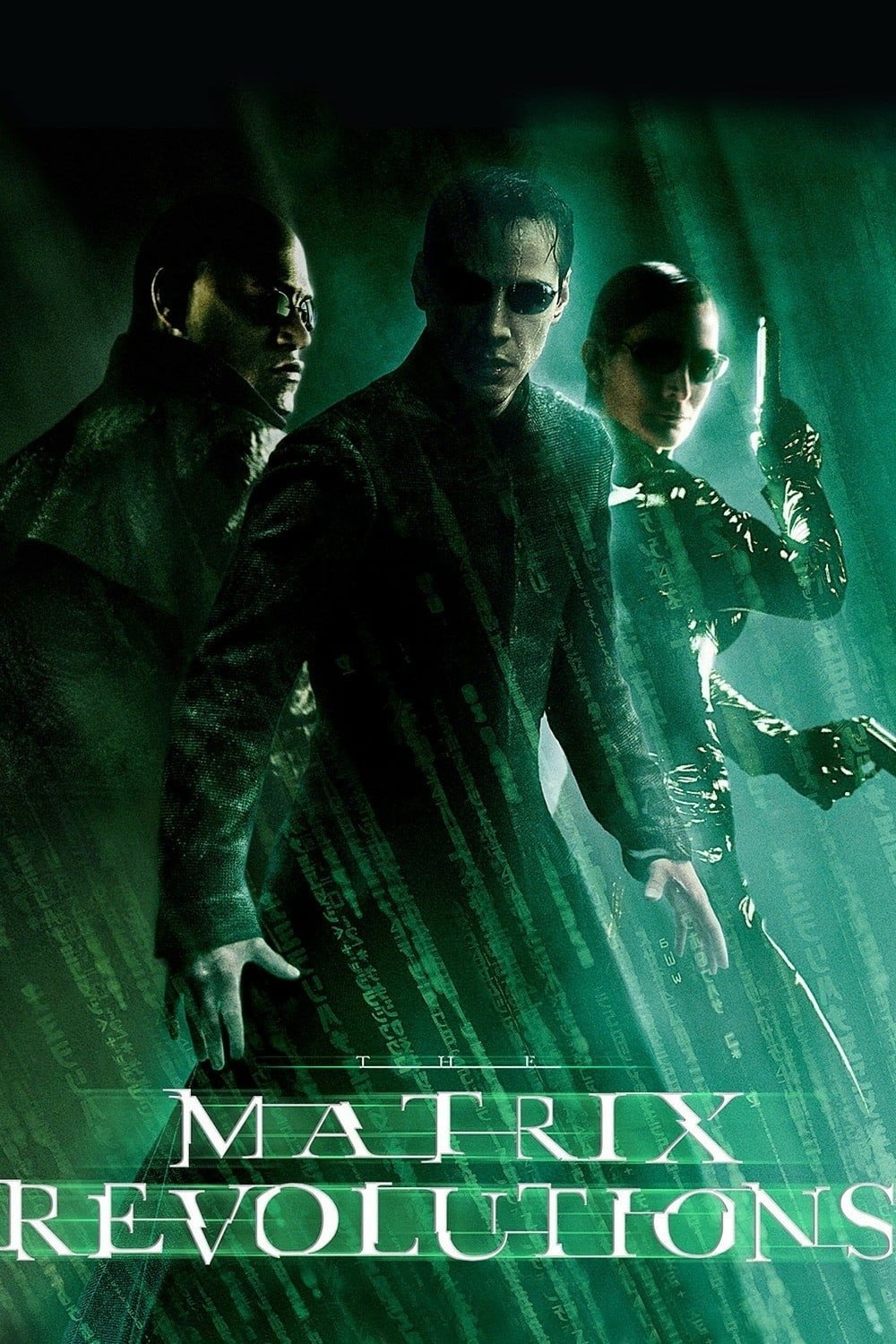
I’d put my The Matrix Revolutions review at somewhere between a 2.5 and a 3, and I keep flipping between them. It isn’t the best film, and again it disappointed me compared to the first one. There are some amazing action sequences in it, but the whole thing feels so depressing that it’s hard to enjoy them properly. I went in hoping this was the film that would pull the whole trilogy together after Reloaded left it hanging, and I walked out wanting more, and not in the good way. It does give the story an ending, and I’ll say a bit more about that further down, but the road to get there isn’t one I’d want to take again in a hurry.
Stuck in limbo
It picks up right where that one stopped, with Neo comatose and stuck in a limbo train station run by the Trainman, a program tied to the Merovingian. Trinity and Morpheus go off to bargain with the Merovingian to get him back, along with Seraph. Smith has copied himself all over the Matrix by now, and that includes the Oracle, who looks a bit different this time. The first act is mostly a lot of people going to see other people to ask for favours.
Commander Lock tries a strike of his own against the machines that goes badly wrong when Smith, who’s taken over a crew member called Bane, sabotages it, and that’s what leaves Zion with nothing but a last stand. Smith by this point is more than a villain, he’s something close to a virus, and the whole film hangs on how much of the Matrix he’s swallowed. Even the Oracle isn’t safe, and the idea that anyone can be turned into another Smith makes the Matrix feel properly dangerous in a way it hasn’t before. Meanwhile the machines are heading for Zion, and that’s where the real story is. Neo comes out of limbo and the whole thing finally starts to move, with Smith spreading and the humans bracing for the worst. Neo decides to go to the Machine City to look for peace, which is a different kind of mission from anything he’s done before.
The siege of Zion
The machines break through the dock and the siege of Zion begins, with hundreds of thousands of Sentinels pouring in and the mech suits holding the line. That battle is where the film is at its best, and the scale of it is something to see on a big screen. The defenders in their armoured suits pour fire into an endless swarm, and Captain Mifune leads them with a real sense of desperation. Niobe flies the Logos at crazy speed through the tunnels to get Neo and Trinity as far as the Machine City. I’d go back just for that, and I wish the rest of the film had matched it. The last stand against overwhelming numbers is what The Time of the Doctor is built around as well.
The mech suits, the Sentinels swarming, the last stand: it’s pure war-film stuff, and the sound and the scale make it feel huge. It’s the closest the film comes to the excitement of the first one for me.
Back in the real world, Morpheus and the crew have their own problems. Morpheus is struggling with his faith in the prophecy now that the Architect’s speech has shaken everything, and Trinity is more determined than ever to bring Neo back. Commander Lock, who sees things in black and white, is Morpheus’s opposite number, and the two of them argue about how to prepare for the machines. Captain Mifune, a young soldier with a big job ahead of him, is put in charge of the defence, and the film makes sure you know he’s out of his depth. It’s a good setup for the battle that follows, and it gives the humans a real sense of what’s on the line.
The flight to the Machine City
While the defenders are fighting for their lives, Neo and Trinity are on a different mission altogether. Niobe pilots the Logos right through the middle of the fight and brings them as far as the Machine City, and the two of them go the rest of the way in a small ship, flying up through a storm above the clouds. It’s a quieter stretch than the siege, with the two of them alone and the machines coming after them, and it’s where the film tries hardest to be about the two of them. Trinity gets hurt in the crash on the way, and she dies in Neo’s arms before they’ve even reached the end. I can see what it’s trying to do, and it’s meant to hurt, but it just added to the heavy mood I was already struggling with.
Neo then meets the Deus Ex Machina, the machine intelligence at the heart of the city, and it makes him an offer. If he can stop Smith, who’s grown too big even for the machines, the machines will stop attacking Zion. That’s the deal he’s after, and it’s a surprisingly calm scene given everything that’s happened before it. It’s a neat idea that the thing he’s fighting for is peace rather than a victory, and it gives the ending something more than another punch-up. It just wasn’t enough to make me love what came next.
Smith, and a CGI problem
The trouble starts with the Smiths. The effects work with all the copies, both in the playground early on and in the final fight sequence at the end, just aren’t that good. Whenever the film asks me to believe that Neo is up against a whole crowd of Hugo Weaving, it looks like a cartoon, and that pulled me out of it every time. The first film was all about how real the impossible felt, so getting that wrong is a big thing. The rain fight itself is a big moment, with the two of them trading punches while the whole crowd of Smiths watches, and I wanted to love it more than I did. Closing a trilogy on a letdown is a risk, and Spider-Man 3 took it as well.

The mood is the other thing I couldn’t shake. It’s so depressing, all the way through, from the siege to the flight through the storm to the Machine City and Trinity dying in the crash, and I didn’t come out of it with the feeling the first film gave me. I know it’s more of a war movie than a cyberpunk one this time, and I can see why they went that way, with Zion’s last stand and everyone throwing everything at it. It just didn’t leave me feeling like I’d been on an adventure. I never got that rush of discovery the first film had, and the film never got near it.
So is that the end?
The ending is what’s stuck with me the most. Neo takes the deal and goes into the final fight with Smith, and he lets himself be taken over by Smith so the machines can finish him off, peace comes, and the Oracle and Sati watch a sunrise while Neo is carried away. It does give closure and ends the trilogy, which is a positive I guess. But it leaves lots of questions in my mind about whether it’s truly the end, or simply another loop like the Architect hinted at in the earlier film. If the whole thing has been reset before, what’s to say this isn’t the next time round?
I’m glad it’s wrapped up, and I’m not sorry I saw it through. It’s a very different trilogy finish from Return of the Jedi, where I walked out buzzing. Instead, I walked out feeling exhausted and profoundly relieved. Yet despite everything, those lingering questions are precisely why the mythology remains so compelling.
I’m glad I saw how it ended, and I’m not sorry I sat through it. The siege of Zion is a real piece of work, the idea of Neo going to the machines to ask for peace is a good one, and there’s an ending that gives the trilogy some kind of finish. But it’s heavy going, the Smith effects pulled me out of the film every time, and I left the cinema wishing it had been more like the first one.
It’s the hardest film in the series to score, because the best parts are very good and the weaker parts are a lot weaker. I keep going back and forth between a 2.5 and a 3, and I think the honest answer is somewhere in between. It’s the end of the story, and that’s worth something, but it isn’t the end I wanted. Rating: 2.5 to 3 out of 5. It was ok, and no more than that.
