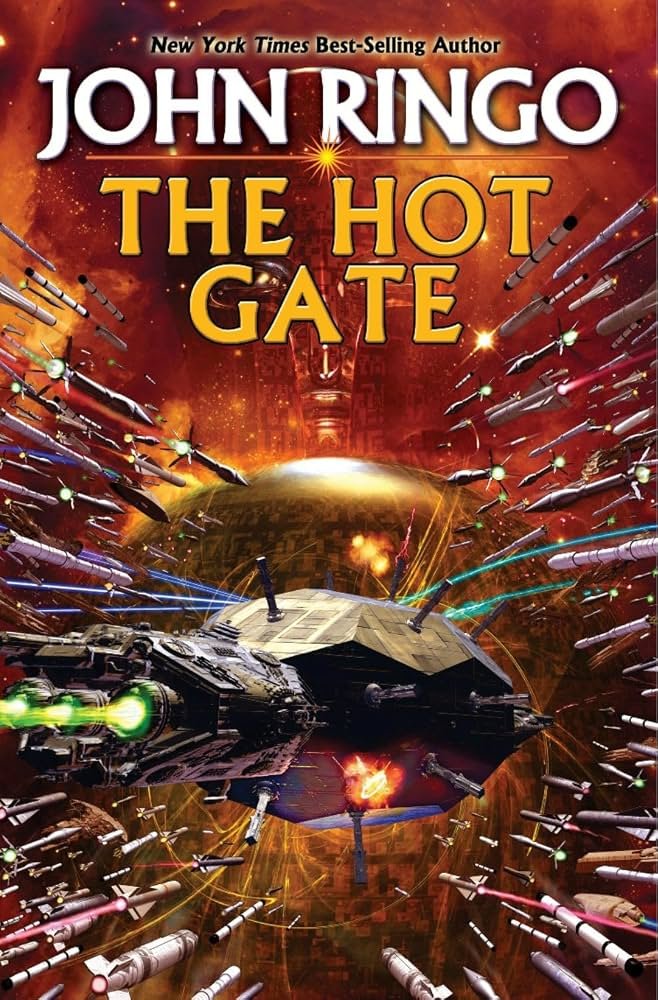
The Hot Gate has the best battle in the trilogy and the argument I have quietly stopped agreeing with. Both of those things are true at once, and I have never quite been able to separate them.
The setup takes far too long
Dana Parker gets moved off Troy and over to Thermopylae to sort out the 143rd, a squadron whose maintenance and readiness numbers are terrible. That is the book. The eventual payoff is enormous. Getting there takes longer than it should, and once again a large share of the runway is spent on military procedure, personnel politics and diplomatic manoeuvring with the Rangora.
Ringo does this in every book of the series, and by the third one I know it is coming. I still find myself thumbing ahead.
The Alliance problem
Here is the part I have to be straight about.
Thermopylae is crewed largely by Alliance personnel, and specifically by South Americans, with the Argentinians at the centre of it. Their performance is poor. Dana is sent to fix them. The novel’s diagnosis is that the problem is not ethnicity but class: officer slots went to wealthy families who consider hands-on maintenance beneath them, the enlisted ranks come from poor families who have learned not to speak up, and the result is a squadron where nobody with a wrench will tell anybody with rank that something is broken.
As a piece of organisational analysis that is not stupid. I have watched status distance wreck a team’s willingness to escalate a problem in industries with no aliens in them at all. The mechanism is real.

Why it still grates
What grates is the resolution. The competent American shows up, applies American norms, and the foreigners get better. The culture that produced the problem never gets a hearing on its own terms and never contributes anything back. It is a one-way transfer, and by the end of it the Argentinians have essentially been improved into Americans.
Ringo is always pro-America. Nobody reads him without noticing. Usually it sits in the background as flavour, and in the first two books it mostly does. Here it is load-bearing. It is the actual plot of a third of a novel.
I flagged this back when I wrote about the trilogy in 2015 and said I could not fully agree and could not fully disagree, so I would leave it aside. I am less inclined to leave it aside now.
What changed was me
To be fair to the book, nothing in it moved. I did.
I read Troy Rising the first time as a Canadian who was, honestly, sold on the whole thing. American competence, American institutions, American willingness to build the enormous stupid ambitious thing while everyone else formed a committee. That was not a hard sell in 2011.
Watching the political situation and the leadership of the last several years, I am no longer as confident in the infallibility this series takes as a given. I am not going to relitigate current events on a book blog. I will just say that the assumption Ringo builds his fiction on has aged into something you notice rather than something you absorb, and a reader coming to this fresh in 2026 will feel that harder than I did at the time.
It is a caveat, not a condemnation. It did not stop me rereading the thing.
Then the shooting starts

And then the last act arrives and I forgive most of it.
The final confrontation with the Rangora is the best sustained combat writing in the trilogy and some of the best in the genre. Massed Assault Vectors, a fortress that can now move through the gate, boat squadrons doing appalling work in shuttles that were never meant for it, and a stretch where the arithmetic genuinely looks like it does not work for humanity. Then one more trick lands and the whole thing turns over.
What makes it land is that everything in it was paid for earlier. The asteroid inflation from Book 1, the industrial base, the production capacity argument the series has been making since page one. This is not a rabbit out of a hat. It is three books of engineering finally getting its invoice paid, and the squadron Dana spent the first half fixing is the reason the manoeuvre is possible at all. The setup I complained about is load-bearing after all.
The book four I never got
Dana and Tyler have something going that the book gestures at and never develops, Butch is absent entirely, and the ending closes the trilogy without closing the universe. Which is my one lasting frustration with this series.
There is so much room left. The Rangora are beaten, not destroyed, and they remain the most interesting non-human faction Ringo has built. The obvious book is the one where something worse comes through the gate network and humanity and the Rangora have to work out how to stand in the same line. I said in 2015 I was still hoping for a fourth book. I am still hoping.
Where it lands
Four stars. Better than Citadel, not as good as Live Free or Die, and the one that requires the most patience from the reader before it pays out. Read the trilogy. The idea at the centre of it, taking a rock and blowing it up into a fortress, is one of the best things anyone has done with hard-ish sci-fi engineering in the last twenty years, and the battles it enables are worth every page of regulations you have to walk through to reach them.
If you want more of the same shelf, Decisively Engaged and Steel World scratch a similar itch, and there are more of them in my top nine military sci-fi picks. For something with the politics dialled all the way down and the sense of scale kept up, Leviathan Wakes is the other series I keep going back to.

1 comment
[…] said this about a Ringo series before: Troy Rising stuck its landing and then got heavy-handed about the politics on the way there. This series has close to the opposite problem. It doesn’t overstay its welcome and it doesn’t […]