
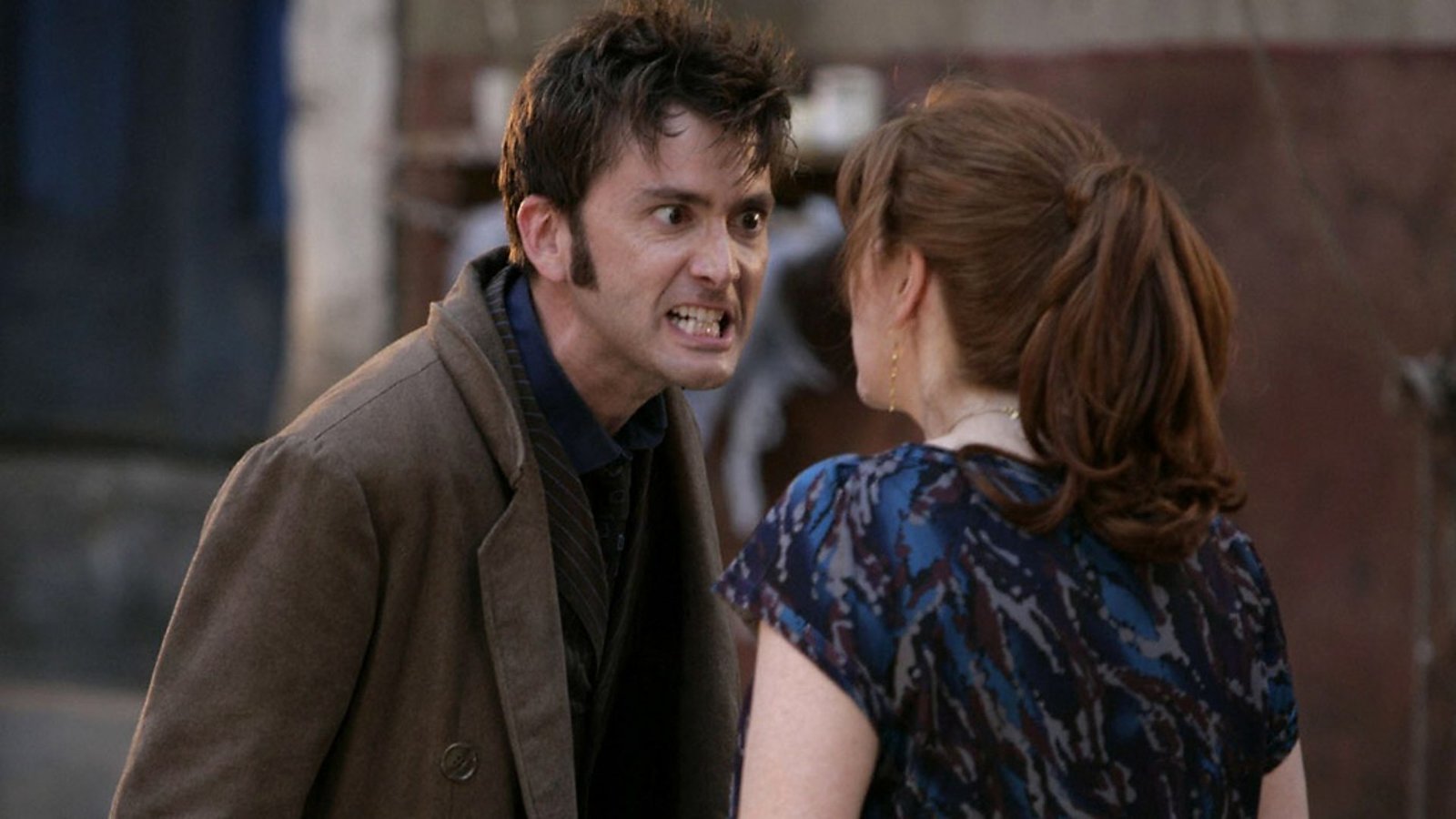
Two episodes into Donna’s run and the show has already justified her completely. “The Fires of Pompeii” drops the pair into the most famous disaster in Roman history on the day before it happens, and then spends fifty minutes asking a question the series usually dodges: what does it actually cost to be the man who knows what’s coming and doesn’t stop it? It’s funny for a while, then it stops being funny, and by the end it’s one of the most affecting things the show has done.
The TARDIS lands, the Doctor cheerfully identifies the city as Rome, and Donna, looking at the enormous smoking mountain on the skyline, works out rather faster than he does that it isn’t. It’s Pompeii. It’s 23 August, AD 79, and Vesuvius goes tomorrow. Donna’s reaction is the correct one and the show knows it: she wants to warn them, all of them, right now, starting with the family whose house they’re standing in. The Doctor tells her no, because Pompeii is a fixed point, one of the moments in history that cannot be altered without unravelling everything around it. Some things are in flux, he says, and some things are simply set.
Donna is having none of it, and her refusal to accept the rule is the engine of the whole episode. She isn’t being naive, she’s being human. Twenty thousand people are going to die tomorrow and a man with a time machine is standing in their kitchen making excuses. The series has laid down rules about meddling before, and Rose learned what happens when you rewrite a death you’re personally invested in back in Father’s Day, but this is the first time a companion has looked at the rule and simply refused to find it acceptable. It gives the episode a genuine argument rather than a lecture, because both of them are right. He’s right that the timeline cannot absorb it, she’s right that walking away from twenty thousand people on the strength of a rule is monstrous, and the show never really resolves that tension, it just makes the pair of them live inside it for an hour. The Caecilius family are beautifully drawn, which makes all of it worse. Peter Capaldi is terrific as the marble merchant paterfamilias, all anxious social climbing and genuine warmth, his wife Metella frets, his son Quintus is a disappointment with a drinking habit, and his daughter Evelina has started making prophecies and has an arm that is turning slowly to stone. They are pleasant, ordinary, doomed people, and the episode makes very sure we like them before it lights the fuse.
Prophets and stone
The mystery is a good one. Pompeii has developed an unnerving surplus of soothsayers, the Sibylline Sisterhood, hooded priestesses whose skin is hardening to rock, and augurs across the city whose predictions are suddenly, inexplicably accurate. Something has given this town the gift of prophecy and it’s killing them by inches. The culprits are the Pyroviles, creatures of living rock whose ship crashed into the mountain seventeen years ago, who have been seeding the population with volcanic dust and slowly converting them, and who intend to convert the entire human race and remake the Earth. The design is superb, towering magma golems glimpsed through steam in the caldera, and the fact that the mountain hasn’t erupted because they’re drinking its energy is a genuinely clever bit of plotting.

The unsettling material, though, is the prophecies. The soothsayers can see straight through both of them. They know the Doctor’s name is a lie, that his home is gone and burned, that there is something on Donna’s back she can’t see. And one of them tells him, flatly, that his song will end soon. It’s dropped in and never explained, and it sits there like a stone in your shoe. Nobody follows it up. I have no idea what to make of it.
The lever
Then comes the choice, and it’s brutal. The only way to stop the Pyroviles converting humanity is to trigger the eruption they’ve been suppressing, to make Vesuvius blow. The Doctor has to choose between twenty thousand people in one city and every person on Earth, and the arithmetic is not in Pompeii’s favour. This isn’t a puzzle he can out-think, there’s no third option and no clever reversal. He has to push the lever and kill a town. And the moment that makes the episode is that he doesn’t do it alone. Donna crosses the room and puts her hands on the lever with his. She has spent the entire hour arguing against him, and now that she understands, she refuses to let him carry it by himself. That single image, two people sharing the weight of an atrocity neither of them wants, is worth more than any speech.
The eruption itself is superbly done, and the show does not flinch from what he’s just caused: the pyroclastic surge rolling down the mountain, people running, a city buried live. There’s a quietly grim touch in the framing too, as the episode drifts toward the huddled shapes we all recognise from the museum casts and lets you make the connection yourself. Every schoolbook photograph of Pompeii is a person who was standing there when this happened, and the episode has just spent an hour making sure you liked a few of them by name.
Just save someone
The last movement is where it all pays off. Back in the TARDIS, with Pompeii burning behind them, Donna breaks. She isn’t asking him to undo it, she knows he can’t. She just begs him to save someone, not the town, not the twenty thousand, just one family, just anybody, so that the day isn’t a total loss. And he goes back. He walks into that burning house and pulls the Caecilius family out, and it costs the timeline nothing at all, and it would never have occurred to him without her.
That’s the entire argument for Donna Noble in one scene. Back at the end of The Runaway Bride, watching him stand in the flames while the Racnoss drowned, she told him he needed someone with him, someone to stop him. This is the other half of that. She doesn’t just stop him doing terrible things, she makes him do kind ones he’d have walked straight past, and after the guarded, careful man we’ve had since Partners in Crime picked her up it’s a genuine change. The coda is lovely and a bit eerie: the rescued family, a year on, keeping a household shrine with two small figures on it. The strange man and the shouting woman, promoted to gods.
What it leaves behind is fixed points properly explored, not a hand-wave but a real constraint with a body count, and a companion who refuses to accept it politely. It leaves two sets of hands on the lever, the best image the season has produced, redefining the partnership in a single shot. It leaves Donna as conscience, not softening him exactly but widening him, because “just save someone” is the most useful thing anyone has said to this Doctor in a long time. It leaves a doomed family we actually care about, Capaldi and company given enough life that the eruption lands as a bereavement rather than a spectacle. And it leaves an unexplained warning, “your song will end soon”, delivered by a dying prophet and then dropped entirely, which is going to bother me.
Rating: 4.5/5. Gorgeous to look at, genuinely upsetting, and built around a moral problem the show commits to properly rather than dodging. The Pyroviles are the weakest element and it barely matters. A city buried on purpose, a family pulled out of the fire because somebody asked, and a Doctor who is measurably better for having Donna Noble shouting at him. This partnership is going to be something.

4 comments
[…] is a superb payoff. The season has been signposting it since a soothsayer looked at her back in The Fires of Pompeii and since a Dalek prophesied a “threefold man.” It […]
[…] room would think to be. She’s been quietly earning this since she put her hands on that lever in The Fires of Pompeii, and here she solves the entire mystery on her […]
[…] the second time. A dying soothsayer said almost exactly the same thing in the ruins of The Fires of Pompeii two weeks ago, and now an Ood says it again on a different planet in a different millennium. Once […]
[…] him off the hook for a second. This is the same rule he explained to Donna in the doomed streets of The Fires of Pompeii — and back then he had somebody standing beside him arguing, someone who forced him to at least […]