The Doctor’s Daughter is the sixth episode of the fourth series of Doctor Who, in which the Tenth Doctor and Donna land on the colony world of Messaline and a tissue sample grows him an instant daughter, Jenny. The post covers the episode’s best idea, a generations-long war that turns out to be only seven days old, along with Donna’s role in cracking it and Martha Jones’s quiet departure.
The review lands on a split verdict. The seven-day reveal, Donna’s detective work and Jenny’s death scene are strong, while the pacing is rushed and the resurrection coda undercuts its own punch. It rates the episode 3/5.
An episode with a title that gives away its own hook and a premise that could have been a disaster: the Doctor gets a daughter, instantly, from a machine, in the first five minutes. “The Doctor’s Daughter” is a mess in places and rushes several things it should have sat with, but it has one genuinely superb twist, a very good Donna, and it quietly closes the book on Martha Jones. Uneven, but never dull.
Generated anomaly
The TARDIS is dragged off course to Messaline, a colony world where the Doctor is immediately grabbed, his hand shoved into a progenation machine, and a tissue sample spun up into a fully grown adult in seconds. She steps out of the device armed, uniformed, and delighted. Donna, who spent half of Partners in Crime miming across a pair of office windows to catch his eye, names her Jenny, short for generated anomaly, and the Doctor spends most of the episode refusing to look at her. That refusal is the best character material here. Jenny is his daughter by any biological measure, and he wants nothing to do with her, because she came out of a machine built to make soldiers and because he has been a father before and lost everything that went with it. Tennant plays the coldness convincingly and the thaw slowly, and there’s a lovely, painful scene where he finally admits what he had and what the war took. It’s the most he’s said about it since he sat in a bar and told Martha about the burnt orange sky in Gridlock. Georgia Moffett is very good as Jenny too, all instinct and enthusiasm, a person with no childhood and no context, learning what she is in real time. Her delight at everything is genuinely charming, and her frustration at being rejected by the one person who should understand her lands.
Seven days
The twist is the reason to watch, and it’s terrific. Messaline is locked in a war between human colonists and the Hath, fish-headed aliens who were once their partners. Both sides breed soldiers instantly from progenation machines. Both sides talk about generations of conflict, ancient grievances, a war that has consumed their entire history. The war has been going on for seven days. Because a generation, when you can grow an adult in twenty seconds, is about an hour. Whole lineages have lived and died since last Tuesday. The “ancient” hatred was invented within a week, and nobody left alive remembers a time before it because nobody left alive is more than a few days old.
What makes the reveal sting is what it says about the people fighting it. Every soldier on Messaline believes themselves the inheritor of an ancient cause. They recite the history, they honour their fallen, they know precisely who the enemy is and exactly why, and every scrap of it was assembled inside a week, by people who are themselves only days old. It’s a genuinely sharp idea about how quickly a grievance can calcify into a birthright, and the episode is wise enough to state it once, clearly, and then move on rather than stopping to lecture anybody about it. And it’s Donna who works it out, from the numbers stencilled on the corridor doors. She’s a temp. She has spent years in filing systems and stock rooms, and she recognises a sequence when she sees one. It’s a brilliant use of the character: not clever in the Doctor’s way, but observant in a completely ordinary way that nobody else in the room would think to be. She’s been quietly earning this since she put her hands on that lever in The Fires of Pompeii, and here she solves the entire mystery on her own.

The object both armies are killing each other over, the Source, turns out not to be a weapon at all but a terraforming device, the thing that was always meant to make this dead world habitable. Seven days of slaughter over a gardening tool. General Cobb is a serviceable zealot, the sort of man who needs the war more than the war needs him, and he’s the real monster of the piece, a man who equates peace with victory at any cost. The confrontation gives the Doctor his best moment, though. Holding a gun on Cobb, with every reason to use it, he puts it down and tells the new society exactly what to build itself on: he’s the man who never would. Given what we watched him do to the Family of Blood, it’s a line he has to keep re-earning, but here, in front of a brand-new civilisation with no history yet, it means something.
Jenny, and Martha going home
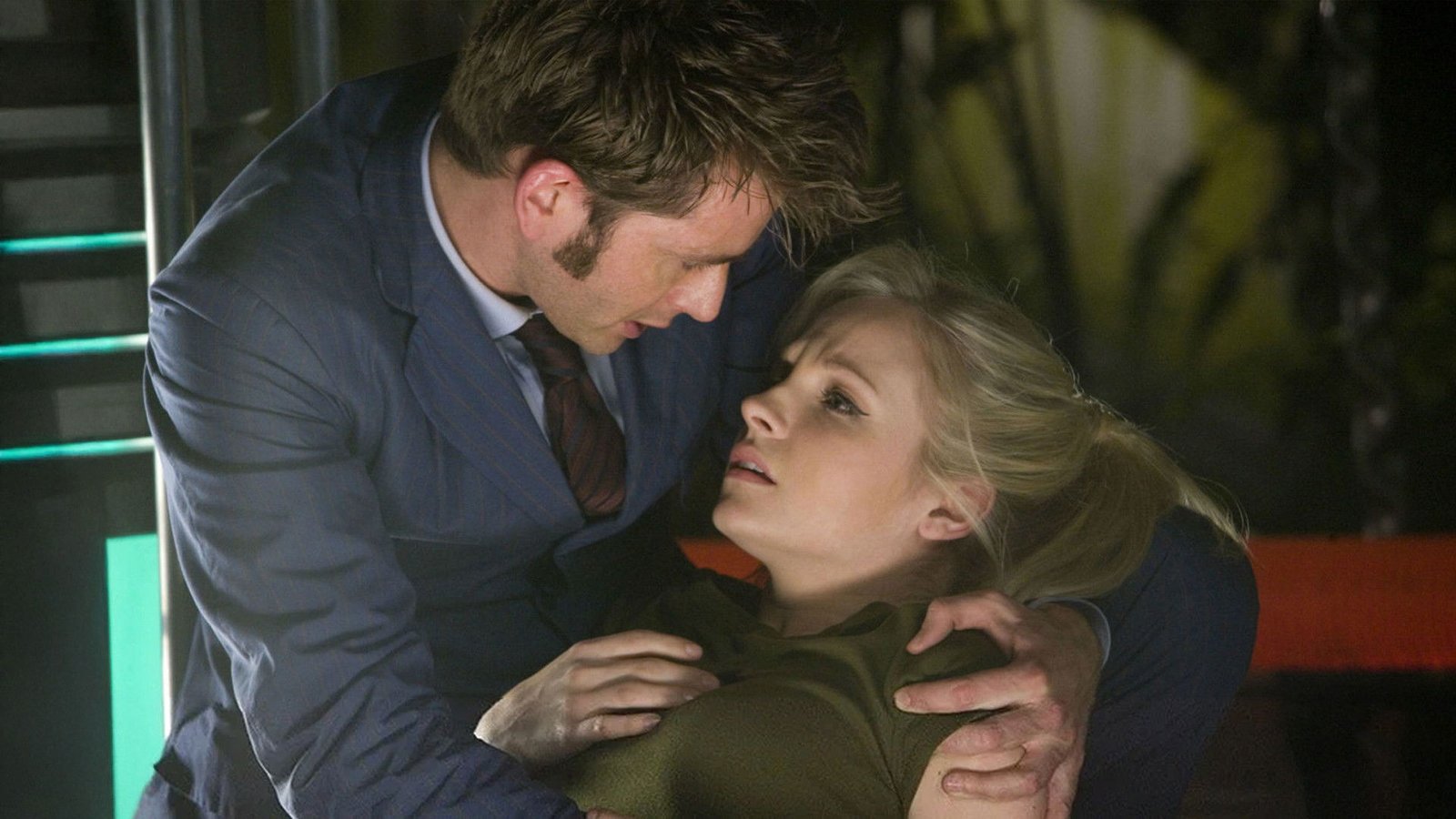
Cobb shoots anyway, and Jenny takes it for him. Her death is the strongest scene in the episode. The Doctor, who spent the whole hour refusing to call her his daughter, holds her while she goes and tells her everything he wouldn’t say when it might have mattered. It’s brutal, well played, and completely earned. And then the episode does something I’m still chewing over: after everyone leaves, the terraforming energy washes over her body and she wakes up, steals a shuttle, and heads off into the universe to have adventures. The Doctor never finds out. I genuinely can’t decide whether that’s a lovely grace note or a cheat that undercuts the death it just spent ten minutes selling me. Probably both. Other fans came away with a mixed bag too, and I can see exactly why. It would be devastating if he knew, and instead it’s a secret I’m left holding on his behalf.
Quietly, in the middle of all this, Martha Jones leaves for good. She spends the episode separated with the Hath, trekking across a hostile surface, watching one of them drown saving her. That sequence is rather better than it needed to be. The Hath are effectively mute, communicating in bubbles and gestures, and the show wrings a surprising amount of pathos out of a fish-headed alien and a human doctor learning to trust one another with no shared language whatsoever. When Peck goes under to haul her out of a sinkhole, it genuinely lands, because here is a creature she couldn’t exchange a single word with, dying for her, on a world that belonged to neither of them. At the end she chooses to go home, not wounded this time, not running from anything, just finished. She’s got a fiancé and a career and a life she likes, and she tells Donna to look after him. After the year she walked across in Last of the Time Lords, it’s a fittingly undramatic exit for a character who earned an undramatic ending. She gets to just stop, and be fine.
I’ll admit the title spoiled the hook for me before the credits even rolled, and I spent the opening scenes waiting for the daughter to turn up. Donna cracking the whole thing with temp-work pattern recognition is what I’ll remember, because the show keeps finding ways to make her ordinariness the useful thing and it keeps working.
Rating: 3/5. Rushed, tonally scattered, and the resurrection coda pulls its own punch. But the seven-day reveal is superb, Donna is excellent, and Jenny’s death scene is the best three minutes in it.

1 comment
[…] The show’s touch is so much lighter here than a fortnight ago it’s almost funny: The Doctor’s Daughter closed on a dead soldier and a father quietly lied to by the universe, and this one closes on a […]