
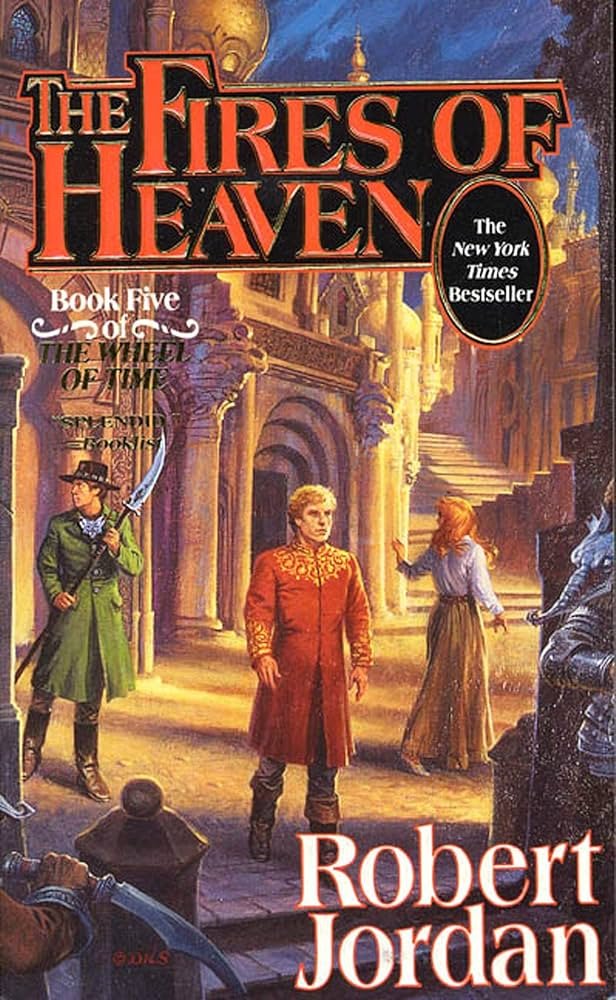
A reread review of Robert Jordan’s *The Fires of Heaven* centers on Mat Cauthon’s transformation from a reluctant participant into a genuinely formidable military commander. The Battle of Cairhien, where Mat outmaneuvers a larger force using terrain and borrowed memories of past battles, is highlighted as one of the strongest sequences in the series.
The review also covers Rand’s uneasy arrangement with the captive Forsaken Asmodean, Nynaeve’s climactic confrontation with Moghedien, and the abrupt disappearance of Moiraine alongside Lanfear at a ter’angreal doorway. Supporting storylines involving the Wise Ones, Egwene, and Aviendha are noted as laying meaningful groundwork despite receiving less attention.
Just finished The Fires of Heaven, and this might be the book on this reread that surprised me the most. I remembered loving it, but I’d forgotten it was specifically Mat’s book — this is where he stops being the lucky rogue with a fancy spear and turns into one of the best military minds in the series, and watching that happen properly for the first time in years was a genuine treat.
Out of the Waste
The book opens with Rand leading the Aiel out into the wetlands for the first time, and there’s an immediate sense that the scale of everything just changed. This isn’t a small band of friends anymore. It’s an army, and armies have politics, logistics, and rivals. Couladin and the Shaido refuse to accept Rand as Car’a’carn, and watching that fracture spread through the Aiel as they march is genuinely tense — Jordan makes it clear early that not every Aiel spear is pointed the same direction, and that’s going to matter a lot before this book is done.
Rand himself is getting harder to read here, and I mean that as a compliment. The weight of Rhuidean, the constant threat of the madness waiting for every male channeler, and now an army that expects him to actually lead it, is visibly wearing on him. He’s still Rand, but there’s a coldness creeping in at the edges that wasn’t there in the earlier books, and it’s unsettling in exactly the way it should be.
Sammael’s fingerprints are all over the chaos in Cairhien too, working through proxies and stirring up exactly the kind of political mess that lets him stay comfortably out of sight while everyone else bleeds. I like that the Forsaken in this era of the series aren’t showing up to throw fireballs in every chapter — they’re playing a longer, dirtier game, and Sammael in particular feels like a real threat specifically because you barely see him do anything directly.
Mat Becomes a General
Here’s the part I really want to talk about. When Rand needs someone to actually run the military side of taking Cairhien, it falls to Mat — and Mat hates every second of it. He complains constantly, insists he never asked for this, and swears up and down he’s not the man for the job. And then he wins. Decisively.
The Battle of Cairhien is one of the best set pieces in the entire series, and I don’t think that’s an exaggeration. Watching Mat read the battlefield, outmaneuver forces that outnumber him, and pull off a genuinely clever victory using terrain, timing, and a scratch army he barely trusts, is just enormously satisfying. It’s not magic that wins this fight. It’s Mat’s brain. All those memories he picked up through the doorway in Rhuidean — centuries of other men’s battles crammed into his head — finally pay off in a real, tangible way, and it’s the moment Mat stops being comic relief with good luck and becomes someone you’d actually want commanding your army. I could read an entire book of just this. He’s easily my favorite character in the series at this point, and this is the book that cements it.

Asmodean’s Leash
While all that’s happening, Rand does something that still strikes me as one of the boldest moves in the series: he captures Asmodean, one of the actual Forsaken, and forces him to teach him how to use the One Power properly instead of fumbling through it alone. The dynamic between them is fantastic — Asmodean resentful and biding his time, Rand cold and pragmatic about using an enemy as a tool because he has no better options. It’s a genuinely uncomfortable alliance, and I like that Jordan doesn’t pretend it’s anything other than what it is. Rand isn’t redeeming Asmodean. He’s using him, and both of them know it.
Nynaeve Finally Gets Her Rematch
The other thread I loved this time through is Nynaeve tracking down Moghedien. After getting outmatched by her back in The Shadow Rising, Nynaeve spends this book hunting the Forsaken down properly, and the confrontation between them is a great payoff. Nynaeve’s biggest weakness has always been her own temper — she blocks off her full strength whenever she gets too emotional — and watching her finally get a handle on that, right when it matters most, and turn the tables on Moghedien using an a’dam of all things, is such a satisfying character beat. She’s spent four books being told she’s not ready. This is the book where she proves otherwise.
Elayne’s right there with her through most of it, and I like how this book keeps leaning on their friendship as a genuine partnership rather than just two characters who happen to be traveling together. They bicker constantly, they doubt each other, and they still show up for each other every time it counts. Between this and Mat’s storyline, it’s honestly one of the better books in the series for pairing characters off in ways that bring out the best in both of them.
The Ending
And then there’s the ending. I knew it was coming and it still got me. Moiraine, cornered with Lanfear at a twisted doorway ter’angreal, makes a choice nobody sees coming — she grabs hold of Lanfear and pulls them both through together, vanishing completely. No body, no confirmation, just gone. After five books of Moiraine being the one adult in the room who always seems to have a plan, watching her sacrifice herself like that, off on the margins of a much bigger battle, is devastating in a way I wasn’t prepared for even on a reread. It’s such a quiet way to write out one of the most important characters in the series, and I think that’s exactly why it works. No last speech, no drawn-out farewell. She’s just gone, and Rand has to keep going without her.
The Supporting Cast Carries Weight Too
A few smaller threads deserve a mention because they’re doing more work than they might get credit for. Amys and the other Wise Ones give Rand’s Aiel storyline a moral seriousness that keeps it from just being about army logistics — they’re constantly pushing him toward honesty and away from the easy manipulations Aes Sedai or ambitious lords keep trying on him, and I like that Rand actually listens to them more than almost anyone else at this point. Bair and the others don’t get huge amounts of page time, but every scene with them sharpens what kind of leader Rand’s supposed to become versus the one circumstances keep pressuring him into being.
Egwene and Nynaeve’s training storylines in the background of all this are easy to lose track of next to Mat’s generalship and Moiraine’s ending, but I appreciated them more on this reread than I have before. Egwene in particular keeps building the political instincts that are going to matter enormously later, and it’s satisfying to watch her learn to navigate Aes Sedai maneuvering by actually paying attention to it instead of just reacting to it.
Wrapping Up
There’s a smaller moment I want to mention too: Aviendha showing up more in this book, still working through what it means to be tied to Rand’s fate whether she wants to be or not. It’s a quieter thread next to Mat’s generalship and Moiraine’s ending, but it’s laying groundwork I know pays off a lot later, and I like how prickly and unresolved Jordan lets it stay here instead of rushing it.
This is a big, confident book. Three or four storylines that could each anchor their own novel, and every one of them lands — Mat’s tactical brilliance at Cairhien alone would make this one of my favorite entries in the series, and then Jordan piles Asmodean’s leash, Nynaeve’s rematch, and Moiraine’s sacrifice on top of it. It doesn’t feel crowded. It feels like a series that finally has the confidence to let its cast carry genuinely separate stories at the same time.
Already looking forward to Lord of Chaos. If you’ve read this one, tell me I’m not alone in thinking the Battle of Cairhien is one of the best things Jordan ever wrote — I could talk about Mat’s turn as a general all day.

5 comments
[…] more honest observation: Mat barely features in this book after being the clear standout of The Fires of Heaven, and I missed him more than I expected to. He gets pulled into a mission escorting Elayne and […]
[…] directly against him is satisfying in a way this particular rivalry has been building toward since The Fires of Heaven. Rand takes the city, and the way Jordan stages it — political maneuvering as much as open […]
[…] pass through. It’s readable. It’s competent. It’s just not firing on the same cylinders as The Fires of Heaven or Lord of Chaos, and I don’t think that’s just me being tired of the series. I think it’s […]
[…] Just finished Towers of Midnight, and I’ve been waiting eight books for this one specific payoff, so let me just say it up front: Mat and Thom going into the Tower of Ghenjei to rescue Moiraine is everything I wanted it to be. This whole book is packed, but that mission is the thread I’d been holding my breath for since The Fires of Heaven. […]
[…] a series this long. But rereading start to finish, the strength of books like The Shadow Rising, The Fires of Heaven, and this entire final run more than make up for it. This is genuinely one of my favorite series of […]