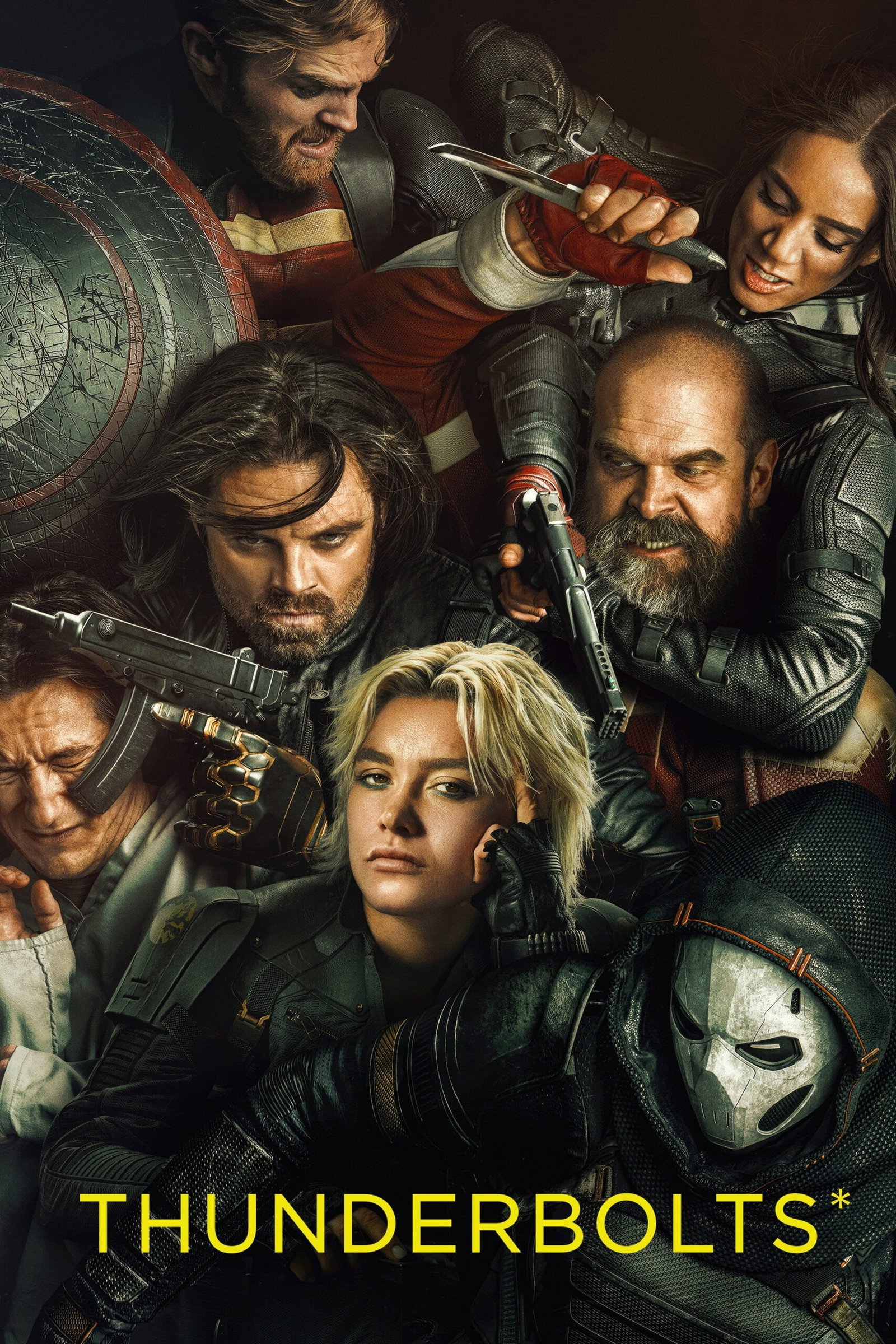
Thunderbolts* is a perfectly decent film with a cast better than its script, and I came out of it entertained without being especially convinced.
Fair warning before I go further: I’m going to talk about the ending, including what the asterisk in the title turns out to mean. The marketing worked hard to hide it. If you haven’t seen it yet, come back after.
Yelena is the reason this works
It’s good to see Yelena again, and Florence Pugh does a genuinely strong job carrying a film that leans on her more than it probably intended to. I’d watched the Hawkeye miniseries, so I came in already sold on the character, and nothing here dented that.
She’s playing the only person in the group with a functioning interior life, which is both the film’s biggest asset and a sign of where it’s thin. Everybody else is a collection of traits waiting for a scene to justify them. Yelena is a person.
The vault fight is the best action in it
The early sequence in the vault is a lot of fun. Yelena against Taskmaster, Ghost and John Walker in a confined space, everybody fighting dirty, no clean lines of sight. It’s well staged and it has actual stakes because none of these people can absorb damage the way an Avenger can.
The effects across the film are really good and the action generally holds up. This isn’t a movie that fails on craft.
What surprised me was Taskmaster being demolished as fast as she was. In Black Widow that character put up a serious fight, and the whole premise of the ability, copying anybody’s movements on sight, ought to make her one of the hardest people in any room to put down. Dispatching her that quickly felt like the script clearing space rather than a fight anybody actually lost.
The Sentry is not the Sentry
Here’s my main structural complaint. The Sentry in the comics, at least as I remember him, isn’t a villain. He’s a tragedy. The Void is his own darkness rather than a separate antagonist, and the interest comes from a man with the power of a million exploding suns who is fundamentally too damaged to be trusted with it, including by himself.
The film gets the damage right and loses the tragedy. What’s left is closer to a conventional big bad with a sad backstory, and at that point the character stops being distinctive.
It also creates a problem going forward. In his powered-up form he’s so overwhelming that I’m not sure what the MCU does with him next. He’s either the solution to every threat or he has to be written out of every room, and neither is a story. They’ve built something they can’t really use.
Marvel didn’t shy away from the psychology, then took the easy way out
Credit where it’s due, this is a Marvel film that puts depression and trauma at the centre of its plot and doesn’t treat it as a quirk. It’s good to see Bucky again, and good that his history isn’t played for either laughs or angst. Coming a couple of months after Brave New World, which had its own thin patch where a psychological hook needed a real ending and got a speech instead, the pattern is starting to look like a house style.
But the resolution is where it loses me. It comes down to love conquers all, more or less, and that’s a very tidy answer to a problem the film spent two hours arguing isn’t tidy.
Watching it, I kept thinking of that Pixar film where a girl’s emotions are characters in her head and the plot is about getting her back to happy after sadness takes over. This is a live-action version of the same idea, with punching. That’s a perfectly nice thing to be. It’s just a long way from what the setup promised, and the gap between the two is where my reservations sit.
The rest of the roster
Bucky is the other reason to watch this. He’s been in this franchise for fifteen years and has spent most of that time being either a weapon or a wound, and here he finally gets to be a person with a job. Sebastian Stan plays him tired rather than tortured, which is a much more interesting register and one the character has earned.
John Walker is a harder sell. The film wants him to be a man who genuinely believes he was wronged, and Wyatt Russell plays that well, but the script keeps flinching from letting him be as unpleasant as the premise needs. You can’t build a redemption arc for someone the film won’t first let be properly bad.
Ghost and Red Guardian are mostly texture. Red Guardian gets the comic relief slot and David Harbour is having an obvious good time, though the joke is the same joke every time. Ghost has a genuinely interesting power set the film uses twice and then forgets.
That’s the recurring issue: too many people, not enough reasons. A tighter film with three of these characters would have had room to make all three matter.

Does the team work?
On paper it shouldn’t. That’s the point, and Civil War did the same trick more sharply years ago by making the ideological split the actual plot rather than a texture.
The comparison that hangs over it is the original assembly, where a group of people who couldn’t stand each other became a team and it felt earned because the film gave every one of them a reason to be there. Thunderbolts* has more characters than it has reasons, and some of them are simply present.
The asterisk reveal, the team being rebranded as the New Avengers, is a decent gag and a reasonable ending. It also raises the obvious question of whether this particular group is who you’d want standing between Earth and anything serious. On current evidence, not really. Against Age of Ultron, a film I found overstuffed and underpowered, this is tighter but working with much less.
The asterisk
Since I flagged spoilers up top, let’s deal with the title properly.
The asterisk resolving into the team being rebranded as the New Avengers is a decent piece of marketing and a reasonable structural ending. It gives the film a destination, and it explains why a movie about a group of expendable people was worth making.
It’s also a slightly cheap trick. The film spends its runtime arguing that these are broken, compromised people who don’t deserve the benefit of the doubt, and then hands them the most valuable brand in the setting as a reward for surviving. The tonal gap between those two things never quite closes.
I don’t hate it. It’s the kind of ending that works better as a hook for what comes next than as a conclusion to what just happened, and I suspect that’s exactly the intention.
What a better version looks like
I keep coming back to the film this could have been, which is usually a sign the material was strong enough to deserve it.
Take the same cast, the same Sentry setup, and refuse the tidy ending. Let the resolution be partial. Let him be manageable rather than fixed, with the clear implication that the management is ongoing and might fail. That’s a harder film and a less satisfying two hours, but it’s the one the premise was writing cheques for.
The version we got wants the credit for engaging with the subject and the comfort of resolving it, and you can’t really have both. Depression doesn’t have a third act.
Where I land
Okay movie. Not one of my favourites, but an interesting enough watch and a long way from the worst of this run. The cast is doing more than the material deserves, Pugh especially, and the action is genuinely well made.
I’d have taken a harder, sadder film about people who don’t get fixed. What I got was a competent ensemble picture that flinches at the end. Worth seeing, particularly for Yelena, and I suspect it’ll be remembered more for what it sets up than for what it is.
