A review of The Lazarus Experiment, the sixth episode of Doctor Who’s third series, in which a scientist’s rejuvenation machine turns him into a monster at a black-tie gala. The post covers Mark Gatiss as Professor Lazarus, the Jones family, the Doctor’s argument about what a long life is worth, and Martha’s push to become a proper companion.
It finds the episode fine rather than special: strong on Gatiss, Martha and the Southwark Cathedral finale, weaker in a routine middle stretch and CGI that can’t keep up. It also flags Mr Saxon’s second unexplained appearance. Rating: 3/5.
After a fortnight of Daleks in the sewers under New York, “The Lazarus Experiment” is a much smaller sort of episode, one building, one monster, one very bad idea, and honestly it was ok for me rather than anything more. It’s an old-fashioned mad-scientist story in black tie. It never gets near the top of this series, but it does two things really well: Mark Gatiss gets a wonderful part to chew on, and it finally settles what Martha Jones actually is on that ship. Which, after six weeks of the Doctor insisting it’s only ever one more trip, was starting to matter.
Back where she started
The Doctor opens by doing something faintly cowardly, dropping Martha back home on the same night she left. The “one trip” he insisted on in Smith and Jones has stretched to several, and rather than talk about it he just puts her back where he found her, all breezy thanks and no commitment. Martha’s face says it all. She’s been to New Earth and 1930s Manhattan, she’s saved his life more than once, and she’s being dropped off like a taxi fare, which I thought was a bit rotten of him. Then the TARDIS vanishes and pops straight back, because he’s caught the name Lazarus on the news, and suddenly it’s not goodbye after all.
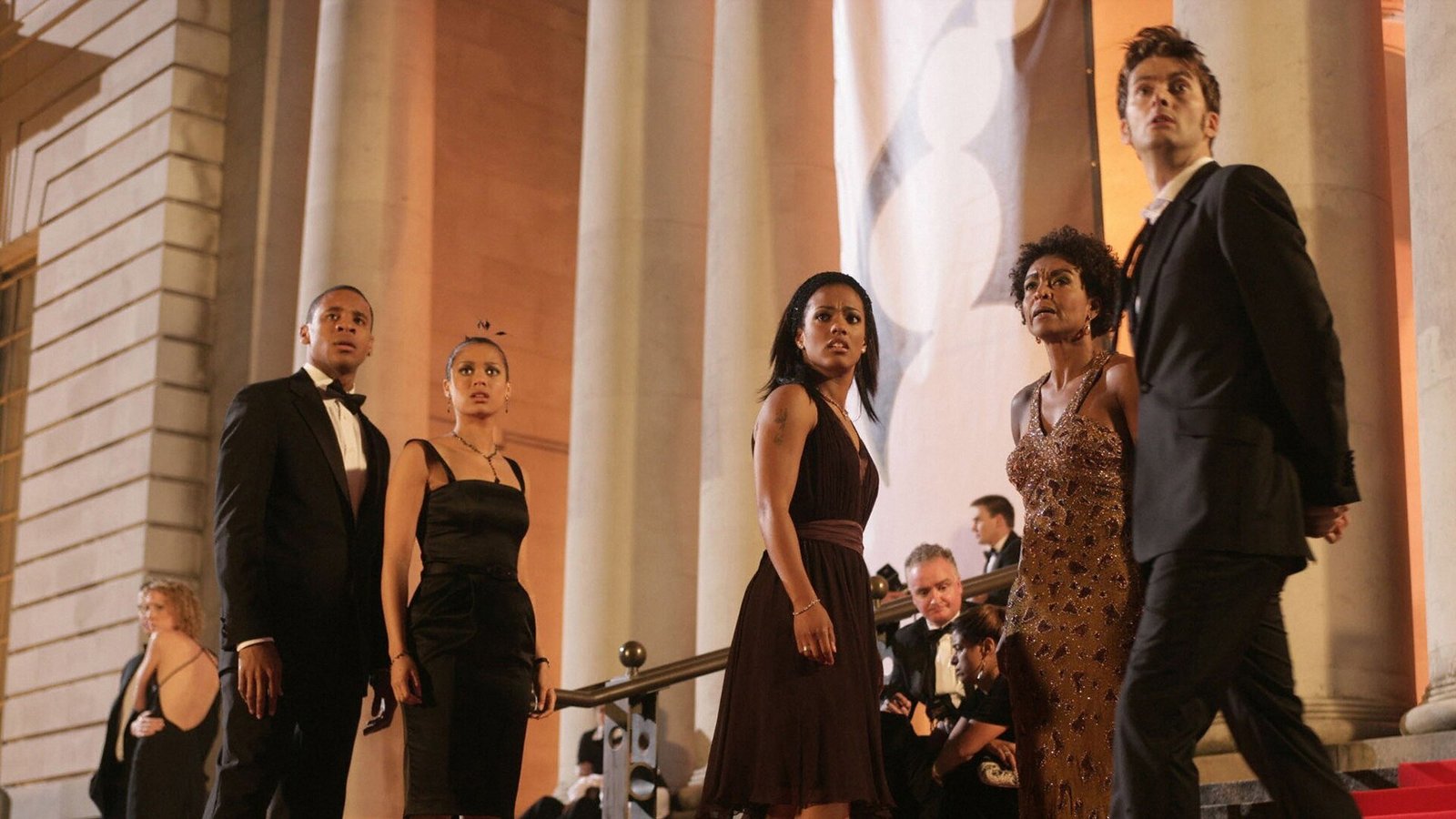
Her sister Tish is working for Professor Richard Lazarus, and he’s unveiling something big at a black-tie do that evening, so the Joneses are all there, Francine already suspicious of this strange man her daughter keeps turning up with and brother Leo tagging along. The domestic bickering gives the episode a nice grounded feel before anything starts eating people. And it’s a smart use of a supporting cast the show’s been quietly building since episode one, so that when things go wrong there are people in the room I actually care about, not just extras in evening wear.
The man who wanted more time
Lazarus himself is the reason to watch, and Gatiss is great in it. He plays him as a silky, vain, very persuasive man of seventy-six who’s built a machine to reverse his own ageing and then steps into it in front of a room full of guests, because of course he does. When he comes out decades younger the room applauds, and it’s a fantastic scene because the triumph is real and the horror hasn’t turned up yet. But the newly young Lazarus has an appetite that’s unsettling straight away. He wants food, he wants attention, he wants a woman on his arm, he’s got his youth back and his first instinct is to consume.
The catch is standard issue but done well enough. The process hasn’t stopped, it’s switched on something dormant in his DNA, and he keeps changing, convulsing and mutating until he’s a scuttling, skeletal thing with a tail that drains the life out of anyone it catches and leaves a husk behind. The design’s decent, though the CGI is doing more than it can comfortably afford and a few of those shots looked rough even on first watch. Guests in evening dress fleeing through the gleaming lab atrium works nicely. What worked best for me was before the monster shows up properly, Lazarus doubling over mid-conversation and trying to hold a charming smile together while his own body turns on him, and Gatiss plays that losing battle beautifully. I was glad the change came in stages rather than all at once, so by the time he’s fully monstrous you’ve watched a man get taken apart by his own success.

Underneath it all is the point the episode’s actually making, and the Doctor makes it well. Lazarus quotes poetry at him and talks grandly about beating death, and the Doctor, who’s watched more people die than anyone alive, isn’t remotely impressed. A longer life isn’t the same as a fuller one, and as he puts it, it’s not the time that matters, it’s the person. Coming from a man who’s been going for over nine hundred years and has buried everybody he ever cared about, that lands, the immortal telling the would-be immortal he’s got the whole thing backwards. It’s also one of the few times this series he’s talked about his own age without ducking into a joke. And I couldn’t help thinking about Martha, who’s spent weeks getting nothing out of him about what he actually is, while here he is telling a stranger the plain truth about what a very long life costs you.
The thing in the cathedral
The chase ends up in Southwark Cathedral, which is a lovely choice, Lazarus dying and monstrous and crawling back to the church where he sheltered as a boy in the Blitz. There’s a flash of the frightened kid inside the creature there, and the episode’s better for that bit of pity. The Doctor’s solution is proper Doctor Who: he gets up to the organ and turns the cathedral’s pipes into a weapon, blasting sound until the resonance knocks the thing off the bell tower, and it dies as the withered old man it was trying so hard to stop being. Tidy on its own terms, and a really atmospheric location, even if it goes a bit routine in the middle getting there.
Martha does well all the way through. She’s the one up that bell tower with the thing, she keeps her head while people are being drained around her, and she and Tish get a decent sisterly thread out of it. It helps that Tish isn’t written as a damsel either, she’s ambitious, a bit starstruck by her charismatic boss and absolutely mortified once she grasps what she’s been working for, which makes the danger feel personal in a way a ballroom full of strangers never would. And at the end Martha plants her feet. She won’t be dropped off again, tells the Doctor she’s not a passenger, and this time he agrees, so she stops being a stand-in and becomes a companion in her own right after six episodes of earning it.
There’s a colder note under the happy ending, though. Francine’s spent the night being wound up about the Doctor by a well-dressed stranger at the party, a man very interested in her daughter’s new friend and full of pointed warnings about how dangerous he is. And the man he works for turns out to be the same one who put money into Lazarus’s work, a Mr Saxon. That name came out of nowhere in The Runaway Bride too, when the army got the order to open fire on the thing over the Thames. Twice is a coincidence, I suppose. I’m starting to think it isn’t one.
Rating: 3/5. It was ok, efficient and well acted and right about what it’s saying, but it drags a bit in the middle and the effects aren’t up to what they’re being asked to do. Gatiss and the Martha stuff lift it above the average episode, and I’d happily watch his first scene in that machine again.

2 comments
[…] her to do while he screams. After being dropped home like a taxi fare a couple of weeks ago in The Lazarus Experiment, she is now unmistakably the person keeping him alive. It’s a straight line from the CPR she […]
[…] Runaway Bride, where the name Saxon first turned up authorising tanks over the Thames, and again in The Lazarus Experiment, where his money was behind the rejuvenation machine and his people were briefing Martha’s mother […]