A review of 42, the seventh episode of Doctor Who’s third series, which plays out in real time as the cargo ship SS Pentallian falls into a living sun. The post covers the countdown format, the door-quiz obstacle, the possessed crew, the Doctor’s own infection and Martha holding things together.
It finds the episode one of the tensest of the season, lifted by Tennant’s frightened Doctor and Martha’s steadiness, while noting a thin supporting crew and that it fades from memory quickly. It also picks up the strangers listening in on Martha’s mum. Rating: 3.5/5.
Here’s a gimmick that could have been unbearable and instead really worked for me: “42” takes place in real time. Forty-two minutes of story, forty-two minutes of episode, a countdown ticking away and a cargo ship falling into a star at the end of it, and I spent most of it sitting forward on the sofa. It’s Doctor Who doing a pressure-cooker thriller, and while it’s not the most memorable hour of the season it’s easily one of the tensest, which I’ll take any week.
Forty-two minutes
The TARDIS answers a distress call and lands aboard the SS Pentallian, a battered working freighter with dead engines, a skeleton crew and a sun filling every window. The heat’s already rising and the hull’s already groaning, and nobody has time to be surprised that a police box has turned up, which I liked, because this crew are far too busy dying to care who these two strangers are. The Pentallian isn’t a gleaming starship either but a grubby industrial hauler full of exposed pipework and sweat stains, with the general air of a place where corners have been cut for years. The crew match it, tired working people in overalls rather than uniformed officers, bickering and underpaid and running a ship that should’ve been serviced a decade ago. So the disaster feels less like bad luck and more like something that was always going to happen eventually. And the TARDIS isn’t a way out either, it’s stuck in a part of the ship that’s got too hot to get back to, so the Doctor and Martha are trapped in it with everyone else, which takes away the usual escape hatch and I liked that a lot.

The countdown drives everything, handheld camera, sweat, red emergency lighting and people shouting over alarms, and there’s no room for the Doctor to stroll about being clever. He arrives, works out what’s going on and starts running, and he doesn’t really stop. My favourite bit is the obstacle in the way. To reach the engines the crew have to get through a long chain of sealed doors, each one opening only to the answer of a trivia question, a security system some long-gone crew member obviously thought was hilarious. So Martha and Riley end up sprinting through a burning ship answering pub-quiz questions about happy primes and whether Elvis or the Beatles had more number ones, which sounds daft on paper and was honestly nerve-shredding to watch.
It’s also where Martha ends up phoning her mum from a spaceship to ask a trivia question, which is very funny and, as it turns out, not entirely harmless. Francine takes the call at home, and somebody is quietly listening in, and I’d love to know who. The episode just leaves it there and goes back to the fire.
Burn with me
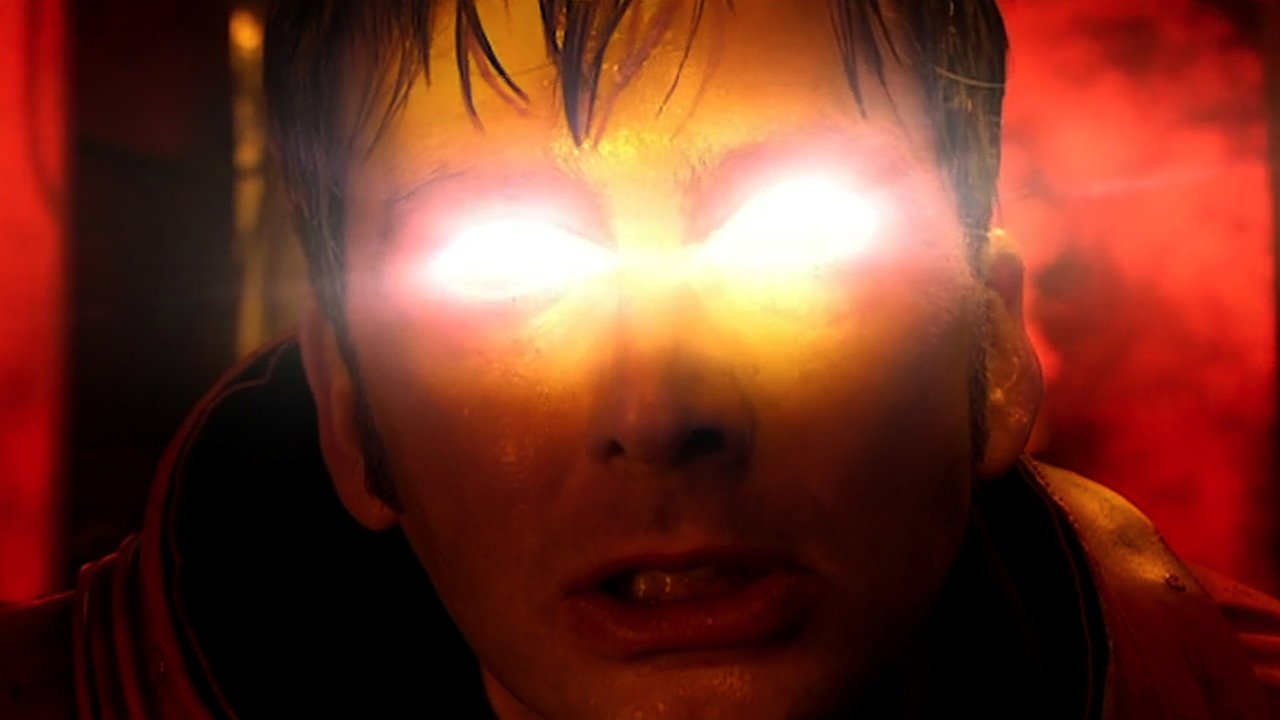
The threat itself is the best idea here. The crew have been scooping fuel straight out of the star on the cheap, without scanning it first, and the star is alive. It’s been alive the whole time and they’ve been mining bits of a living thing to keep their engines running. So it takes them. Possessed crew become walking furnaces, visors down, light pouring out of their eyes, turning anyone they touch to ash and repeating the same horrible line, burn with me, and the show plays it as pure horror. Korwin going first, laid up in the medical bay with his temperature climbing while McDonnell tries to keep her ship in one piece, then turning on his own wife, Ashton stalking the corridors, the sun using human mouths to say it wants its property back.
Then Martha and Riley get jettisoned in an escape pod on a straight course into the star, and the Doctor goes outside to work the magnetic control that drags them back, and that’s where the sun gets into him. What happens next is the bit I’ll remember. Rather than shrugging it off he comes apart, sobbing and terrified, begging Martha to freeze him in a stasis chamber before he kills someone, and Tennant is superb in it. It’s genuinely upsetting, the man who always has an answer reduced to pleading with his friend to make it stop. The show very rarely lets him be this frightened, and if he’s this scared, nobody’s safe.
And it lets Martha be magnificent. She’s the one holding it together, working the controls, doing the thing he’s asked her to do while he screams. After being dropped home like a taxi fare a couple of weeks ago in The Lazarus Experiment, she’s now very clearly the person keeping him alive. It’s a straight line from the CPR she gave a dying stranger back in Smith and Jones, except that time she’d known him for an hour and this time it’s somebody she’s come to care about a good deal too much, and I think the show knows the difference, and so does she.
What it costs
The ending follows its own logic properly. You can’t out-fight a sun, so you give back what you took, the stolen fuel gets vented back into the star, and the price is paid by Captain McDonnell, who walks her possessed husband out of an airlock and goes with him. Grim, and dignified, for a character the episode’s been quietly building up as the one responsible, because she cut the corners and she settles the bill herself. There’s a nice uncomfortable environmental point under all of it too, a crew strip-mining something living because it was cheap and convenient and insisting they didn’t know, when not knowing was the choice they made. It doesn’t hammer it home and I was glad of that.
The shape of the thing owes an obvious debt to the base-under-siege stories the series does so well, and the isolation and dwindling crew of The Impossible Planet are all over it, the Doctor again stuck with something far older and bigger than him that’s using people as a mouthpiece. But where that two-parter was slow creeping dread, this is forty-two minutes of continuous panic, different flavours of the same poison really. The crew here are thin, too, apart from McDonnell I couldn’t tell you much about any of them, which is the price of never stopping for breath.
Then the Doctor gives Martha a key to the TARDIS. After all the “one trip” hedging that’s the real promotion, not a speech, just a key pressed into her hand, and I was properly pleased for her. And then she phones her mum again, and Francine is sitting in her front room with strangers listening to every word, and the smile drops off the episode entirely.
Rating: 3.5/5. I really enjoyed it while it was on, relentless and anchored by a superb Tennant, even if the supporting crew are thin and it’s faded from my memory faster than it should have in the week or so since. That stasis chamber scene hasn’t, though.

1 comment
[…] sitting in her own front room with strangers listening in on her daughter’s phone calls back in 42. Here she finally understands exactly what she has been helping, and it’s far too late. Watching […]