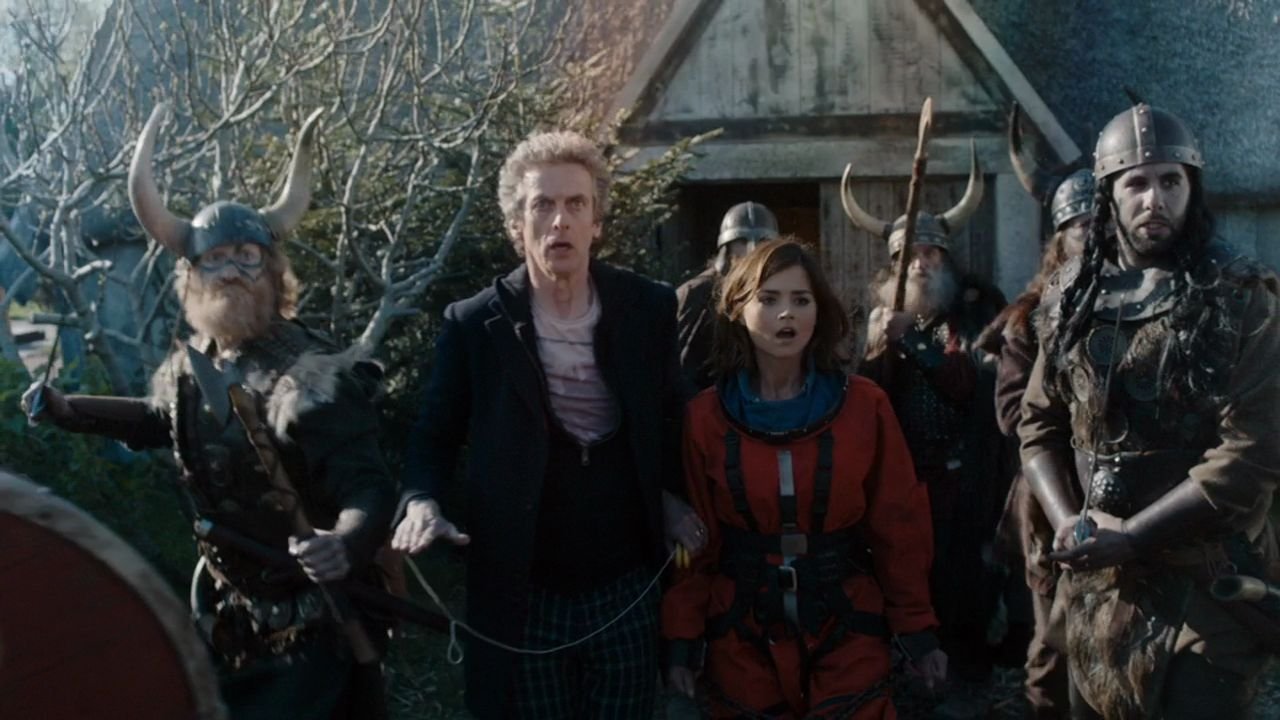
Season 9 of Doctor Who gave us some of Peter Capaldi’s absolute best moments as the Twelfth Doctor. Coming hot off the heels of the incredibly tense, claustrophobic brilliance of Under the Lake, we crashed right into “The Girl Who Died”—and with it, one of the most tragic character arcs of the Moffat era: Ashildr (played brilliantly by Maisie Williams).
But her story leaves a massive, lingering question for fans: after saving her life and rendering her immortal, why did the Doctor refuse to let her travel with him in the TARDIS?
The show never spells it out with a convenient exposition dump, but if we dig into the established lore, the answer is hiding in plain sight. It all comes back to a handsome, flirtatious Time Agent from the Russell T. Davies era.
The Captain Jack Precedent
To understand Ashildr, we have to look at Captain Jack Harkness. At the end of Season 1, Rose Tyler absorbed the Time Vortex and resurrected Jack, accidentally making him immortal. And what did the Ninth Doctor do? He ran away, leaving Jack stranded on Satellite 5.
It wasn’t until the Tenth Doctor’s era that we finally got an explanation for the abandonment. When Jack confronted the Doctor about being left behind, the Time Lord’s response was visceral:
“I can’t help it. I’m a Time Lord. It’s instinct; it’s in my guts. You’re a fixed point in time and space; you’re a fact. That’s never meant to happen. Even the TARDIS reacted against you, tried to shake you off. Flew all the way to the end of the universe just to get rid of you.”

This is the fundamental rule of Time Lord biology and TARDIS mechanics: they are physically repulsed by unnatural immortality. Jack was a walking paradox. His very existence was an anomaly that threatened the fabric of space and time, and the TARDIS—a sentient, hyper-dimensional machine—flat-out refused to tolerate him.
A Mirror to His Own Arrogance
Ashildr is cut from the exact same paradoxical cloth, with one heartbreaking difference: the Doctor did this to her himself.
Unlike Jack, whose immortality was a cosmic accident caused by Rose, Ashildr’s eternal life was the direct result of the Doctor’s own grief and hubris. She was supposed to die. By jamming a Mire medical chip into her head, the Doctor rewrote a fixed event. He turned a young Viking girl into a permanent, unkillable fixture of the universe.
If the TARDIS couldn’t stomach Jack, it certainly wasn’t going to tolerate Ashildr. But on a deeper, psychological level, the Doctor couldn’t stomach her either. Having her in the TARDIS would mean staring at his own worst mistake every single day. She is the ultimate reminder of what happens when Time Lords push too far and break the rules of the universe just because they can.
The Diner TARDIS Loophole
Of course, this is Doctor Who, a show built on wibbly-wobbly exceptions to the rules. If Ashildr is a paradox that a TARDIS will instinctively reject, how on earth do we explain the finale of Season 9?
At the climax of Hell Bent, we see Ashildr flying away to explore the universe with Clara Oswald in a stolen TARDIS disguised as a 1950s American diner. How does that work?
There are a few ways to justify it. First, the Diner TARDIS is a completely different (and likely older) model than the Doctor’s Type 40, meaning its safety protocols or sentient aversions might not be the same. Second, a TARDIS’s personality is deeply linked to its pilot. The Doctor’s TARDIS shares his Time Lord instincts; Clara’s stolen TARDIS might not.
But the most compelling explanation? Clara is a paradox, too.
At that point in the story, Clara has been extracted from the exact moment of her death. She has no pulse, she doesn’t age, and she is frozen between heartbeats. The Diner TARDIS isn’t just carrying one immortal anomaly; it’s carrying two. It is essentially a ghost ship piloted by the dead, operating entirely outside the normal laws of time. A TARDIS full of paradoxes might just cancel itself out.
Ultimately, the Doctor left Ashildr behind because he had to. She wasn’t a companion; she was a consequence. And as much as the Doctor loves running, he knows you can never outrun a fixed point in time.
