Every so often Doctor Who does a horror episode with no ambition beyond being frightening for forty-five minutes, and those are often the ones that stick. “Knock Knock” is a haunted-house story assembled from entirely familiar parts, the too-cheap rent and the locked tower and the landlord who appears at the window and the housemates picked off one by one, and it works because it commits to the atmosphere completely and because it has David Suchet doing something genuinely strange in the middle of it. It’s also, quietly, the most relatable premise the show has attempted in years: six students trying to find somewhere to live.
The rent
The opening act is the best part, and it’s almost entirely about property. Bill and five friends are being shown around flats that are damp, tiny and unaffordable, and are on the verge of giving up when a man appears and offers them an enormous, beautiful, wood-panelled house for a rent that makes no sense. There’s a tower they can’t use. There are no mobile signals. The windows shut on their own. They take it, obviously. Everybody takes it. The episode is very funny about the fact that the only genuinely implausible element in a story about alien woodlice is that six students could find anywhere at all. The horror grammar is well handled from there. Mike Bartlett’s script understands that a haunted house works on sound: the creaking, the tapping in the walls, doors that are closed when they were open. Bill Anderson shoots it with a lot of held frames and very little music, and the sequence where a housemate is absorbed into a wall, the wood simply closing over her while she’s mid-sentence, is genuinely nasty.
The housemates are better sketched than this kind of episode usually manages. They’re not victims queued up for the woodwork, they’re six people who’ve just agreed to live together and are still working out the etiquette of it, which the script gets right in small ways: the one who’s already annoying everyone with his music, the two circling a romance, the negotiation about who gets the good room. Shireen in particular is written as a real friend rather than a plot function, and the early scenes of them hauling boxes and bickering do the job that makes the later deaths land at all. There’s also a nice piece of restraint in how the house itself is introduced. The episode declines the obvious move of making it visibly sinister, with no cobwebs and no thunder and no ominous score. It’s simply a very fine old house in good repair, which is far more effective, because everything that’s wrong with it is a thing the tenants talk themselves out of noticing. The shutters that close on their own get explained away. The missing phone signal gets shrugged at. Horror by rationalisation is a genuinely good mode for a story about people who cannot afford to be picky.
The Doctor as an embarrassment
The best running joke is the Doctor’s presence. He helps Bill move in, refuses to leave, and installs himself in the house as an unexplained older man who won’t say what his relationship to her is. Bill is mortified throughout, and the episode gets a lot out of it, because he introduces himself as her grandfather, then denies it, then starts investigating the plumbing. Capaldi plays him as someone who has decided this is a laugh and is enjoying it enormously, and Pearl Mackie plays the specific social agony of your weird friend embarrassing you in front of new housemates. It’s a real character beat as well as a gag. He isn’t there because of a distress signal. He’s there because he’s bored of being parked at the university guarding a vault, and because he’s found somebody he likes and has invented a reason to stay.

The episode is quietly important for the two of them, in fact, because it’s the one where the boundary breaks. Everything up to now has been trips, whether to a colony world or to the frozen Thames in Thin Ice: he collects her, they go somewhere, he returns her. Here he turns up in her actual life, uninvited, and installs himself in her house among her friends, and she has to decide how to explain him. Her eventual answer, that he’s just someone she knows, is both a dodge and a promotion, because by the end of the episode he’s a fixture rather than a destination. That shift is what makes the season’s later losses land, and it happens here, in a scene about carrying boxes upstairs.
Dryads, and a daughter
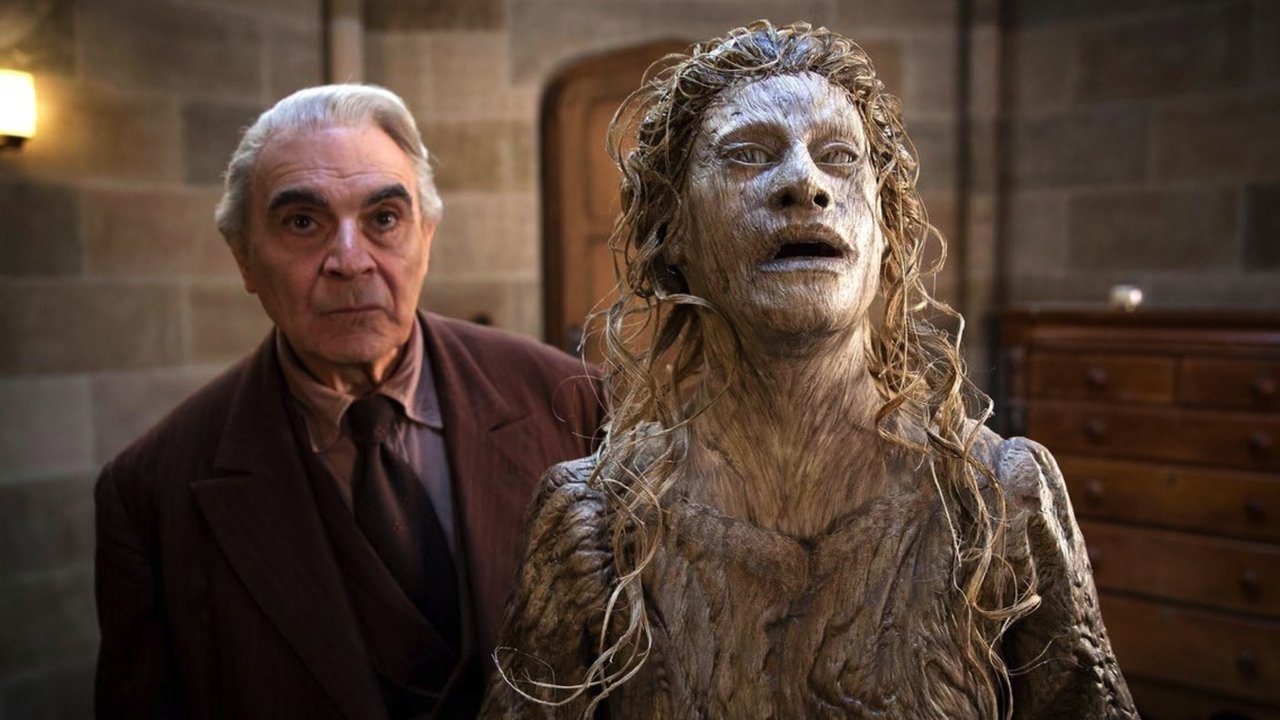
The mechanism is decent: alien insects living in the woodwork, swarming, capable of dissolving a person into the structure of the house or of holding a body together indefinitely. The Landlord has been feeding tenants to them for decades. Every twenty years he fills the house, waits, and lets the woodwork take them, because the dryads keep his daughter Eliza alive, a woman made of polished wood sitting in a tower room, preserved somewhere between life and death. David Suchet, best known to most of the audience for thirteen series of Poirot, is superb, and the performance is the reason the episode holds. He plays the Landlord not as a monster but as a man performing a duty he stopped questioning a very long time ago, courteous and slightly nervous and apologetic in manner even while doing something monstrous. There’s a wonderful small moment where he tunes his tuning fork and listens to the house the way you’d check on a sleeping child.
The twist is that Eliza isn’t his daughter. She’s his mother, preserved since he was a boy, and he has spent his whole life as a child bringing food to a parent who stopped being able to say no to it. That’s a genuinely good reversal and it changes the meaning of all that courtesy, because he’s been obeying a mother rather than protecting a daughter. Where the episode wobbles is in the mechanics. Exactly what Eliza is, how much she knew, and why the dryads cooperate at all are left vague in a way that feels unfinished rather than mysterious. The ending, with Eliza choosing to let go, taking her son with her, and releasing the absorbed tenants, is emotionally right and logically hazy. If the dryads could simply restore everyone, a lot of the preceding horror deflates.
Rating: 3.5/5. Effective, atmospheric and unusually well acted for a monster-of-the-week, with a guest performance that elevates the whole thing and a first act that’s genuinely funny about the housing market. The internal logic of the dryads doesn’t survive much scrutiny and the restoration ending undercuts the deaths, but as a piece of straightforward Saturday-night horror it does exactly what it sets out to do. The rent was too low, the tower was locked, and the man at the door was only ever doing what his mother told him.
