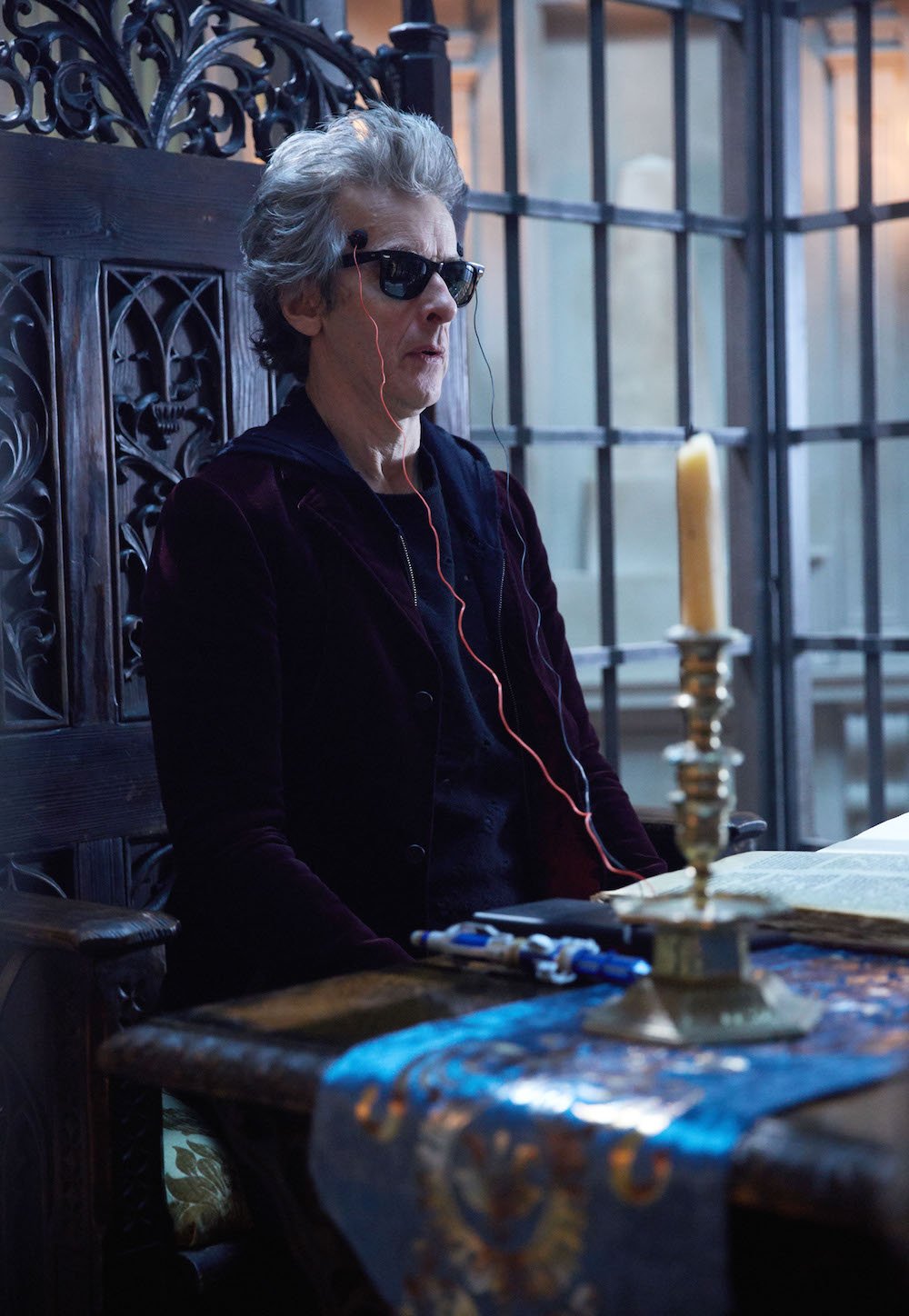
The best hook of the season, and possibly of the era: there is a text in the Vatican’s forbidden library, translated from an unknown original, and everyone who reads it kills themselves. Not out of horror. Not because it curses them. Because once you have read it, you understand something, and once you understand it there is no reason to carry on. “Extremis” is Steven Moffat doing what he is genuinely best at, a puzzle box with a horrible answer at the bottom, and it is the smartest forty-five minutes Doctor Who has produced in a long time. It plays as a dry run for something very big and very nasty, which is exactly what it is, and it’s still the most interesting thing in the season by a distance.
The Haereticum
The atmosphere is superb from the first scene. Cardinals arrive at a university to consult a blind Doctor about a heresy, the Vatican’s secret library turns out to be a vast underground labyrinth called the Haereticum, and there are candles and stone and a room where the previous readers’ bodies are still sitting. The horror is intellectual rather than physical, and the episode trusts that completely. There’s no creature stalking the corridors for the first two acts, just a document and a growing pile of people who read it and then calmly went off to end themselves. When the Doctor finds a laptop with the file open and a line of code running, the dread is entirely about what the file says.

The Monks are a strong design when they finally appear. They’re corpse-like, with desiccated faces and sunken features, robed in red, and they move with an unhurried, processional gait that belongs to clergy rather than predators. Putting them in a story set largely in the Vatican is a deliberate provocation, and the episode gets real mileage out of the visual rhyme between the two sets of robed figures walking the same corridors. They’re one of the better new creatures of the modern era, and the episode is disciplined about how little it shows them.
The shadow test
The answer is the thing. This is a simulation. The Vatican, the Pentagon, CERN, the Doctor, Bill and Nardole are all a projection being run by the Monks as a rehearsal, a way of modelling humanity in enough detail to plan a flawless invasion of the real Earth. The Veritas is the document in which somebody inside the simulation worked out what they were, and the reason readers kill themselves is that discovering you are a subroutine is not survivable news. The test for it is beautiful in its simplicity: ask a room of people to each say a random number. Real people produce noise. Simulated people all say the same number, because the same routine generates them all. It’s the sort of detail that makes a high concept land, cheap to shoot, instantly comprehensible, and completely chilling.
The scenes where it dawns on them are the best acting in the season. Nardole crumbling to dust mid-sentence. Bill working out what she is and having about eight seconds to feel it. And a simulated Doctor, a copy running on borrowed processing, sitting in a room understanding that he is not the man he thought he was and that nothing he does tonight can matter. Except it does, and that’s the moment the episode earns its reputation. He points out that a simulation good enough to model the Doctor is good enough to produce something that behaves like him, and so he does the thing the real one would do, emailing the whole file out of the simulation to his own real self as a warning. Capaldi plays it with enormous, quiet dignity: a fake man deciding that being a copy of somebody decent is a sufficient reason to act decently. It’s the best thing the Twelfth Doctor has ever been given, and the whole hour is an experiment that pays off.

The CERN sequence is the episode’s best single scene and the one that sells the premise. The Doctor arrives to find the physicists having a party, drinking and laughing and saying goodbye to each other, because they’ve read the Veritas, run the numbers themselves, confirmed it, and decided to go out together rather than one at a time. One of them explains it while handing round drinks, entirely calm. They’ve rigged the building to explode. They ask him, politely, to leave first. It’s a wonderfully unsettling piece of writing because nobody in it is hysterical. These are people who checked the working, agreed with it, and are now doing the only thing that makes sense to them, cheerfully. Terror would have been less frightening. The episode is cut nonlinearly too, interleaving the simulation with the Missy flashbacks, and the two strands are shot very differently, the Vatican material dim and candlelit against execution scenes that are flat and bright. It’s disorienting on first viewing in a way that turns out to be entirely deliberate, since one of those strands is the only one that actually happened.
The vault, and what it costs
Running underneath is the season’s other mystery, finally opened. The flashbacks answer what’s in the vault the Doctor has been guarding at the university. He was hired as an executioner, apparently a professional service, for a body that needed someone who could be trusted to do it properly, and the condemned was Missy. He didn’t kill her. He faked it, locked her in a quantum-fold chamber, and swore an oath to guard her body for a thousand years. Michelle Gomez is very good in a small amount of screen time, and the material changes what Nardole has been doing entirely: he isn’t a comic sidekick, he’s an enforcement mechanism, left behind by River with instructions to make the Doctor keep his word. It’s a lot of plot to carry alongside a simulation story, and the episode juggles it well, mostly because both strands are about the same thing, which is a man being bound by promises he made to people who aren’t around to hold him to them.
The one criticism worth making is about shape. This is the first act of a three-part story, and everything genuinely great about it is self-contained. The simulation, the Veritas and the shadow test don’t carry forward in any meaningful way. What carries forward is the Monks’ plan, which is much more ordinary than the episode that introduces it. There’s a version of this where “Extremis” is a standalone masterpiece rather than a prologue, and I suspect it would be better remembered for it.
What it leaves behind is a text you can’t survive reading, not cursed but simply true, where the truth removes the point of continuing. It leaves the Haereticum, the Vatican’s forbidden library as a stone labyrinth full of the people who got there first. It leaves the random number test, cheap and elegant and horrifying. It leaves a copy who behaves like the original, since the Doctor we follow isn’t real, works it out, and does the right thing anyway. And it leaves Missy in the vault, alive because he was hired to execute her and didn’t, with Nardole quietly enforcing the thousand-year oath he swore instead.
Rating: 4.5/5. Ingenious, frightening and unusually philosophical, with a central idea executed with total confidence and a performance from Capaldi that carries the whole thing. It loses half a mark only because its brilliance is largely disposable, since this is a prologue to a much more conventional story and almost nothing about the simulation matters afterwards. Everyone who read it worked out what they were, and stopped. He worked it out, and sent an email.

2 comments
[…] at the midpoint and a resolution that substitutes sentiment for a solution. After the ingenuity of Extremis and the tension of the pyramid, this is a distinct step down, but the imagery of the occupation is […]
[…] to him. The Monks’ method is worth dwelling on too, because it explains the simulation from Extremis. They don’t predict the future so much as rehearse it: run the model, watch how it fails, adjust, […]