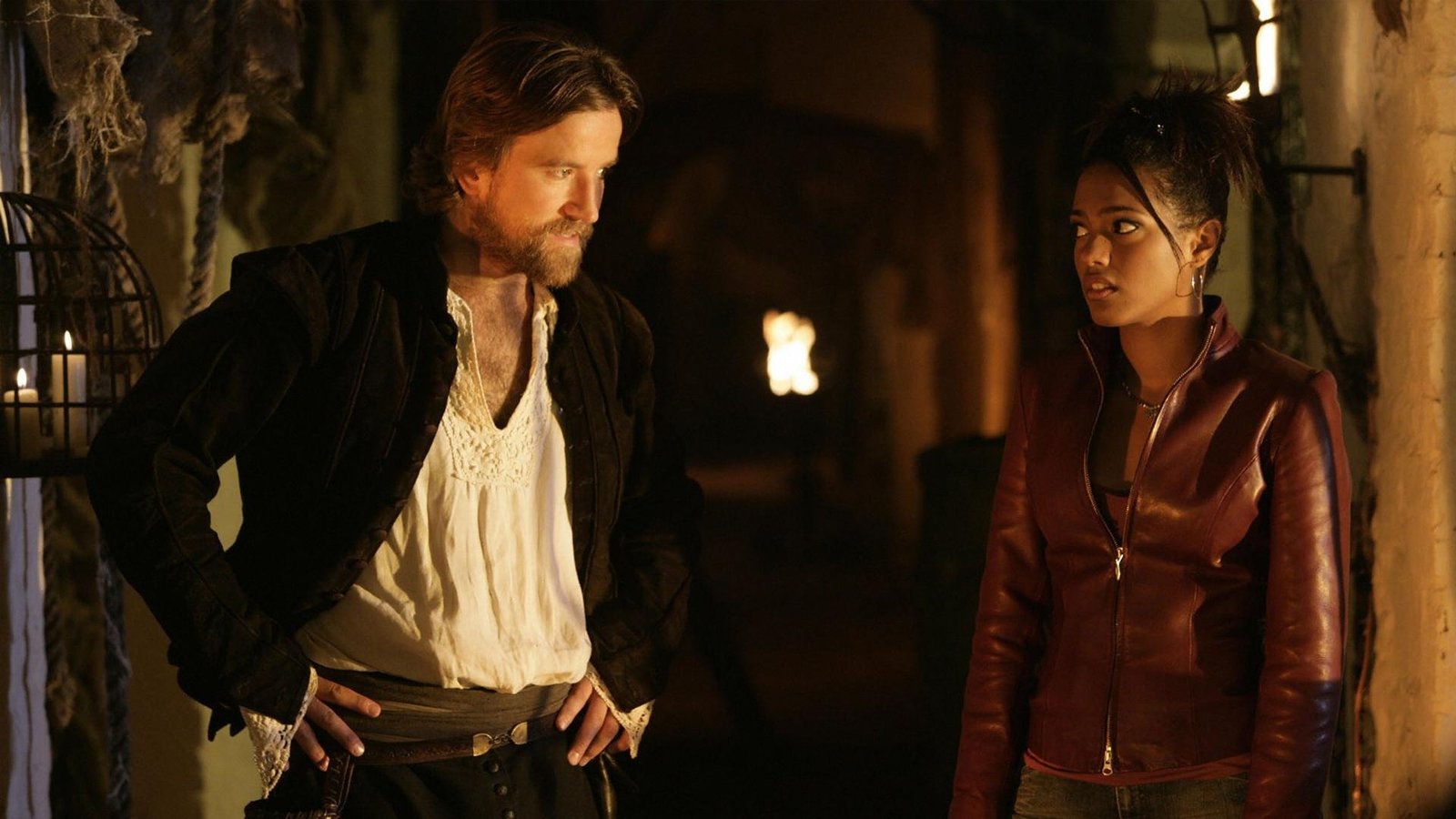
The Shakespeare Code is the second episode of Doctor Who series three, sending the Tenth Doctor and new companion Martha Jones to Elizabethan London in 1599. There they cross paths with William Shakespeare and the Carrionites, an exiled alien species whose power is built entirely out of language rather than machinery, as the witches manipulate the grieving playwright into writing an incantation disguised as a lost play.
The review covers Shakespeare’s characterisation as the sharpest person in the story, the episode’s handling of Martha’s safety and her unspoken feelings for the Doctor, and a climax built around the power of words as both weapon and cure. It lands at 3.5 out of 5, praised as a hugely likeable, briskly told romp let down only slightly by its Harry Potter punchline and a loose middle stretch.
“One trip” lasted precisely one episode, which surprised nobody. Fresh from the Moon in Smith and Jones, Martha gets her promised single journey and the Doctor takes her to Elizabethan London, where they promptly run into three witches, a lost Shakespeare play, and an alien species whose entire science is built out of words. “The Shakespeare Code” is a big, gaudy, thoroughly enjoyable historical romp with one genuinely lovely idea at its centre, and it’s the episode where Martha starts to work out what she’s actually signed up for.
One trip, and a playwright
The TARDIS lands in 1599, and to the episode’s credit it doesn’t pretend the past is a theme park. Martha’s first question is a good one and a pointed one: as a black woman walking around Elizabethan London, is she safe? The Doctor’s answer, which amounts to walk about like you own the place because it always works for him, is breezy to the point of glib, and the show is at least self-aware enough to let her raise it rather than ignoring the question entirely. It’s a small moment, but it’s the kind of thing the series hasn’t always bothered with. Then it’s off to the Globe, and to Shakespeare himself, who is played as an absolute rock star: swaggering, filthy, quick-witted, and openly delighted by both of his new admirers. Dean Lennox Kelly is tremendous fun in the role, and the choice to make Shakespeare a charismatic show-off rather than a marble bust is exactly right. He clocks Martha immediately, christens her his Dark Lady, and flirts with roughly everyone in the building.
He’s also, crucially, the sharpest person in the episode. Shakespeare is the one who sees straight through the Doctor’s cheerful patter to the grief sitting underneath it, the lost girl the Doctor won’t talk about, and he spots Martha’s feelings for him just as fast. Having the greatest observer of human nature in history be the character who reads our leads properly is a neat trick, and it gives a romp some unexpected weight. The Doctor is still carrying that beach in Norway around with him, the goodbye that closed out Doomsday and the sentence he never got to finish, and it takes a poet to say so out loud. Martha, meanwhile, has to stand there and listen to him talk around another woman, which is its own particular kind of awful.
The power of words
The Carrionites are a great creation: three witch-like crones, ancient and exiled, whose technology isn’t machinery at all but language. Where the rest of the universe built its science on numbers, they built theirs on words, the right syllables in the right shape, and reality does what it’s told. It’s a proper Doctor Who idea, the kind that turns a fairy-tale image into science fiction without draining the magic out of it, and it gives the episode a lovely internal logic. Naming a thing gives you power over it. Get the words right and you can crack the world open. Their plan is elegantly literary. Banished long ago, they need an incantation powerful enough to tear open the way back for their species, and the finest arrangement of words on the planet belongs to a grieving playwright. Shakespeare lost his son Hamnet, and that wound left him open to their influence, and under it he has written a sequel nobody has ever seen. Love’s Labour’s Won is a real lost play, or at least a real entry in a 1598 list of Shakespeare’s works that nobody has ever matched to a surviving text, which is exactly the sort of hole in history this show ought to be filling.

The Globe itself is part of the machine: built to fourteen sides on a design its architect, Peter Streete, was quietly fed by the witches, a shape engineered to amplify whatever is spoken inside it. Streete paid for that with his mind, and the trip to see him raving in Bedlam is the episode at its darkest. That sequence is worth singling out. The show doesn’t soften what an Elizabethan madhouse actually was, a paying attraction with visitors buying their way in to gawp at the inmates, and the Doctor’s flat disgust at the casual cruelty of it gives the hour a jolt of something real in among the frolics. It’s also the point where the Carrionites stop being pantomime cackling and turn genuinely frightening, when Mother Doomfinger stops a man’s heart with nothing but a touch and a rhyme. It all builds nicely to opening night, with the play about to be performed, the audience packed in, and the last lines of the manuscript waiting to be read aloud to a full house. It’s a properly theatrical climax for a properly theatrical episode: the villains’ doomsday device is a first night, and the countdown is an actor working his way toward the final page of the script.
Expelliarmus
The resolution follows the episode’s own rules, which is the best thing about it. If words are the weapon, then words are also the answer. Shakespeare stands on his own stage and improvises a counter-spell live, groping for the right rhythm while the sky tears open above him, and it’s Martha who supplies the last word, borrowed from rather more recent literature. “Expelliarmus!” Your enjoyment of that gag will vary. I laughed, and the Doctor’s delighted “good old JK” pushed it a shade further than it needed to go. It’s a very 2007 joke and it will date like milk. But it’s sound on the episode’s own terms, because the point is that the right word from anyone can do the job, and it matters that the killing blow comes from Martha rather than the Doctor. The Carrionites and every copy of the play get sucked into a crystal ball, and a lost masterpiece is lost all over again.
Then the coda, which is a gift. Queen Elizabeth I sweeps in, takes one look at the Doctor, denounces him as her sworn enemy and orders his head removed. He has absolutely no idea why. Neither do we. He hasn’t done it yet, whatever it was, and the pair of them leg it for the TARDIS with the guards in pursuit. It’s a delightful bit of nonsense, and I note this is now twice a queen of England has taken violent exception to him, after Victoria threw him out of the Empire in Tooth and Claw. He does have a knack for it.
Martha is brilliant here, useful, and the one who lands the winning blow, and the Doctor still talks about someone else the whole time. The show is honest enough to let that sit there uncomfortably instead of smoothing it over, which is more than most of these episodes bother to do.
Rating: 3.5/5. Hugely likeable and briskly told, with a terrific central idea and a scene-stealing Shakespeare, though the Harry Potter punchline and a slightly shapeless middle stop it short of the top rank. Good, silly, clever fun. Witches at the Globe, a lost masterpiece wiped back out of history, and a Time Lord legging it from Good Queen Bess with the guards at his heels. Whatever “one trip” was supposed to mean, I think we can safely say it went out of the window somewhere around the second act.

3 comments
[…] how straight it’s played. Gareth Roberts, who did much the same trick with Elizabethan London in The Shakespeare Code, clearly loves this stuff, and the episode is packed with the specific furniture of the genre: the […]
[…] hasn’t done a properly sunlit historical since it handed Shakespeare a very strange Tuesday in The Shakespeare Code, and the change of palette does the season good after weeks of dark corridors and crashed hulls. It […]
[…] about her being a Black woman in 1930s New York, handled with rather more directness than The Shakespeare Code managed in Elizabethan London. Solomon takes her seriously the moment they meet, the world beyond […]