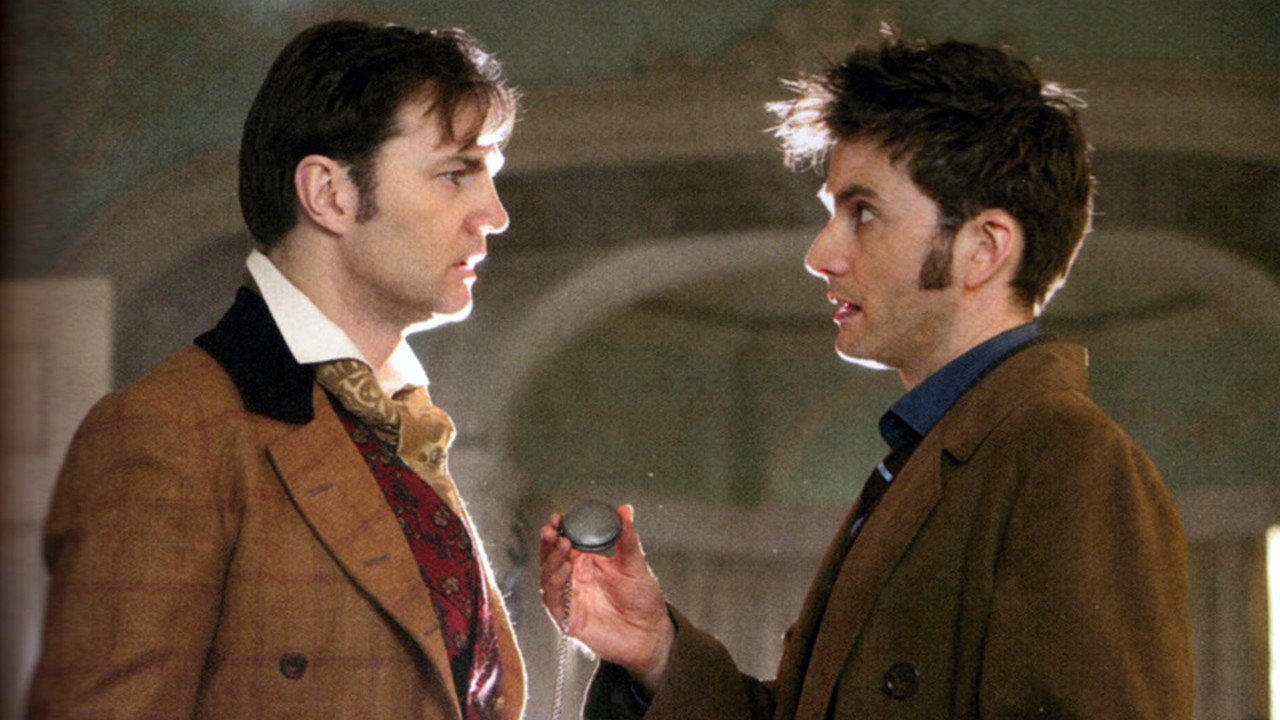
“The Next Doctor” is the 2008 Doctor Who Christmas special, set in Victorian London in 1851. The Doctor meets a man calling himself the Doctor, who turns out to be Jackson Lake, a grieving father whose mind was overwritten by a Cyberman infostamp, while the Cybermen and Miss Hartigan plot to raise a giant CyberKing.
The post praises the first half’s character work, David Morrissey’s performance and the dinner ending, but finds the CyberKing finale daft and out of tone with the rest. It rates the special 3/5.
The Doctor is alone. That’s the fact this special is built on, and it’s why it works as well as it does, for the first half at least. “The Next Doctor” opens with the best hook the show has dangled in years, spends forty minutes doing something genuinely tender with it, and then a building-sized robot stamps through Victorian London and the whole thing goes a bit peculiar. Half a great Christmas special, and the good half is very good indeed.
Another Man in a Long Coat
London, Christmas Eve, 1851. The Doctor steps out into the snow and hears somebody shouting for help, and the man who comes charging round the corner in a frock coat, brandishing a sonic screwdriver and trailed by a fierce and capable companion, introduces himself as the Doctor.
It’s a lovely premise, and the episode plays it with real mischief. This other Doctor has a sonic (an actual screwdriver, sonic-ed), a companion called Rosita, an alarming amount of confidence, and a TARDIS, which turns out to be a hot air balloon standing for Tethered Aerial Release Developed In Style. He also has no idea who this thin, bewildered stranger in the pinstripes is.
Rosita deserves a mention as well. She’s sharp, thoroughly unimpressed, and does a good deal of the actual rescuing, and there’s a nicely pointed moment where she asks flatly why she’s expected to trot along behind a man having an identity crisis. For a few seconds the special notices that the companion role looks rather different viewed from the outside, and then, sadly, it moves on.
David Morrissey is terrific, playing it absolutely straight: brave, theatrical, slightly overcompensating, exactly like a man doing an impression of someone he admires. And the Tenth Doctor’s reaction is where the episode finds its heart. He assumes he’s met a future regeneration, and instead of being alarmed he’s delighted, a bit wistful, a bit relieved, quietly reassured that he goes on. Which, given that two separate people have now told him his song is ending, is a rather poignant thing to watch him cling to.
The truth is much sadder, and it’s the best thing in the special. The other Doctor is Jackson Lake, a mathematics teacher. The Cybermen killed his wife in front of him and took his son, and in the chaos he was hit by an “infostamp”, a Cyberman data cartridge loaded with the complete history of the Doctor. It poured every one of the Doctor’s adventures into a grieving man’s head, and his mind, unable to survive what had just happened to him, took the escape it was offered. He became the Doctor because he couldn’t bear to be Jackson Lake.
That’s a genuinely beautiful idea. Not a villain, not a trick, just a man in unbearable pain who reached for the nearest story about someone who never gives up and climbed inside it. The scene where the memories come back and Morrissey has to be Jackson again, watching his wife die a second time, is superbly played and the emotional peak of the hour.
What makes it sting is the detail of how thoroughly he built the thing. The screwdriver, the coat, the balloon with its carefully worked-out acronym, even the companion — he assembled an entire functioning version of a man he’d only ever encountered as data poured into his skull, right down to the swagger. And the swagger is the giveaway. The real Doctor never needs to announce himself; Jackson does it constantly, because he’s holding the whole costume together with sheer volume.
It also lands hard because of where the Doctor is. He’s been travelling alone since he wiped Donna Noble’s memory and left her on her mother’s doorstep at the end of Journey’s End, and he is not coping. It’s the second Christmas in a row he’s ended up wandering on his own, after Voyage of the Damned, and meeting a man who invented a version of him to survive grief is not a comfortable mirror.

Cybermen, Again
The plot around all this is the weakest part. The Cybermen have fallen through the Void into the nineteenth century, the same escape route that closed behind them at Canary Wharf in Doomsday — and they’ve allied with Miss Hartigan (Random Remarks has a plain blow-by-blow if you lost track of who’s who), who runs a workhouse and has been supplying them with stolen children as labour.
These are the Cybus models we watched being stamped out in a Battersea factory in The Age of Steel, which gives them an oddly poignant status here: refugees from a dead parallel world, stranded in the wrong century with no factory, no fleet and no way home, improvising an invasion out of whatever the nineteenth century happens to have lying around. That’s a genuinely interesting premise, and it’s a shame the special doesn’t do a great deal with it beyond using it to explain why they’re short-handed.
Miss Hartigan is a decent villain, and Dervla Kirwan gives her real venom: a woman treated as furniture by every man in Victorian London, who takes the Cybermen’s offer because it’s the first power anyone has ever handed her. Her contempt for the men on the workhouse board is the sharpest writing in the second half.
Then the Cybermen make her the CyberKing, and the CyberKing turns out to be a several-hundred-foot Cyberman-shaped war machine that rises out of the Thames and stomps through Victorian London while people flee in the streets.
It is, and I say this fondly, absolutely daft, the sort of thing I’d have loved at eleven and rolled my eyes at a bit now. The scale is ludicrous, it obliterates any sense that this is a story happening in real history — you cannot hide a skyscraper-sized robot walking through 1851, and it drags a delicate character piece into a monster movie for its last fifteen minutes. The resolution, with the Doctor in the balloon and an infostamp overload, is fine. It just belongs to a different, sillier episode than the one I’d been enjoying.
Dinner
The ending pulls it back. Jackson Lake gets his son back, alive, and the two men stand in the snow having both survived something. And then Jackson invites the Doctor to Christmas dinner.
The Doctor always says no to this. And here, finally, he says yes, because a man he barely knows worked out that the loneliest thing about him is that nobody ever asks. It’s a small, warm, well-judged ending, and it does more for the character than the entire CyberKing sequence.
Rating: 3/5. The first half is among the best character work the show has done at Christmas, and the second half is a giant robot fight. Averages out to a special that’s well worth watching and slightly frustrating to think about.

1 comment
[…] isn’t going to risk doing that to somebody else. It’s the same wound that ran through The Next Doctor at Christmas, and he’s no closer to dealing with it. Go back to Voyage of the Damned and you […]